

Yes, you can often build an accessory dwelling unit in a Very High Fire Hazard Severity Zone in Los Angeles. State-exempt ADU pathways generally override the City’s blanket VHFHSZ restrictions, but your project still has to clear site-specific gates: road access width, parking rules, and objective fire-safety standards. Those three factors, not the VHFHSZ label itself, decide whether your permit moves forward.
TL;DR:
- State exempt options include conversions, detached units up to 800 square feet with four foot setbacks, and junior units capped at 500 square feet.
- Fire reviewers often assess whether roads approach 24 feet wide and corner or through lots offer 20 feet of unobstructed frontage for apparatus.
- A hazard zone ADU generally needs one parking space, but transit within a half mile by walkable route can remove that requirement.
- The City cannot require ADU sprinklers if the primary home was not required to have them, but fire hardening and ember resistant vents remain expected.
What VHFHSZ Designation Means and How State Law Limits Local Restrictions
A Very High Fire Hazard Severity Zone is a map designation that Los Angeles uses to flag lots at elevated wildfire risk, usually in hillside or brush-adjacent areas. The City historically responded by restricting or outright prohibiting ADUs on VHFHSZ parcels, treating the zone as a reason to say no before looking at the specific lot.
The LAMC 12.22 A.33 ADU ordinance still contains that VHFHSZ and Hillside Area language, and it lists the development standards that apply to ordinance ADUs. But the ordinance also incorporates state ADU law by reference, and state law takes priority when the two conflict. ZA Memo 143 spells this out directly: state-exempt ADU types cannot be blocked by the City’s VHFHSZ restriction, even though the restriction remains on the books for other project types. ZA Memo 142, issued to implement SB 897 and AB 2221, tells plan-checkers to read the City’s ordinance in a way that stays compatible with state law rather than enforce it literally where the two diverge.
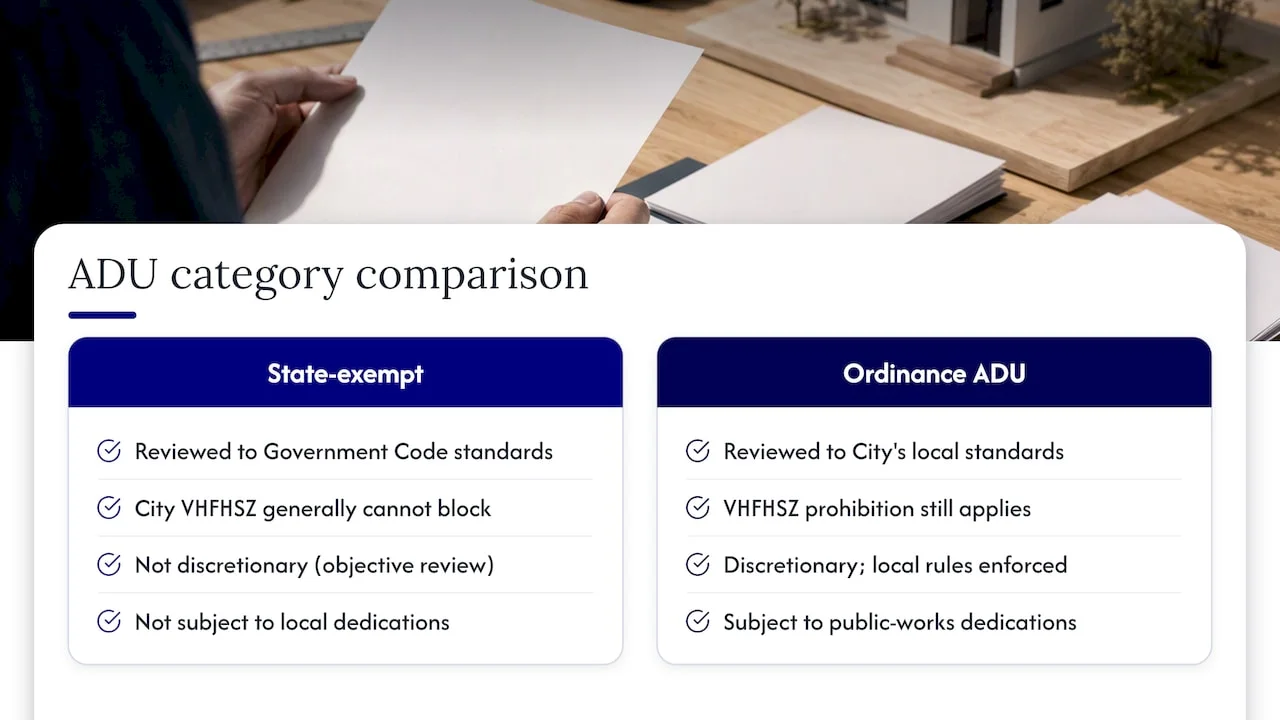
That distinction, state-exempt ADU versus ordinance ADU, is the first fork in the road for any VHFHSZ project. A state-exempt ADU is reviewed against objective standards set by the Government Code, and the City’s discretionary VHFHSZ prohibition generally cannot be applied to it. An ordinance ADU, by contrast, stays subject to the City’s local development standards, including the VHFHSZ provisions and any public-works dedications tied to them.
The practical takeaway: before you design anything, figure out which category your project falls into. That choice determines whether the City’s hillside restrictions apply to you at all, and it shapes nearly every other decision covered in this guide. Our Los Angeles ADU zoning guide walks through how state and local standards interact in more detail.
State-Exempt ADU Pathways You Can Use in a VHFHSZ
Government Code section 66323 (formerly part of 65852.2(e)(1)) sets out specific ADU and JADU configurations that cities must approve ministerially, without discretionary review, as long as they meet objective size and location criteria. These are the pathways that commonly get around a VHFHSZ prohibition, because the City cannot layer a discretionary hazard-zone denial on top of a ministerial state approval.
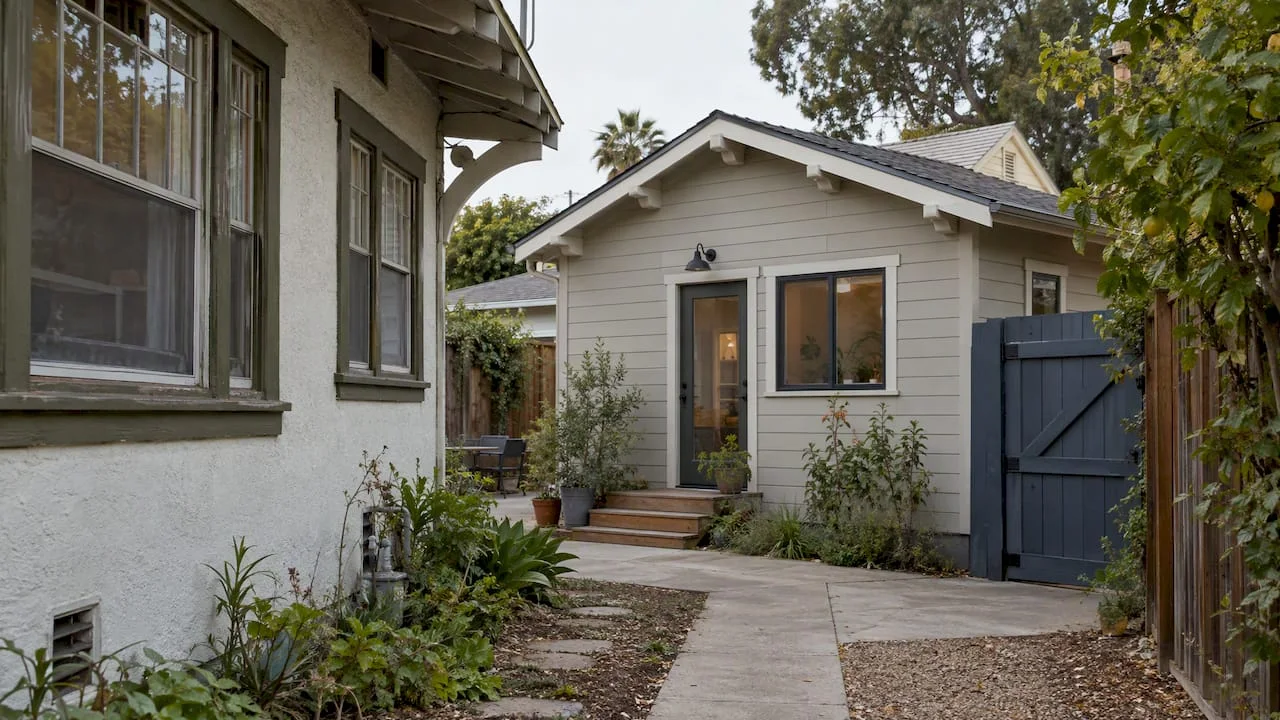
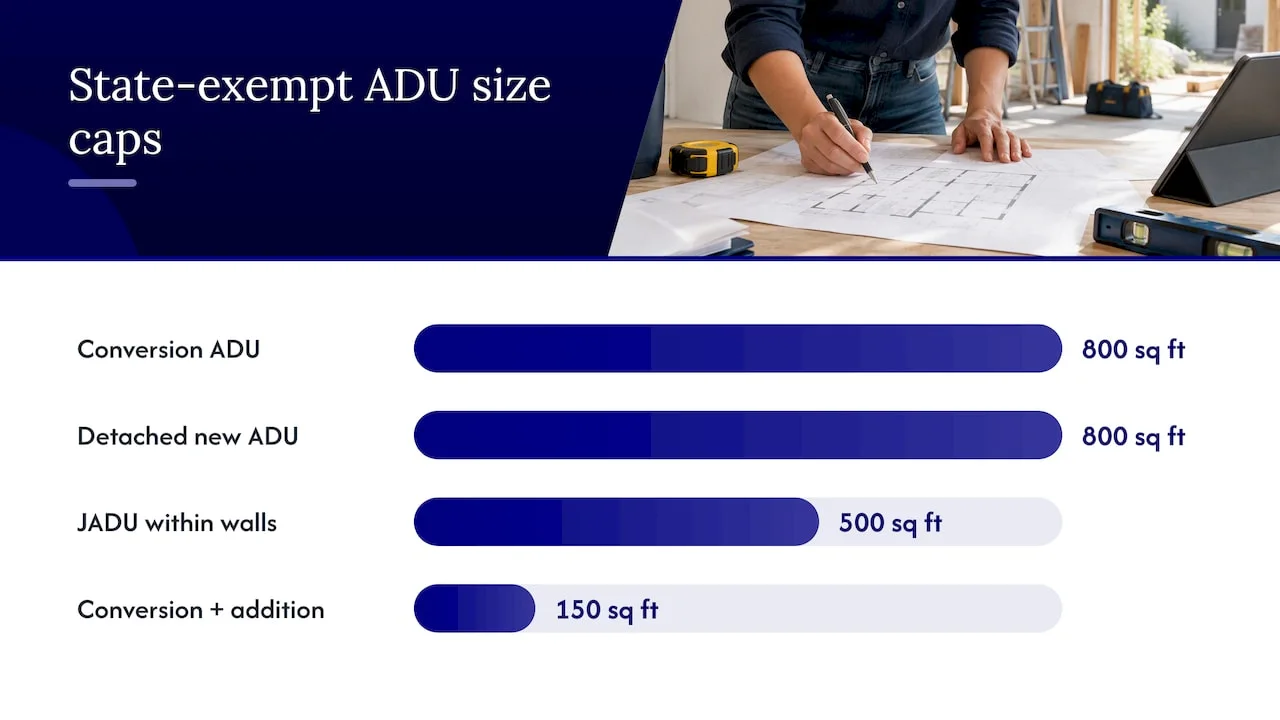
- Conversion ADU: converting existing permitted space inside the primary residence or an existing accessory structure, such as a garage, into a dwelling unit, generally capped near 800 square feet with minimal setback changes.
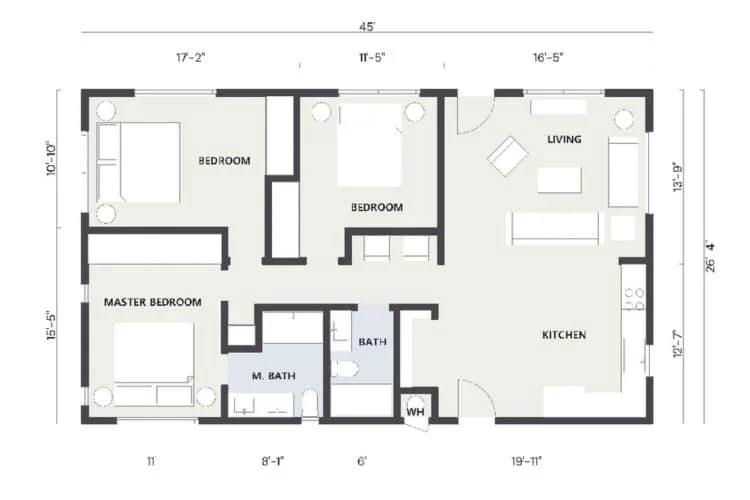
- Detached new-construction, up to 800 square feet: a single-story detached ADU built new on the lot, subject to 4-foot side and rear setbacks and a height limit.
- JADU within the existing walls: a junior ADU of up to 500 square feet created inside the existing primary residence, sharing some systems with the main house.
- Combined conversion plus small addition: expanding a converted accessory structure by a limited amount, usually up to 150 square feet, to accommodate entry or egress.
Each of these pathways comes with its own size, height, and setback ceiling, and those numbers are what a plan-checker actually measures against, not the VHFHSZ map layer. A garage conversion that stays within the existing footprint faces a different review path than a new detached unit carved out of a hillside yard, because the conversion typically disturbs less grading and vegetation and raises fewer access questions.
Choosing the right pathway early matters more in a VHFHSZ than almost anywhere else in the city, since it determines whether your fire-zone status is even a live issue during review.
Access, Roadway Width, and Public Works Issues That Block or Delay Approval
Even a state-exempt ADU still has to satisfy objective fire-access standards, and these are where most VHFHSZ projects actually stall. The City and County Fire Department generally expect two distinct, non-overlapping means of access to a site in hazard areas, and many hillside streets were never built to that standard. In practice, reviewers often reference roadways at or near 24 feet of improved width when evaluating whether emergency apparatus can maneuver safely.
Corner and through lots carry their own wrinkle: reviewers typically look for roughly 20 feet of unobstructed frontage clear of parked cars, gates, or landscaping, so that fire apparatus has a usable approach from at least one side. If your lot’s frontage is narrower, obstructed, or shared with a neighbor’s driveway easement, that gets flagged before the rest of your plan set is even reviewed.
- Pull your ZIMAS report and note every overlay: VHFHSZ, Hillside Area, Coastal Zone, or HPOZ.
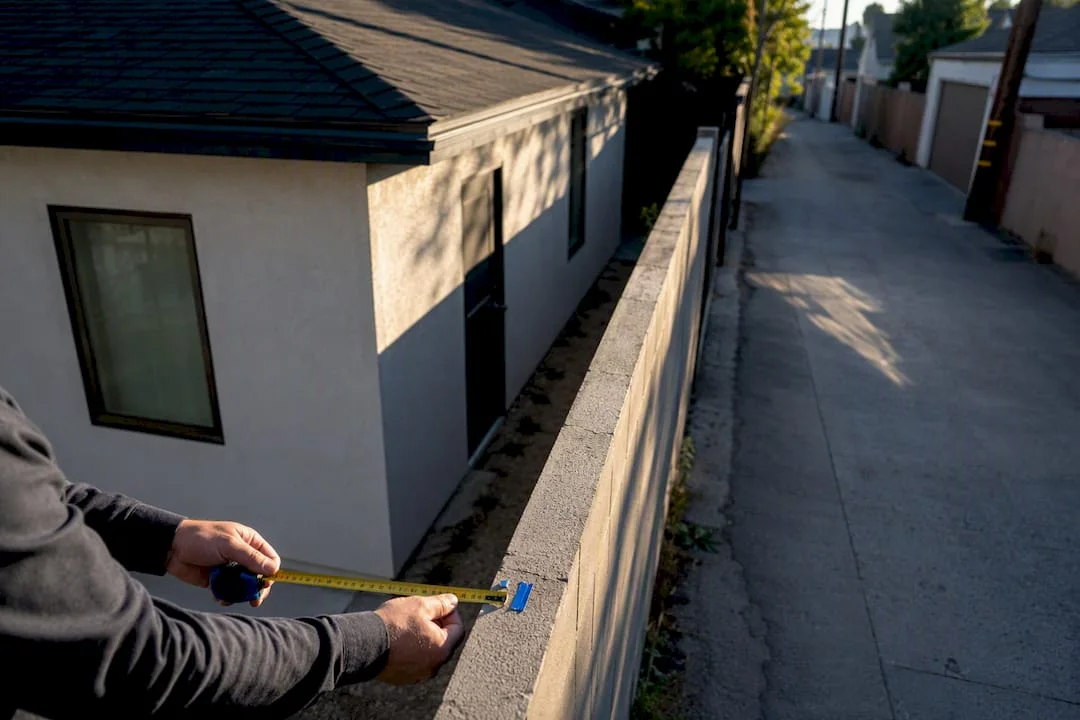
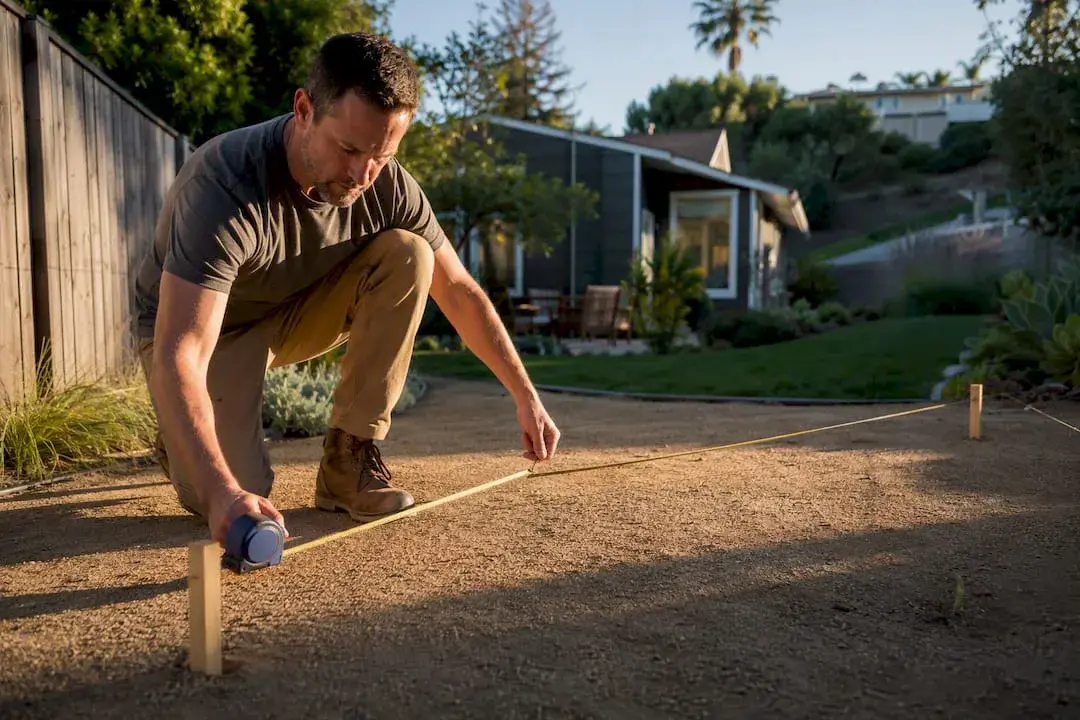
- Physically measure your street width and frontage rather than relying on an assessor’s map.
- Request a Public Works pre-check if your street looks narrower than 24 feet or your frontage is partially obstructed.
- Document existing access conditions with photos and a dimensioned site plan in your submittal.
Public Works can require street dedications or off-site improvements, like widening a substandard street, on an ordinance ADU. State-exempt ADUs limit how much of that burden the City can impose, since ministerial approval is tied to objective standards rather than discretionary conditions. That protection is not absolute, though, and a site with genuinely unsafe access can still face delay regardless of ADU type.
Pro Tip: Order a Public Works pre-check before you pay for a full plan set. A $200-300 request now can save weeks of resubmittal later.
For a deeper look at how grade and driveway standards affect permitability on hillside lots, see our piece on driveway requirements for Los Angeles ADUs.
Parking and Transit Exemptions for ADUs in a VHFHSZ
Inside a VHFHSZ, the general rule is one off-street parking space per ADU, per the LA County ADU ordinance summary, which applies the same baseline logic the City uses for hazard-zone parcels. That single-space requirement is far lighter than typical residential parking minimums, but it still has to be sited and shown on your plans.
Several exemptions commonly eliminate the parking requirement entirely, and claiming one correctly can simplify your site plan:
- The ADU sits within one half mile of a qualifying public transit stop.
- The project is a junior ADU built inside the existing primary residence.
- The ADU is attached to the primary dwelling rather than detached.
- The lot is within a designated historic district subject to its own parking standards.
- The ADU replaces a demolished garage and meets the specific replacement-parking carve-outs.
Transit proximity is the exemption most homeowners end up using, since much of Los Angeles sits within a half mile of a bus line. To document it, include a scaled map on your site plan showing the distance from your lot to the nearest qualifying stop, measured along a walkable route rather than a straight line. If your project involves converting an existing garage, be clear in your plan notes about whether you are removing covered parking and which exemption you are relying on to avoid a replacement-parking demand. Our parking checklist for Los Angeles ADU projects walks through how to assemble that evidence for submittal.
Fire Safety and Sprinklers: When Retrofits Are Actually Required
Sprinkler retrofits are one of the most common points of confusion in VHFHSZ plan checks, and they are frequently requested when they should not be. ZA Memo 143 explains that under Government Code section 66314(d)(12), the City may not require fire sprinklers in an ADU if the primary residence on the same lot was not required to have them. Since most existing single-family homes in Los Angeles predate sprinkler mandates, this exemption applies to a large share of VHFHSZ ADU projects.
Sprinklers are not an automatic requirement for an ADU in a VHFHSZ. Per ZA Memo 143, the retrofit can only be required when the existing primary dwelling was itself obligated to carry sprinklers, which rules it out for most older homes.
That said, reviewers still expect fire-hardening measures appropriate to the hazard zone, even when sprinklers are off the table; for technical best practices on leak detection and water protection measures for ADUs, see our smart leak prevention guide.
- Ignition-resistant exterior materials on walls, eaves, and decking.
- Ember-resistant vents covering attic, foundation, and crawlspace openings.
- A cleared vegetation buffer around the structure consistent with defensible-space expectations.
- Fire-rated windows or glazing where the structure sits close to a property line.
If a plan-checker requests a sprinkler retrofit on a project that qualifies for the exemption, cite the specific Government Code section and reference ZA Memo 143 directly in your plan-check response or cover letter rather than arguing the point generically. Our guide on confirming sprinkler exemptions for California ADUs has sample language you can adapt.
Permit Submittal Workflow for VHFHSZ ADU Applications
A clean submittal package is the single biggest lever you have over plan-check timelines in a VHFHSZ, since incomplete access or fire documentation is the most common reason for resubmittal.
- Site plan showing lot dimensions, setbacks, existing structures, and the VHFHSZ overlay noted explicitly.
- Access documentation, including measured street width, frontage photos, and a Public Works pre-check result if you obtained one.
- Scaled floor plans and elevations for the proposed ADU, dimensioned to match the state-exempt size category you are claiming.
- Structural and Title 24 energy compliance notes, prepared to match the foundation and framing conditions of a sloped or hillside lot.
- Fire-safety notes, listing the hardening materials you are specifying and citing the sprinkler exemption basis where it applies.
- Parking exemption evidence, such as a transit-distance map, if you are not providing a dedicated space.
- Completed application forms for LADBS, filed through the appropriate plan-check counter or online portal.
In your cover letter, state plainly which pathway you are using, for example “state-exempt detached ADU under GC §66323,” and reference ZA Memo 143 and the ADU ordinance by name when asserting that a VHFHSZ restriction does not apply to your project. Checking the DBS approved standard ADU plans library before you commission custom drawings can shorten plan check considerably when your lot fits one of the pre-approved layouts. Resubmittals in VHFHSZ reviews most often trace back to missing access documentation or an unclear sprinkler-exemption basis, both of which the steps above are designed to head off.
Feasibility Checklist: Verify Your Site Before Ordering Plans
Run through this before paying for a full design package. Catching a fatal constraint early saves weeks and avoids redesign costs later.
- Pull your parcel on ZIMAS and record every flag: VHFHSZ, Hillside Area, HPOZ, Coastal Zone.
- Measure your street width and, on a corner or through lot, confirm 20 feet of unobstructed frontage.
- Request a Public Works pre-check if access looks marginal.
- Map the distance to the nearest transit stop to see if you qualify for the parking exemption.
- Note whether you’ll demolish an existing garage or covered parking space, and which parking rule that triggers.
- Decide whether a garage or attic conversion fits your lot better than a new detached structure, given the access and grading constraints you found.
Pro Tip: Do the ZIMAS and measurement steps yourself first. They take under an hour and often rule out one pathway before you spend money on a site visit.
Our ADU feasibility checklist for Los Angeles covers this process in more depth, including what a paid site visit adds beyond the self-check steps above.
Why a Specialized ADU Design-Build Partner Matters on VHFHSZ Lots
VHFHSZ projects fail less often because of the fire-zone label itself and more because access, parking, and sprinkler questions get mishandled during design or plan check. Having a team that prepares permit-ready drawings, structural engineering, and Title 24 compliance documentation together, rather than piecing them together separately, reduces the number of places a VHFHSZ project can stall.
Coordinating with Public Works and the Fire Department before finalizing a design, rather than after a plan-check rejection, resolves access and dedication questions while they are still cheap to fix. A site plan that already shows measured frontage, a clear sprinkler-exemption basis, and a defined parking exemption gives a plan-checker less reason to request additional information.
For a homeowner on a VHFHSZ lot, the practical sequence that works best is a paid feasibility review first, a pre-application conversation with the City where warranted, and then a permit-ready design package built around whichever state-exempt pathway the feasibility review identifies.
, Uni Construction
Get Help Permitting Your VHFHSZ ADU in Los Angeles
A VHFHSZ designation on your lot does not have to mean the end of your ADU plans, but it does mean your design and your plan set have to be built around the right pathway from day one. We handle that work end to end: our Design Engineer and Structural Engineer services prepare the engineering and Title 24 documentation your lot’s grading and access conditions require, our Drafting Service produces permit-ready plan sets that cite the correct state-exempt pathway, and our Construction Company team carries the project through to build-out once permits are in hand.
A feasibility engagement typically starts with a site review against access, parking, and fire-safety gates, followed by a permit roadmap and a scope and fee estimate specific to the lot. Projects are scoped around what the parcel can actually support rather than a generic template.
Visit our Los Angeles ADU design page to request a feasibility consultation and see how we approach VHFHSZ sites across the city.
FAQ
California’s ADU statutes continue to expand ministerial approval rights for state-exempt ADU types, and cities like Los Angeles must interpret their local ordinances to stay compatible with those state provisions, as ZA Memo 142 directs. For VHFHSZ parcels specifically, the key protections, the sprinkler exemption under Government Code 66314(d)(12) and the state-exempt pathways under GC 66323, remain the operative framework homeowners should rely on.
The Los Angeles Department of Building and Safety maintains a library of approved standard ADU plans that have already cleared plan check and can be adapted to a qualifying lot. Using one of these pre-approved sets typically shortens review time compared to a fully custom design, though a VHFHSZ lot’s access and grading conditions still need individual verification.
In most cases, yes, since state law establishes ministerial approval pathways for ADUs on single-family and multifamily lots statewide. In a VHFHSZ specifically, your backyard project still needs to satisfy access, parking, and fire-safety standards even when it qualifies as state-exempt.
Under the state-exempt detached pathway, a new ADU is generally capped at 800 square feet, while a junior ADU created inside an existing home is capped at 500 square feet. Larger ADUs are possible under other local standards, but they typically fall outside the state-exempt category and become subject to the City’s full ordinance review, including VHFHSZ provisions.