

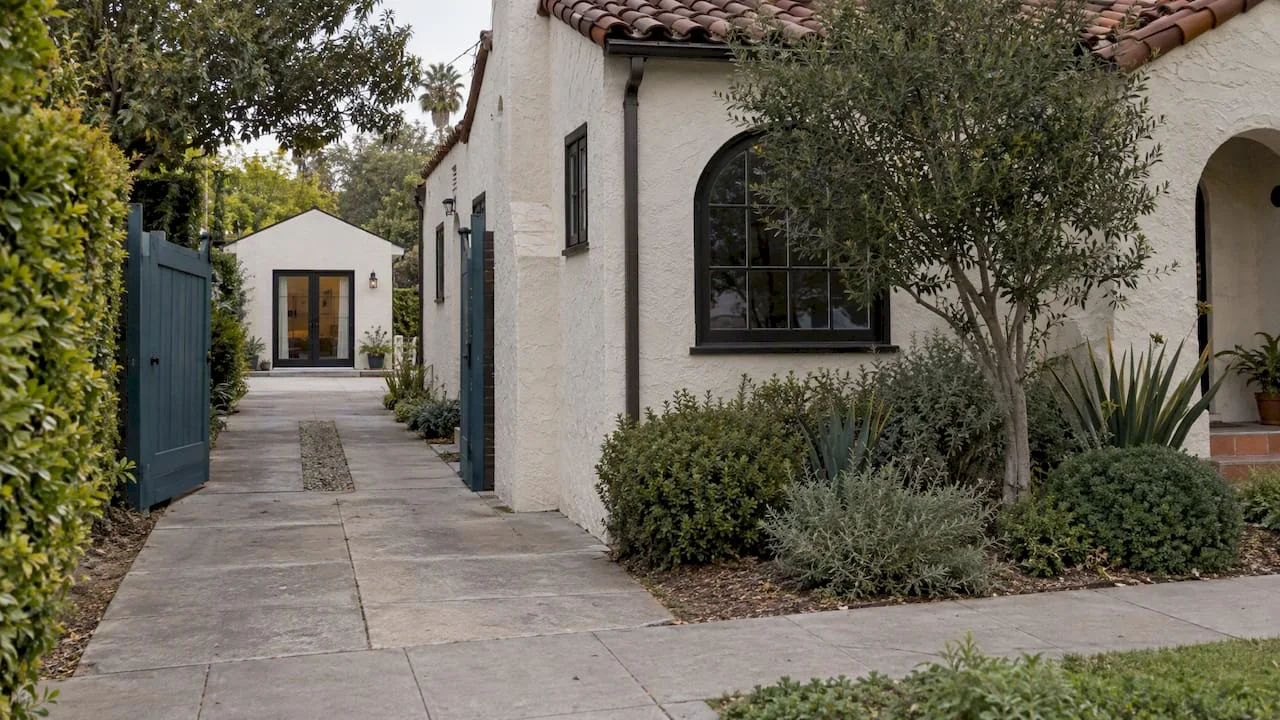
Yes, you can build an ADU in a Los Angeles Historic Preservation Overlay Zone (HPOZ). State law still entitles you to a ministerial approval, meaning a check against objective rules rather than a discretionary hearing. But exterior work in an HPOZ gets an extra layer of city review, and the city is now writing objective design standards (ODS) that spell out what a compliant ADU looks like. This guide explains how the pieces fit together and what to settle before you hire a designer.
TL;DR
- Every exterior change in an HPOZ, including a new ADU, goes through HPOZ review. Which path you get depends on whether your house is a Contributing or Non-Contributing resource.
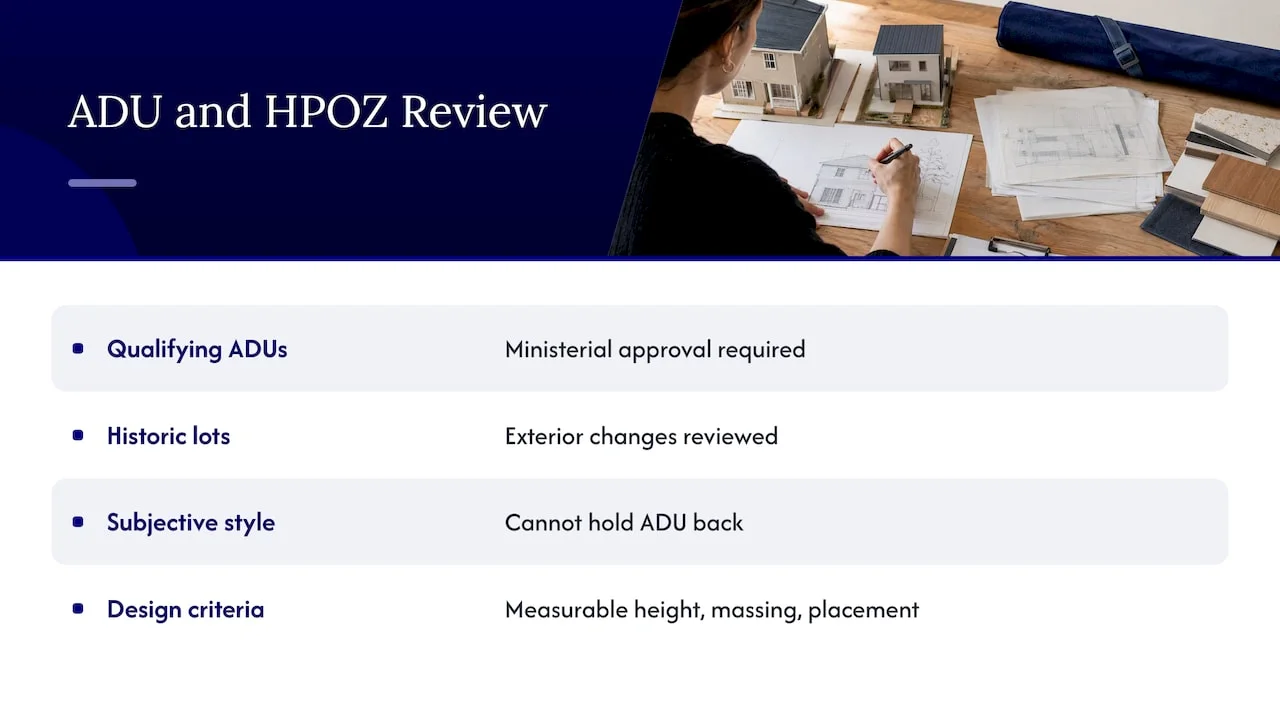
- State law requires ministerial ADU approval, and subjective standards such as matching the neighborhood’s architectural style cannot be used to deny one.
- Los Angeles City Planning has a draft set of objective design standards for ADUs in HPOZs (dated June 22, 2026). Projects that meet them can opt in to the faster Review of Conforming Work.
- Check your parking situation early. Converting or demolishing a garage can trigger replacement-parking rules.
- Get your zone’s status, survey designation and Preservation Plan before you commission drawings.
What an HPOZ is and why it changes ADU planning
An HPOZ is what the city calls a local historic district. The City Planning department describes the program as a way to identify and protect the distinctive architectural and cultural resources of historic neighborhoods, and it lists more than 35 designated HPOZs, each with its own Preservation Plan and design guidelines.
That last detail matters most. There is no single “HPOZ rulebook.” A Craftsman bungalow district and a district of 1920s Spanish Revival courtyards can ask for different things. Your first job is to find which HPOZ you are in and download its Preservation Plan.
An ADU in an HPOZ is still an ADU. The normal city zoning questions of size, height, setbacks and eligibility apply on top. If you want the baseline first, our Los Angeles ADU zoning guide covers size, setbacks, parking and eligibility outside the historic overlay.
How state law and HPOZ review fit together
Two systems apply to your lot at the same time.
State law. California’s ADU statute requires ministerial approval of qualifying ADUs. The state Department of Housing and Community Development’s ADU Handbook points to Government Code section 66323 for the categories of ADU that must be permitted, and the handbook’s guidance is that local agencies cannot use subjective standards to hold an ADU back. A rule like “must maintain a similar architectural style” is the kind of discretionary test the state does not allow for ADU applications.
Local historic review. The city’s historic district project review page says all properties in local historic districts must undergo additional review for exterior renovations, additions, new construction and other exterior changes. A new ADU is new construction on a historic lot, so it is in scope.
The practical result is a narrow lane. The city cannot reject your ADU because it dislikes the look. It can require that the ADU meet clear, measurable standards for things like height, massing and placement. That is why the objective design standards matter so much.
The three HPOZ review paths
The path your project takes depends on how the district’s survey classifies your property and what the work involves. According to the city’s Local Historic Districts page, the options are:
| Review path | Typically fits | What to expect |
|---|---|---|
| Certificate of Appropriateness | Larger or more significant changes, often on Contributing properties | The most involved path, with HPOZ Board review |
| Certificate of Compatibility | Work on Non-Contributing resources | A lighter review than a Certificate of Appropriateness |
| Review of Conforming Work | Work that conforms to the Preservation Plan | Ministerial, handled by staff against set criteria |
Treat the table as orientation, not a promise. The city decides the path for your project, and your HPOZ planner is the person to confirm it.
Contributing vs. Non-Contributing: check this first
Owners often confuse these two labels. A Contributing property adds to the district’s historic character. A Non-Contributing one, such as a later infill building or a heavily altered house, does not. You can build an ADU on either. The difference is how closely the primary house and the new building are examined.
Find your designation in the district survey, or ask the HPOZ planner assigned to your area. Do this before you pay for drawings, because the answer shapes the whole design brief.
The draft objective design standards for ADUs in HPOZs
This is the most important recent change. The city has published a draft of Objective Design Standards for ADUs in HPOZs dated June 22, 2026. A city fact sheet updated July 24, 2026 says the city is developing ODS for infill housing and for ADUs in HPOZs. Because these are drafts, the details may change before adoption. Confirm the current version with City Planning before you finalize a design.
The opt-in route
The draft sets a clear choice. If a project is not consistent with the objective standards, it must be revised to comply. Alternatively, the applicant can opt in to having the ADU processed through the ministerial Review of Conforming Work under the HPOZ ordinance and the applicable Preservation Plan.
In plain terms, designing to the standards is meant to be your route to a predictable, hearing-free review. Designing outside them does not mean your ADU is banned, but it is a different conversation, and you should expect more back and forth.
What the draft asks of a detached ADU
The draft’s detached ADU section applies to new freestanding buildings and to ADUs that modify or attach to existing accessory structures. Examples of the measurable requirements in the June 2026 draft:
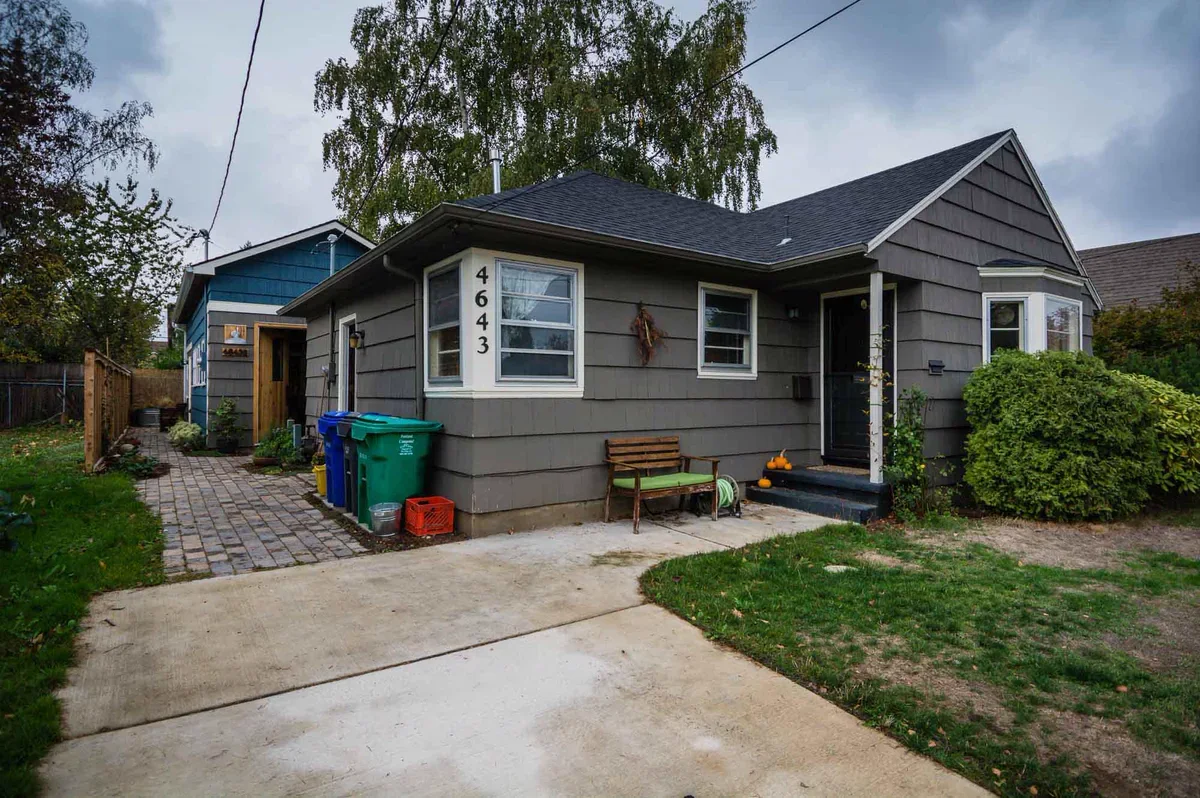
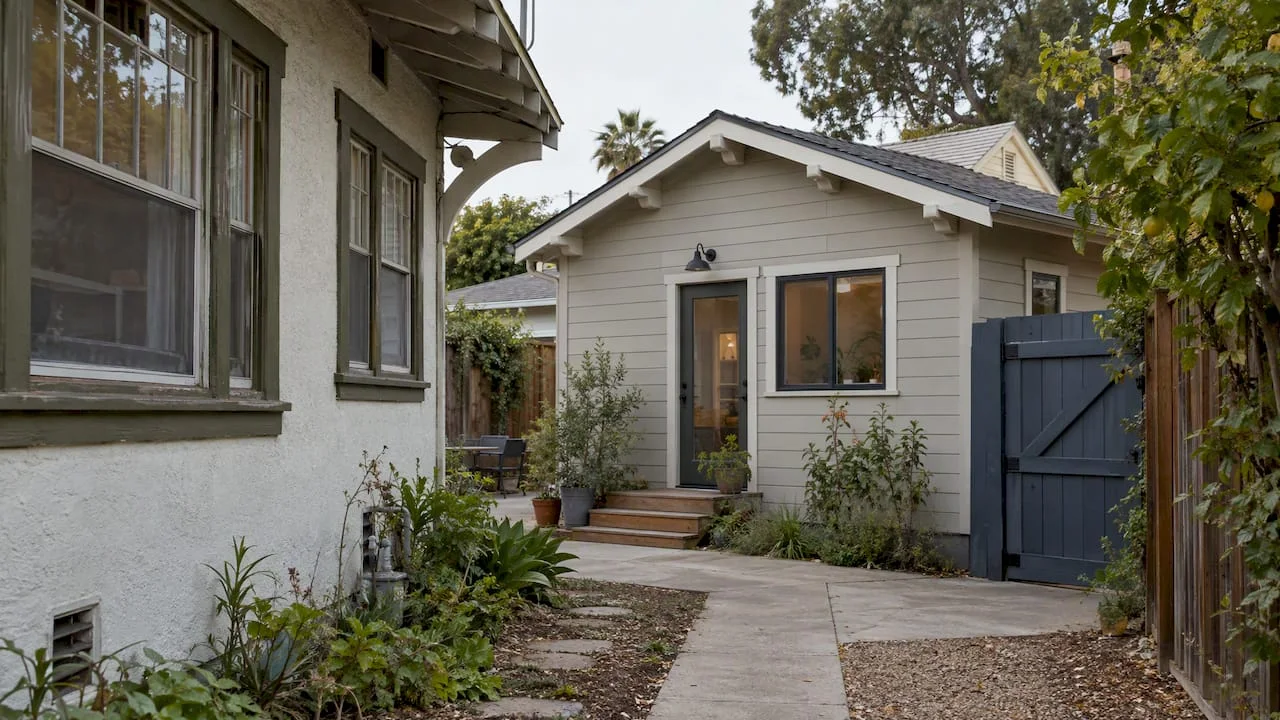
- A detached ADU is located behind the rear wall of the primary residence, unless existing lot conditions cannot accommodate that placement under Government Code section 66321.
- A detached ADU takes up no more than 50 percent of the rear yard, again unless meeting the standard would prevent an ADU the state law allows.
- Flush-mount sliding windows are prohibited.
Notice the built-in escape valve. The draft repeatedly defers to state law when a rule would make an ADU impossible on a tight lot. That fits the state’s position that historic designation is not a blanket reason to block ADUs.
The draft also has a separate set of requirements for attached ADUs, which include placing the unit behind the rear wall of the primary residence unless lot conditions prevent it. Read the whole document, not just these examples. It is the best preview of what your plan checker will look for.
Why windows come up so often
Window type is one of the easiest ways to make a new building look at home in a historic district, and one of the easiest ways to trip a standard. If you are choosing between window styles for a new unit in an older neighborhood, a guide to window styles for historic homes can help you think through proportions and operation types before you meet your designer. Whatever you choose, check it against the current draft, since sliding windows are specifically addressed.
For a deeper walk through how meeting the draft standards can lead to a ministerial permit, see our post on getting a ministerial ADU permit in LA HPOZs. Our broader explainer on HPOZ ADU design and permit rules covers the basics for homeowners.
Parking in an HPOZ
Parking is where historic-district owners get surprised. City planning guidance in the research we reviewed notes that ADU parking requirements are often waived in certain situations, but that replacement of lost off-street spaces can still come into play when a garage is demolished or converted, unless an exemption applies.
That matters for two common HPOZ projects:
- Garage conversions. Old garages in historic districts are often charming and well built, which makes them popular candidates. Before you plan on one, ask the city whether replacement parking applies to your parcel.
- Detached ADUs built where a garage stands. If the new unit replaces a garage, the same question applies.
Do not assume your HPOZ status gives you a total exemption. Confirm with the city in writing, then design around the answer.
If a garage is your starting point, our page on garage conversion ADU design explains what the process involves, and our Los Angeles garage conversion page is specific to the city.
A sensible order of operations
This sequence saves homeowners the most rework.
- Confirm your HPOZ and your designation. Look up your district, then find whether your house is Contributing or Non-Contributing.
- Get the Preservation Plan. It has the district’s design guidelines and the details of what counts as conforming work.
- Read the current draft ODS for ADUs. Note placement, rear-yard coverage and window rules.
- Talk to the HPOZ planner early. Ask which review path applies and whether your district has adopted the new standards yet.
- Run a zoning and site check. Confirm lot size, setbacks, utilities and any other overlays such as fire hazard zones. Our post on very high fire hazard severity zone ADU rules covers a common overlap in hillside neighborhoods.
- Design to the standards. Draw the site plan and elevations to hit the objective criteria, so you can use the opt-in route.
- Submit and track. Our LA ADU approval process guide shows how the pieces of a submittal move through the city.
Use the HPOZ Board as a resource
HPOZ Boards are made up of local residents, and the city encourages them to give owners practical advice. Per the city’s description of the program, that includes guidance on rehabilitation approaches suited to historic buildings. In a project where you are also touching the main house, that input can steer you toward cost-effective choices that fit the neighborhood rather than expensive redesigns that do not.
Bring a clear site plan, photos of the existing house and a rough massing sketch when you meet them. People respond to specifics.
Our perspective: design the ADU for the checklist, not for the hearing
We work on ADUs across Los Angeles, and our experience is that historic-district projects go wrong in three predictable ways.
First, owners commission drawings before they know their designation or district rules. The drawings then have to be redone once the HPOZ planner weighs in. Find out first, draw second.
Second, designers treat “historic” as a style problem. Under state law and the draft standards it is mostly a measurement problem: where the unit sits, how much of the yard it covers, how it relates to the house, which window types it uses. Those are things a good set of plans can answer on paper, which is why we prefer to design to the objective criteria and take the ministerial route wherever the lot allows.
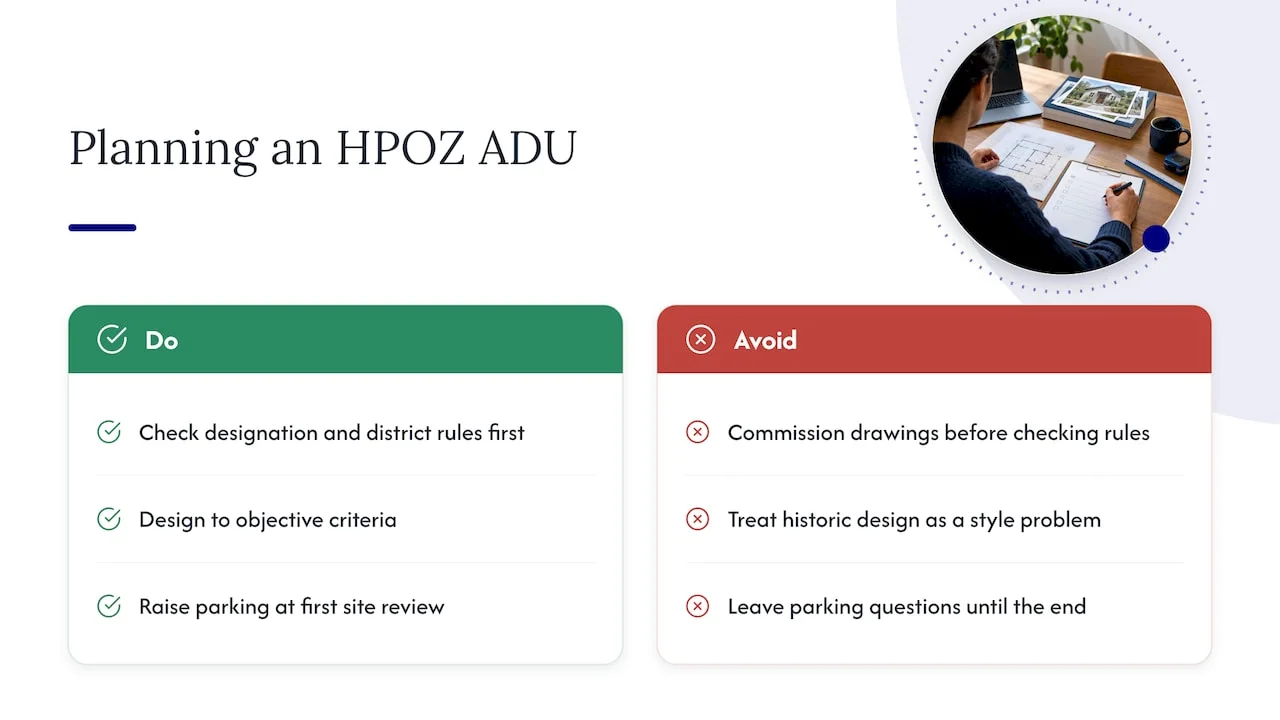
Third, parking and garage questions get left to the end. They can change the footprint, the budget and the schedule, so we raise them at the first site review.
Our aim is a streamlined path from design through permit to build, with one team coordinating the architectural, structural and construction work. If a draft standard changes, the plans adapt rather than start over.
, Uni Construction
Getting your HPOZ ADU designed and built
If you own in an HPOZ and want a team that handles drawings, structural engineering, permitting support and construction under one roof, start with our Los Angeles ADU builder page. For the drawing side, see our architectural designer and structural engineer services, or browse completed projects, including a detached ADU in Los Angeles. Send us your address and we can start by checking your district, your designation and the likely review path.
What the zone does not change
A few things stay the same inside an HPOZ:
- Ministerial treatment still applies. The state’s position is that historic designation cannot be used as a blanket reason to block an ADU that meets objective criteria.
- Local zoning still applies. Height, setbacks and size limits are tied to the city’s ADU ordinance, which the Zoning Administrator’s ZA Memo 143 discusses. It notes the city’s ADU ordinance became effective December 19, 2019 and added Section 12.22.A.33 to the Los Angeles Municipal Code.
- Building and safety review still applies. Structural, energy and fire-related requirements are separate from the historic review.
The city’s current ADU rules also sit next to a county framework for unincorporated areas. If your property is outside City of Los Angeles limits, the county’s ADU ordinance FAQs apply instead, and historic districts there follow different local rules.
FAQ
Yes. State law requires ministerial approval of qualifying ADUs, and historic designation does not let a city block one that meets objective criteria. The difference is that your exterior work also goes through HPOZ review, and your design has to fit the measurable rules that apply.
Not necessarily. The draft objective standards let an applicant opt in to the ministerial Review of Conforming Work, which is designed to avoid discretionary hearings. Projects that do not meet the standards may face a different process, so confirm your path with the HPOZ planner.
Check your district’s survey and Preservation Plan, or ask the HPOZ planner for your area. The designation drives which review path applies, so get it in writing before you start drawings.
As of our latest check, the city’s standards are in draft form, dated June 22, 2026, with the city developing them alongside standards for infill housing. Look at the current City Planning version before locking in a design, since details can change.
Sources
- Local Historic Districts (HPOZs), Los Angeles City Planning
- Historic District Project Review, Los Angeles City Planning
- Los Angeles Objective Design Standards for ADUs in HPOZs, draft (June 22, 2026)
- Objective Design Standards for Infill Housing and ADUs in HPOZs, fact sheet (July 24, 2026)
- California HCD 2025 ADU Handbook
- Zoning Administrator Memo No. 143
- Los Angeles City Planning ADU parking guidance
- Los Angeles County ADU Ordinance Amendment FAQs