

ADU impact fees in California are one-time charges local governments collect to offset the cost of public infrastructure when new housing units are added. California law exempts ADUs 750 sq ft or less from development impact fees entirely, and units under 500 sq ft from school impact fees. For larger units, fees must be proportional to the primary dwelling’s size, not charged at the full single-family rate. Understanding these thresholds is the single most important step in budgeting your ADU project accurately.
Impact-fee threshold note: Under the March 2026 California HCD ADU Handbook, the statewide development-impact-fee exemption includes ADUs with 750 sq ft of interior livable space or less. Above 750 sq ft, applicable impact fees must be proportional. School, utility, plan-check and permit charges follow separate rules.
How are ADU impact fees calculated and applied in California?
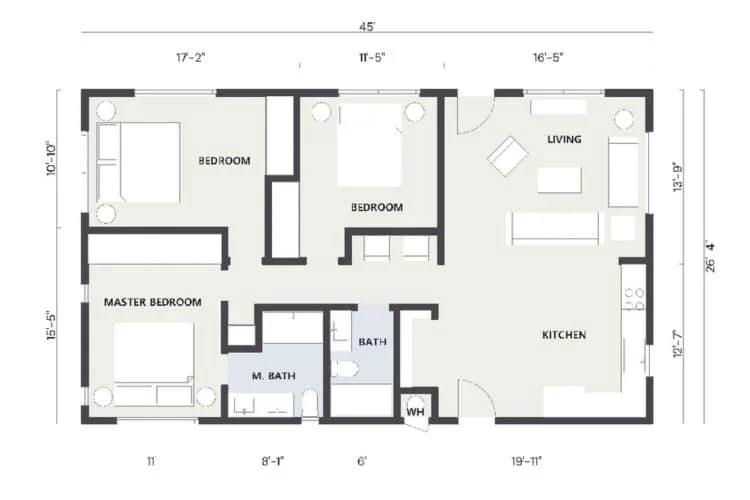
California measures ADU size for fee purposes using interior livable space only. Exterior walls, garages, and staircases are excluded from that calculation. This distinction matters more than most homeowners realize.
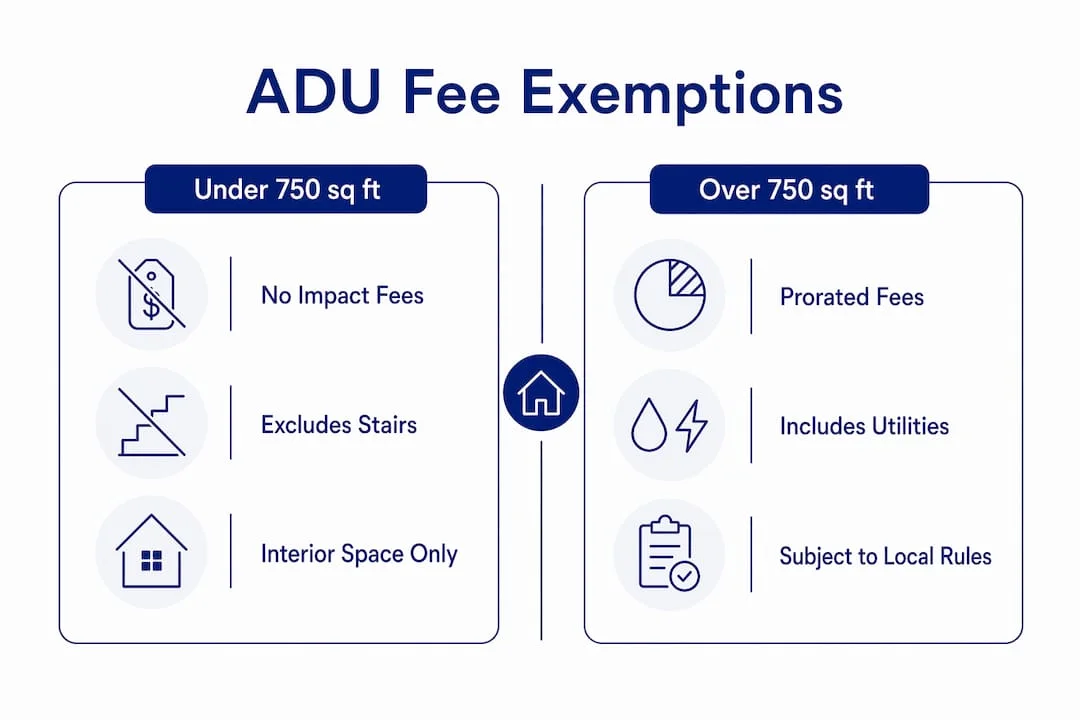
A 780 sq ft ADU with a 30 sq ft staircase and thick exterior walls could have an interior livable area well 750 sq ft. or less That unit would qualify for a full development impact fee exemption, even though its physical footprint looks larger on paper. Knowing this rule lets you design for maximum space while staying under the exemption threshold.
When an ADU does exceed 750 sq ft of interior livable space, local agencies must calculate fees proportionally. The formula compares the ADU’s square footage to the primary dwelling’s square footage. A 900 sq ft ADU on a property with a 2,700 sq ft main house would be charged roughly one-third of the standard single-family impact fee rate. That is a significant reduction compared to what a standalone new home would owe.
Local jurisdictions vary considerably in how they apply these rules. Some cities calculate fees conservatively and apply every eligible charge. Others actively support ADU construction and waive fees at the lower end of the proportional range. Key variables that affect your final fee total include:
- Unit size relative to primary dwelling: The proportional formula directly ties your fee to this ratio.
- Jurisdiction: Los Angeles, Diamond Bar and Pomona administer separate local fee schedules. Confirm which authority serves the parcel before comparing estimates.
- ADU type: Garage conversions and junior ADUs often face different fee structures than detached new builds.
- Affordability designation: Units deed-restricted as affordable housing may qualify for additional waivers.
Pro Tip: Ask your local planning department for the exact fee schedule before finalizing your ADU floor plan. A 10 sq ft reduction in interior livable space could eliminate your entire development impact fee.
What exemptions and waivers exist for ADU impact fees in California?
California state law creates two primary exemption tiers that every homeowner and investor should know before budgeting.
- Development impact fee exemption: Any ADU with interior livable space 750 sq ft or less owes zero development impact fees. This covers transportation, parks, and general infrastructure fees that can otherwise add thousands of dollars to a project.
- School impact fee exemption: Under SB 543, ADUs at or below 500 sq ft are exempt from school impact fees statewide. School fees are often overlooked in early budgets but can reach several thousand dollars in high-demand districts.
- Proportional fee cap for larger ADUs: Units above 750 sq ft are not charged full single-family rates. Fees scale based on the ratio of ADU size to primary dwelling size, which typically results in a fraction of what a new standalone home would owe.
- Affordability-based waivers: Some cities and counties offer additional fee waivers for ADUs that are deed-restricted as affordable housing for low- or moderate-income tenants. Los Angeles and several Bay Area jurisdictions have adopted these policies to increase housing supply.
- Local discretionary waivers: A handful of jurisdictions have passed local ordinances that go beyond state minimums, waiving fees entirely on all ADUs regardless of size as a housing production incentive.
Pro Tip: If your ADU falls just above the 500 sq ft school fee threshold, check whether your school district’s fee schedule has a minimum charge floor. Some districts charge a flat fee for units between 500 and 750 sq ft that is lower than the proportional rate suggests.
The exemption framework under California housing law is designed to make small ADUs financially accessible. The state’s Housing and Community Development department (HCD) publishes annual housing law fact sheets that detail current thresholds. Checking those directly before you finalize your project scope is worth the 20 minutes it takes.
How do ADU impact fees affect financial feasibility and investment returns?
Impact fees function as an upfront tax on new housing. For small ADUs 750 sq ft or less, California’s exemption removes that barrier entirely. For larger units, the proportional fee structure still reduces the cost compared to building a standalone home, but the fees are real and must be factored into your return on investment calculation.
Research from RAND shows that fee waivers on small ADUs are fiscally sustainable for local governments. The increased property tax revenue and sales tax activity generated by new residents offset the waived fees within 4–7 years. That finding matters for investors because it signals that California cities have a financial incentive to keep ADU fees low, making the current exemption framework likely to persist.
The RAND research makes a compelling case: waiving impact fees on small ADUs does not cost cities money in the long run. It accelerates housing production, raises property values, and generates tax revenue that more than compensates for the waived fees within a single decade. For homeowners, that means the political will to maintain these exemptions is strong.
For investors evaluating ADU feasibility, the math works best when the unit stays 750 sq ft. or less A well-designed 749 sq ft ADU in Los Angeles can rent for $2,000 to $3,000 per month while owing zero development impact fees. A 900 sq ft unit might command $200 to $400 more in monthly rent but could owe $8,000 to $15,000 in fees upfront. The breakeven on that fee difference takes years.
Working with a contractor who separates construction costs from total project costs is the single best way to protect your budget. Many bids show only the cost to build the structure. The full financial picture includes fees, compliance costs, utility connections, and design fees. Reviewing LA County ADU regulations before you finalize your unit size can help you avoid fee surprises specific to your jurisdiction.
Key Takeaways
California’s ADU impact fee exemptions make units 750 sq ft or less the most financially efficient choice for homeowners and investors, with zero development fees owed and proportional caps protecting larger builds.
| Point | Details |
|---|---|
| 750 sq ft development fee exemption | ADUs with interior livable space 750 sq ft or less owe zero development impact fees under California law. |
| 500 sq ft school fee exemption | SB 543 exempts ADUs at or below 500 sq ft from school impact fees statewide. |
| Interior space measurement | Fee thresholds apply to interior livable space only; exterior walls and stairs are excluded from the calculation. |
| Hidden costs beyond impact fees | Title 24 compliance, utility connections, and plan check fees can add $10,000 or more to total project costs. |
| Fee waivers benefit both parties | RAND research shows cities recoup waived ADU fees through increased tax revenue within 4–7 years. |
What I’ve learned after years of building ADUs in California
The biggest mistake I see homeowners make is treating impact fees as a fixed, non-negotiable number. They are not. The 750 sq ft threshold is a design target, not a constraint. When we sit down with a client early in the design phase, the first question we ask is whether their program can fit within 749 sq ft of interior livable space. Most of the time, it can. That single decision eliminates the development impact fee entirely.
The second mistake is trusting a contractor’s initial bid as the full cost. I have reviewed bids that looked competitive on paper but excluded Title 24 compliance, soils reports, and utility connection fees. Those omissions can add $15,000 to $25,000 to a project that the homeowner thought was already budgeted. Always ask for a line-item breakdown that separates construction costs from permit, fee, and compliance costs.
California also gives applicants formal appeal rights when a permit application is found incomplete. Most homeowners do not know this. If your local agency flags your application as incomplete, you have the right to challenge that finding. A well-prepared application with complete drawings and a clear fee analysis reduces the chance of that happening in the first place.
My honest advice: engage your local planning department before you finalize your design. A 30-minute pre-application meeting can reveal fee schedules, local waivers, and measurement policies that save you thousands. The California ADU permit process rewards homeowners who do their homework early.
, Uni Construction
How Uni Construction can help with your California ADU project
Navigating ADU fees, exemptions, and permit requirements takes real local knowledge. Uni Construction specializes in ADU design in Los Angeles and the surrounding areas, with direct experience managing fee compliance, permit-ready drawings, and the full approval process for California homeowners and investors.
Whether you are planning a detached backyard cottage, a garage conversion, or a junior ADU, Uni Construction’s team knows how local jurisdictions apply fee schedules and where exemptions apply. The goal is to get your project designed correctly the first time, so you avoid costly revisions, fee surprises, and permit delays. Contact Uni Construction for a consultation and get a clear picture of your total project costs before you commit to a design.
FAQ
California law exempts ADUs with interior livable space 750 sq ft or less from development impact fees. Units under 500 sq ft are also exempt from school impact fees under SB 543.
Fees for ADUs exceeding 750 sq ft must be proportional to the ADU’s size relative to the primary dwelling’s size. They cannot be charged at the full single-family rate.
No. California measures ADU size for fee purposes using interior livable space only. Exterior walls, staircases, and garage areas are excluded from the calculation.
Title 24 energy compliance, utility connection fees, plan check fees, and soils reports are common costs that contractors often exclude from initial bids. These can add $10,000 or more to total project costs.
Local agencies must issue a completeness determination within 15 business days and approve or deny a compliant ADU permit application within 60 days of receiving it.