

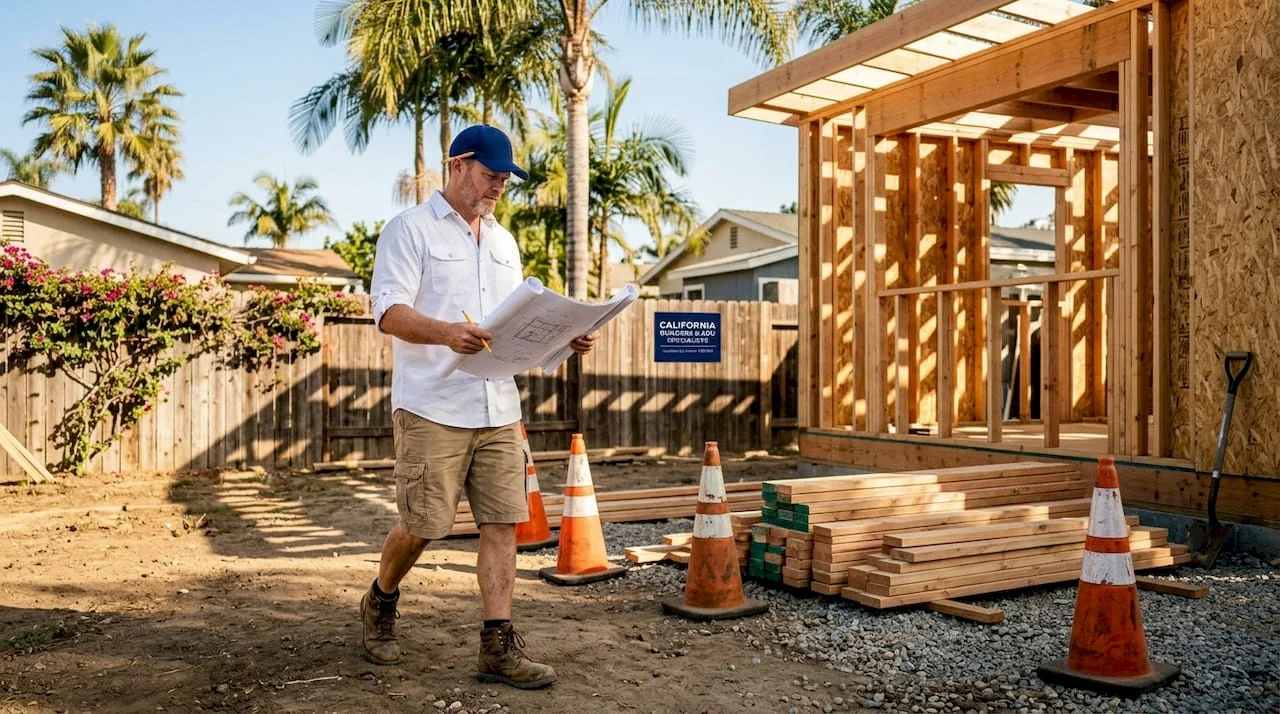
Figuring out what an ADU will actually cost you is harder than it looks. The adu construction cost per square foot varies so widely across California that a single number can mislead you into budgeting too little or walking away from a project that would have penciled out beautifully. A garage conversion in Sacramento and a detached cottage in Los Angeles can differ by $150 or more per square foot, even before you account for your specific site conditions. This guide breaks down every major cost driver so you can build a realistic budget rather than guess at one.
Key Takeaways
| Point | Details |
|---|---|
| Fixed costs inflate small ADU pricing | Kitchens, bathrooms, and permits don’t shrink with unit size, so smaller ADUs cost more per square foot. |
| Soft costs add 12 to 18 percent | Design, engineering, and permits stack on top of hard construction and must be budgeted from day one. |
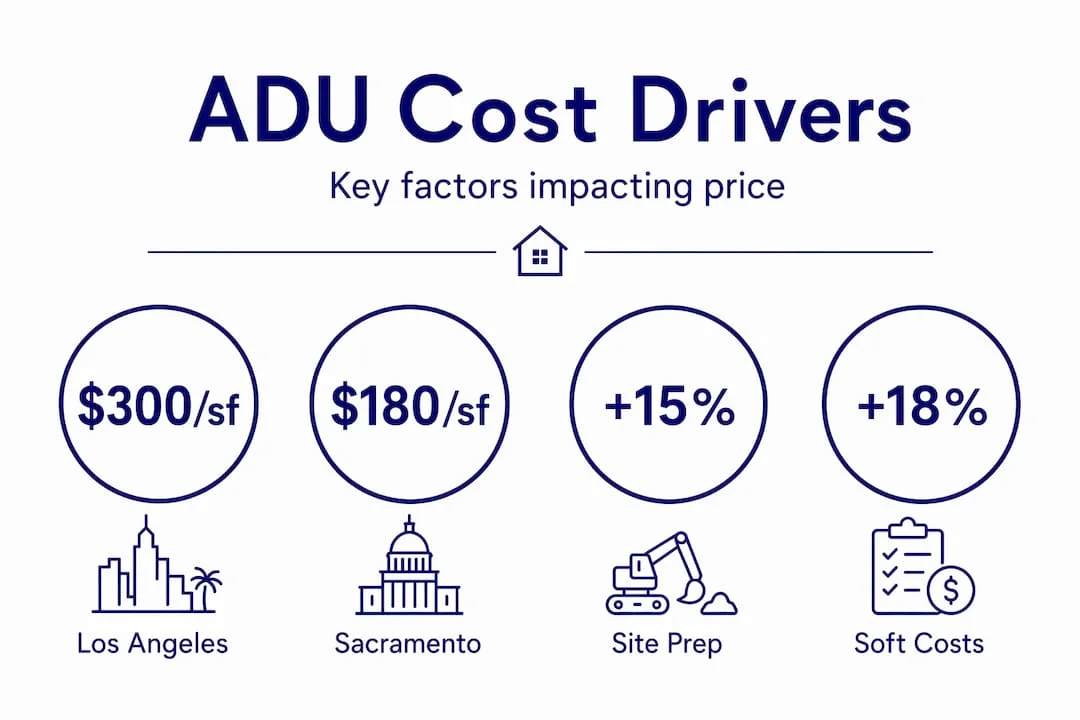
| Location shifts pricing dramatically | Los Angeles and the Bay Area run $300 to $500+ per square foot while Sacramento can be 30 to 40% less. |
| Site conditions are a wildcard | Utility trenching and difficult terrain can add $15,000 to $30,000 beyond base construction costs. |
| Larger ADUs offer better cost efficiency | Spreading fixed costs across more square footage lowers your per-square-foot number and increases rental income potential. |
ADU construction cost per square foot: what the number actually means
When contractors or online calculators throw out a price per square foot, they are almost always quoting hard construction costs only. Hard costs cover materials, labor, framing, roofing, electrical, plumbing, and finishes. They are the biggest piece of the budget, but they are not the whole picture.
Soft costs add 12 to 18% on top of hard construction. That category includes architectural drawings, structural engineering, Title 24 energy compliance reports, permit fees, and utility hookup applications. On a $350,000 hard construction budget, soft costs push your all-in total to roughly $400,000 to $415,000. Homeowners who skip this math routinely underestimate their ADU budgets by up to 20%.
Here is how cost ranges break down by ADU type across California:
- Detached ADU: $300 to $500+ per square foot, total project $150,000 to $400,000+
- Attached ADU: Generally comparable to detached, though shared wall savings vary
- Garage conversion: $250 to $500 per square foot depending on existing structure quality
- Junior ADU (JADU): $200 to $400 per square foot, lower total due to size limits
- Prefab or modular ADU: $250 to $400 per square foot installed
Pro Tip: Ask your contractor to quote hard costs and soft costs separately. Contractors who bundle everything into a single per-square-foot number often leave out permit fees, engineering, and utility connection costs.
Site preparation costs deserve their own line item too. Grading, demolition of existing structures, and connecting to water and sewer lines are not reflected in any base price per square foot figure. They vary entirely by your property.
How California region shifts your per-square-foot price
California is not one construction market. It is five or six, stacked on top of each other with very different labor rates, permit fee structures, and subcontractor availability.
| Region | Hard Cost ($/sf) | All-In Estimate (700 sf ADU) | Notes |
|---|---|---|---|
| San Francisco | $380 to $500+ | $320,000 to $430,000+ | Highest labor rates, union fees, steep permit costs |
| East Bay / Oakland | $300 to $400 | $240,000 to $325,000 | Slightly lower than SF but still premium |
| Los Angeles | $280 to $420 | $300,000 to $450,000+ | Wide range driven by site and finish level |
| Sacramento | $200 to $300 | $150,000 to $250,000 | Most affordable major metro in the state |
| Coastal or hillside Los Angeles site | Obtain site-specific bids | Include access, foundation and utility work | Topography, coastal review and construction access can change the budget |
Detached ADUs in Los Angeles typically run $300,000 to $450,000+, while Sacramento projects land between $150,000 and $250,000 for comparable units. That gap is not about product quality. It reflects labor market wages, city-specific permit and design fees that range from $4,000 to $15,000 for permits alone and $8,000 to $20,000 for architectural and engineering work, and subcontractor pricing driven by regional demand.
Pro Tip: Using a city-level cost band for your region instead of a statewide average makes your budget significantly more accurate and improves your financing conversations with lenders.
If you are investing in the Los Angeles area specifically, the ADU costs in Los Angeles page at Uni Construction breaks down pricing by site type and finish level with real project data from Southern California.
Why smaller ADUs cost more per square foot
This is the insight that surprises most homeowners. A 400 square foot ADU almost always has a higher per-square-foot cost than an 800 or 1,200 square foot unit, even though the total dollar amount is lower.

The reason is fixed costs. Every ADU, regardless of size, needs a kitchen, at least one bathroom, an electrical panel, a gas connection, and a full permit package. Fixed costs don’t scale with square footage. A kitchen rough-in might cost $25,000 whether you are building 400 or 1,200 square feet. When you spread that $25,000 over 400 square feet, it adds $62.50 per square foot. Spread over 1,200 square feet, it adds only $20.83.
Here is how that plays out in practical terms:
| ADU Size | Estimated Hard Cost | Per Square Foot | Notes |
|---|---|---|---|
| 400 sf | $140,000 to $180,000 | $350 to $450/sf | Fixed costs dominate |
| 600 sf | $180,000 to $260,000 | $300 to $430/sf | Cost efficiency improves |
| 800 sf | $220,000 to $320,000 | $275 to $400/sf | Better spread of fixed expenses |
| 1,200 sf | $280,000 to $420,000 | $250 to $400/sf | Most cost-efficient per square foot |
Building at maximum allowed ADU sizes up to 1,200 square feet reduces your per-square-foot cost by spreading fixed expenses across more space. The total budget is higher, but the cost efficiency is better and so is the rental income ceiling.
The tradeoff is real, though. A larger unit requires more financing and carries more construction risk. But from a pure ROI standpoint, balancing cost per square foot against rental income shows that max-size builds are often more financially advantageous over a five to ten year hold period.
- Build too small and you pay more per square foot while capping your rent potential
- Build too large and you may over-improve for your neighborhood’s rental market
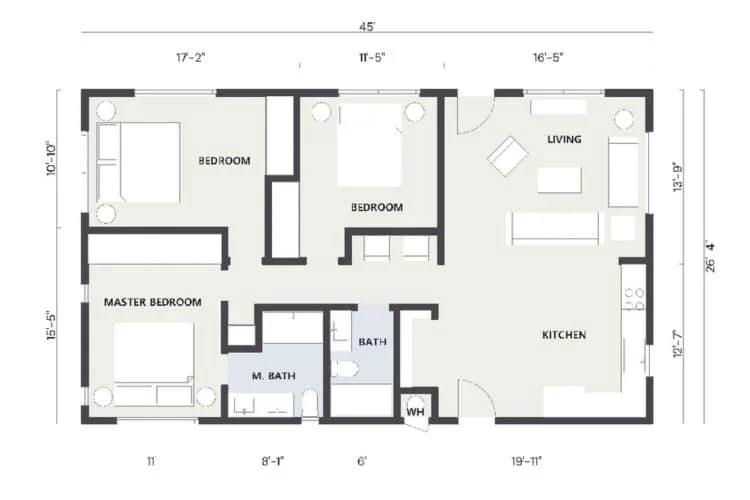
- The sweet spot for most California markets is 600 to 800 square feet for a one-bedroom or 800 to 1,000 square feet for a two-bedroom
Site conditions and design choices that drive up your budget
Two properties on the same street in the same city can have ADU budgets that differ by $40,000 or more. Site conditions are the reason, and they never show up in any base price per square foot figure.
Utility connections are one of the biggest wildcards. Utility trenching distance can add $15,000 to $30,000 or more to a project when the ADU sits far from the main electrical panel, water meter, or sewer cleanout. On a 600 square foot ADU, that single line item can inflate your effective per-square-foot cost by $25 to $50.
Topography and soil conditions matter just as much. A flat, level lot with good soil drainage requires a simple concrete slab foundation. A sloped or hillside lot may need a raised foundation, caissons, or retaining walls. Each of those adds cost, and none of it appears in a generic quote.
Three more cost factors worth watching:
- Energy code compliance (Title 24): California’s energy standards require insulation, window performance, and HVAC specifications that add cost, particularly in new detached construction
- Finish level: Builder-grade finishes versus mid-range or high-end selections can shift your per-square-foot hard cost by $50 to $150 easily
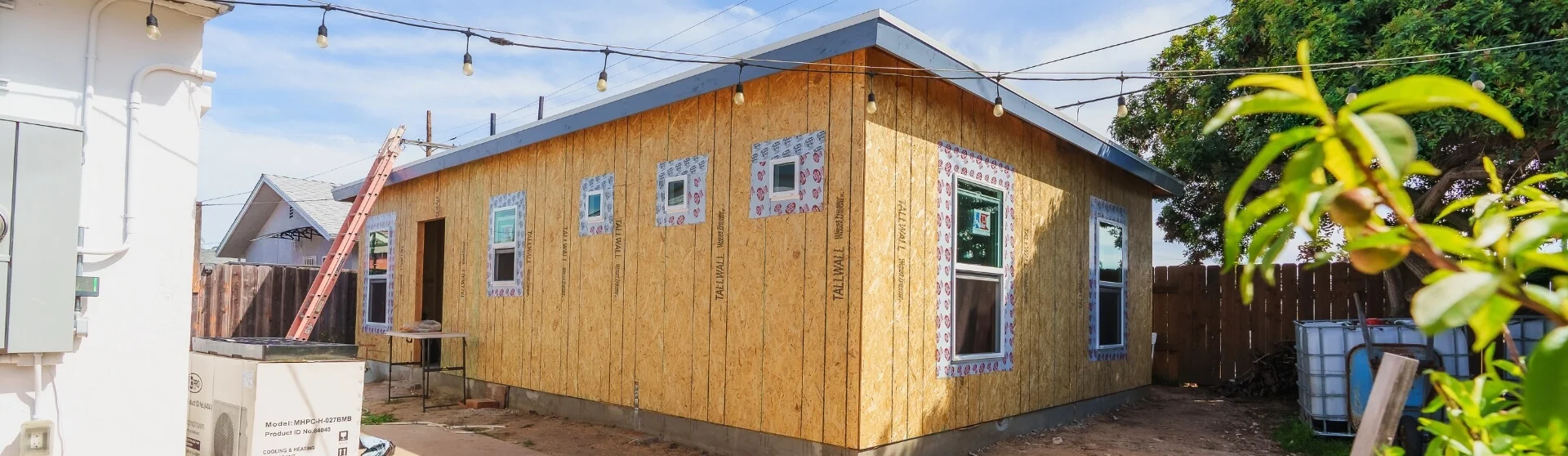
- Prefab versus stick-built: Prefab and modular units can offer faster timelines and predictable pricing in the $250 to $400 per square foot installed range, but site prep costs still apply and local permitting still takes time
Pro Tip: Get a site evaluation before you finalize any ADU budget. A qualified contractor or design-build firm can flag utility distances, foundation requirements, and grading needs that will materially change your numbers.
How to estimate and manage your ADU budget
Good ADU construction cost estimating starts with a simple framework, then adds the layers that most online calculators skip.
- Calculate your base hard cost. Multiply your target ADU size by the median hard construction rate for your region and ADU type. For a 700 square foot detached ADU in Los Angeles, that might be $350/sf, giving you $245,000 as your starting point.
- Add soft costs. Multiply your hard cost by 1.15 (the midpoint of the 12 to 18% soft cost range). That brings your example to roughly $282,000.
- Assess site-specific additions. Get a preliminary site review to estimate utility connection distances, grading needs, and any demolition required. Add those figures as line items.
- Build a contingency. Add 10% to your adjusted total for unforeseen conditions, design revisions, and permit feedback. Experienced builders rarely finish a project without at least some unexpected costs.
- Compare against rental income. For investors, run a quick cap rate check. Divide projected annual net rental income by your all-in project cost to confirm the numbers support the investment.
- Get at least three detailed bids. Never use a single contractor quote or an online ADU cost calculator as your final number. Ask each bidder to itemize hard costs, soft costs, and site work separately so you can compare apples to apples.
The biggest mistake in budgeting for an ADU is treating the per-square-foot figure as the whole answer. It is a useful starting point, nothing more.
Separate an ADU renovation budget from new construction: retained finishes or framing do not tell you whether systems, structure or concealed conditions need work. An ADU rental budget should also distinguish construction spending from ongoing ownership expenses. Use the ADU cost guide to organize scope questions and the financing guide to compare how the work could be funded.
My honest take on ADU cost complexity
I’ve worked on hundreds of ADU projects across California, and the single biggest source of budget shock I see is homeowners treating the price per square foot as a fixed formula. They find a number online, multiply it by their target size, and assume they have a budget. They don’t. They have a rough estimate that’s missing permits, engineering, site prep, and a contingency for the surprises that come with every project.
What I’ve learned is that soft costs catch people off guard more than anything else. A homeowner will research construction costs for months but never look up what a permit actually costs in their city. In Los Angeles, permit fees and design work can run $20,000 to $35,000 before a nail is driven. That’s not a footnote. That’s a real budget line.
I’ve also seen the “build small to save money” logic backfire repeatedly. A 400 square foot unit costs nearly as much to permit and design as a 750 square foot unit. The person who builds the smaller unit often ends up with a worse rental income and a higher per-square-foot cost. Bigger ADUs, up to the size the market will support, generally perform better financially over time.
My advice: start with a site evaluation, not a calculator. Know your region’s permit fees before you finalize any design. And build as large as your lot, budget, and rental market will support. The math almost always favors it.
, Uni Construction
Plan your ADU build with Uni Construction’s expert team
If you’re serious about building an ADU in California, the numbers in this article are only useful once they’re applied to your specific property and goals.
Uni Construction specializes in the full scope of ADU development in Southern California, from permit-ready design drawings and structural engineering to construction management. The team has hands-on experience with Los Angeles city fees, county requirements, and the site-specific variables that make or break a budget. Whether you’re planning a detached ADU in Los Angeles or weighing your options across different ADU types, Uni Construction can provide a personalized cost estimate based on your actual lot conditions, not a generic statewide average. Reach out for a consultation and get clarity on what your project will actually cost before you commit to anything.
FAQ
Detached ADUs in California average $300 to $500+ per square foot all-in, with garage conversions and JADUs running lower. Exact pricing depends on region, ADU type, size, and site conditions.
Fixed costs like kitchens and permits don’t decrease with smaller unit sizes, so they consume a larger share of the per-square-foot cost on compact ADUs compared to larger builds.
Budget 12 to 18% of your hard construction cost for soft expenses including design, engineering, and permits. On a $300,000 hard cost, that means adding $36,000 to $54,000 to your total.
Utility trenching distance, sloped terrain, and poor soil conditions are the most common drivers. Trenching alone can add $15,000 to $30,000 or more depending on how far your ADU sits from existing connections.
Yes. Sacramento ADU projects typically run 30 to 40% less per square foot than comparable builds in Los Angeles or the Bay Area, primarily due to lower labor rates and reduced city permit fees.