


Accessory dwelling unit financing in California is defined as the set of loan products, equity instruments, and grant programs homeowners use to fund ADU construction on their existing property. The most common ADU financing options California homeowners use in 2026 are HELOCs, home equity loans, cash-out refinancing, and construction loans. The CalHFA ADU Grant program began with a $100 million budget and funded 2,500 ADUs before pausing in december 2023. It remains paused as of mid-2026 and should not factor into your current budget. Each financing path has different equity requirements, credit thresholds, and cost structures worth understanding before you commit.
What are the main ADU financing options in California?
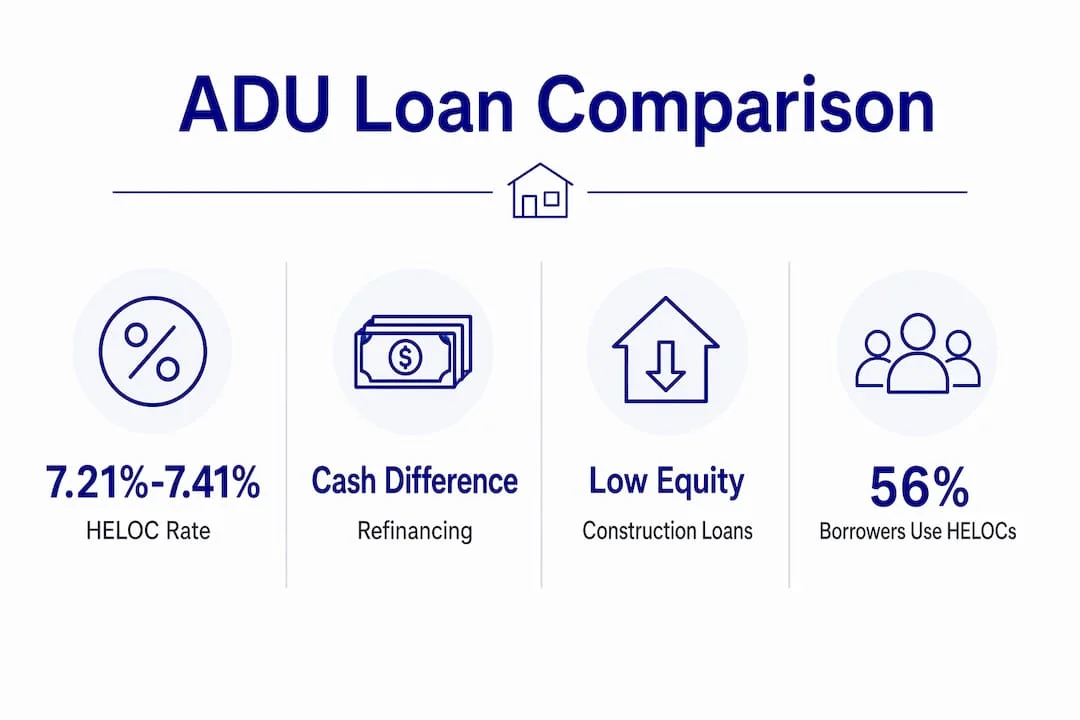
56% of California ADU borrowers use HELOCs or home equity loans, making them the dominant financing choice when sufficient equity exists. That majority reflects a simple reality: most California homeowners carry substantial equity after years of appreciation, and tapping it is faster and cheaper than taking out a new loan from scratch.
HELOCs and home equity loans
A HELOC is a revolving line of credit secured by your home. HELOCs charge interest only on the amount drawn, which makes them cost-effective during construction when funds go out in stages rather than all at once. Average variable rates for HELOCs in California run 7.21%–7.41% in 2026. Most banks and credit unions cap combined loan-to-value (CLTV) at 80%–85%, meaning your total mortgage plus the HELOC cannot exceed that share of your home’s appraised value. Home equity loans work the same way on the equity side but deliver a lump sum at a fixed rate, which suits homeowners who want predictable monthly payments.

Cash-out refinancing
Cash-out refinancing replaces your existing mortgage with a larger one and gives you the difference in cash. The problem is rate risk. Financial experts advise against cash-out refinancing if your existing mortgage rate is below 5%, because replacing a low-rate loan raises your monthly payment on the full balance. For homeowners who locked in rates at 3%–4% during 2020–2021, a cash-out refi can cost tens of thousands of dollars more over the loan’s life. Use this option only when your current rate is already close to market rates.
ADU construction loans
Construction loans are the right tool when you have low or no equity. Interest rates on construction loans generally run 8%–11% during the build phase, then convert to a permanent mortgage after completion. Lenders disburse funds in draws tied to construction milestones, which limits overpayment risk and keeps contractors accountable. The tradeoff is documentation: lenders require detailed plans, licensed contractors, and full budget breakdowns before releasing any funds.
Comparison of major California ADU loan options
| Loan type | Typical rate | Best for | Key requirement |
|---|---|---|---|
| HELOC | 7.21%–7.41% variable | Staged draws, flexible spending | 80%–85% CLTV limit |
| Home equity loan | Fixed, varies by lender | Lump-sum, fixed payments | Sufficient home equity |
| Cash-out refinance | Current market rate | High-rate existing mortgage | Rate comparison critical |
| Construction loan | 8%–11% during build | Low or no equity | Full plans and licensed contractor |
| Personal/renovation loan | Higher, unsecured | Small projects, fast funding | Credit score and income |
Pro Tip: Get quotes from at least three lenders before choosing. California ADU lenders vary widely on fees, CLTV limits, and willingness to count projected rental income toward qualification.
How to determine your eligibility for an ADU loan in California
Lender eligibility for California ADU loans depends on three factors: your credit score, your available equity, and the projected value of your home after construction. Most lenders require a minimum credit score of 680 for HELOCs and home equity loans. Construction loan lenders typically want 700 or higher, given the added complexity of the project.
Your CLTV ratio is the most important number to calculate before applying. If your home is worth $800,000 and your mortgage balance is $500,000, your current LTV is 62.5%. At an 80% CLTV cap, you can borrow up to $140,000 through a HELOC or home equity loan. That math determines your budget ceiling before you ever talk to a lender.
After-renovation value and the appraisal gap
After-renovation value (ARV) appraisals are critical and frequently cause funding shortfalls when homeowners skip them or use an appraiser unfamiliar with ADU projects. The ARV appraisal projects what your home will be worth once the ADU is complete. If the appraiser underestimates that value, your approved loan amount shrinks and you face a mid-project funding gap. Always hire an appraiser with documented experience valuing ADU properties in your specific California market.
Using rental income to qualify for a larger loan
Fannie Mae allows projected ADU rental income to count toward mortgage qualification as of 2026. This is one of the most underused tools in California ADU financing. A homeowner whose income alone would cap their borrowing at $150,000 may qualify for significantly more when a lender adds projected monthly rent to the debt-to-income calculation. Qualifying under this rule requires both an “as-is” and an “as-completed” appraisal, plus a professional rent comp study. The extra paperwork is worth it for homeowners in high-rent markets like Los Angeles or the San Gabriel Valley.
Pro Tip: Commission a professional rent comp study before your loan application. Lenders using Fannie Mae guidelines need this document for underwriting, and it can meaningfully increase your approved loan amount.
The documents you need for any ADU loan application include recent tax returns, W-2s or 1099s, bank statements from the past two to three months, a current mortgage statement, a property appraisal, and your ADU construction plans. Having these ready before you apply cuts weeks off the underwriting timeline.
Step-by-step guide to securing ADU financing
- Calculate your equity and credit score. Pull your credit report and get a current home appraisal. Know your CLTV before approaching any lender.
- Choose the right loan type. Use a HELOC or home equity loan if you have 20%+ equity and a low-rate existing mortgage. Use a construction loan if equity is limited or you need lender-controlled disbursements.
- Get your construction plans and permits in order. Lenders require permitted projects. Review the California ADU permit process before applying, since incomplete permits can stall loan approval.
- Apply with multiple lenders. Submit applications to at least three lenders simultaneously. Rate and fee differences between lenders can add up to thousands of dollars over the loan term.
- Prepare for underwriting. Expect the lender to verify income, review the appraisal, and inspect construction plans. Construction loans take longer to underwrite than HELOCs because of the added documentation.
- Manage fund disbursements carefully. For construction loans, funds release in draws after inspections at each milestone. Keep a contingency reserve of 10%–15% of your total budget for cost overruns.
- Finalize permanent financing after completion. Construction loans convert to a permanent mortgage at project completion. Confirm the conversion terms before signing the original loan agreement.
The step that most homeowners skip is number three. Lenders will not approve funds for unpermitted work, and discovering a permit gap mid-project can freeze your financing entirely. Knowing the risks of ADU investment in California before you start protects both your budget and your timeline.
Common mistakes to avoid when financing an ADU in California
The most expensive mistake California homeowners make is refinancing a low-rate mortgage to fund an ADU. If your rate is below 5%, a cash-out refi raises your payment on the entire loan balance, not just the ADU portion. A HELOC or home equity loan keeps your primary mortgage intact and costs far less over time.
- Ignoring the appraisal gap. An ARV that comes in lower than expected shrinks your loan. Hire an appraiser who specializes in ADU valuations.
- Underestimating total project costs. Closing costs, permit fees, engineering fees, and contractor markups add 15%–20% to base construction costs. Budget for all of them.
- Choosing variable rates without a plan. HELOCs carry variable rates that can rise during a long construction timeline. Know your rate cap and have a payoff strategy.
- Paying contractors before work is complete. Construction loans prevent this by design. Personal loans and HELOCs do not. Set up a milestone payment schedule in your contractor agreement regardless of loan type.
- Skipping the rent comp study. If you plan to rent the ADU, a rent comp study can increase your loan qualification. Skipping it leaves money on the table.
Paperwork complexity intimidates many homeowners away from construction loans, but that complexity is the feature, not the bug. Lender-controlled disbursements protect you from contractor overpayment and project abandonment far better than a lump-sum HELOC ever can.
Total cost of capital is the right metric to evaluate any loan. That means adding origination fees, closing costs, rate adjustment risk, and refinancing impacts to the advertised interest rate. A HELOC at 7.4% with low fees often beats a personal loan at 9% with high origination costs, even though the headline rate looks similar.
Separate grant searches from a committed budget
Searching for California ADU grants is a starting point for checking programs, not evidence that funding is available for your project. Confirm the provider, current funding window, eligibility and payment conditions before relying on any assistance. A “free ADU” offer also needs careful review of who pays, who owns the unit and what rights or obligations the agreement creates. For ADU financing in California, compare the complete borrowing cost and repayment assumptions with the project budget; do not choose the cheapest ADU proposal by headline price alone.
Key takeaways
The best ADU financing option in California depends on your existing equity, your current mortgage rate, and whether you plan to rent the unit after completion.
| Point | Details |
|---|---|
| HELOCs dominate California ADU financing | 56% of borrowers choose HELOCs or home equity loans when equity allows. |
| Protect your low-rate mortgage | Avoid cash-out refinancing if your existing rate is below 5%. |
| ARV appraisal determines your budget ceiling | Use an appraiser experienced with ADU valuations to avoid mid-project funding gaps. |
| Rental income can increase your loan amount | Fannie Mae allows projected ADU rent to count toward qualification with a rent comp study. |
| Construction loans protect your funds | Lender-controlled disbursements reduce contractor overpayment risk on large builds. |
My honest take on ADU financing after years of California projects
The homeowners who get the best outcomes are the ones who treat financing as part of the design process, not an afterthought. At Uni Construction, we see clients come to us after they have already committed to a loan that does not match their project scope. A HELOC sized for a garage conversion will not cover a detached two-bedroom ADU with full utilities. Getting the financing right requires knowing the build cost first.
The advice I give every client is to preserve your primary mortgage rate at all costs. California homeowners who locked in sub-4% rates between 2020 and 2022 have a financial asset in that rate. A construction loan or HELOC as a second lien protects it. Refinancing throws it away.
Working with a lender who has closed California ADU loans before is not optional. Generic mortgage lenders often do not understand ARV appraisals, Fannie Mae rental income guidelines, or construction draw schedules. The wrong lender adds months to your timeline and may underwrite your loan at a lower amount than you qualify for. Ask your lender directly how many ADU loans they have closed in California in the past 12 months.
Finally, the ADU rental income potential in markets like Los Angeles and Pasadena is strong enough that rental income qualification should be part of every application conversation. Do not leave that tool unused.
, Uni Construction
Uni Construction’s ADU design and construction services in California
Financing is only one piece of the ADU puzzle. The other piece is having plans that lenders will actually approve and permits that move through the city without delays.
Uni Construction specializes in permit-ready ADU designs, structural engineering, and full construction management across Los Angeles and the San Gabriel Valley. Our team has guided hundreds of homeowners through the design-to-permit process, producing the exact documentation that construction loan lenders require: detailed plans, licensed contractor coordination, and budget breakdowns. Whether you are building a backyard cottage, converting a garage, or adding a junior ADU, our ADU design services in Los Angeles give you the plans and permits your lender needs to release funds on schedule. Contact Uni Construction for a consultation and get your project started on solid ground.
FAQ
HELOCs and home equity loans are the most common choice, used by 56% of California ADU borrowers. They work best when homeowners have at least 20% equity after accounting for the CLTV limit.
The CalHFA ADU Grant program is paused as of mid-2026 and should not be included in your project budget. It funded 2,500 ADUs before stopping in december 2023, and no restart date has been announced.
Yes. Fannie Mae allows projected ADU rental income to count toward mortgage qualification in 2026, but it requires both an as-is and as-completed appraisal plus a professional rent comp study.
Most lenders require a minimum score of 680 for HELOCs and home equity loans. Construction loan lenders typically want 700 or higher due to the added underwriting complexity.
Use a HELOC if you have strong equity and want flexible draws at lower rates. Use a construction loan if your equity is limited or you want lender-controlled disbursements that protect against contractor overpayment.