


An ADU construction loan is a specialized financing product that funds the building of an Accessory Dwelling Unit by releasing money in stages during construction, then converting to a permanent mortgage once the build is complete. Unlike a standard home improvement loan, this product treats your ADU as a development project with its own underwriting logic, draw schedule, and payoff structure. If you are exploring how to finance an ADU in California or anywhere else in 2026, understanding this loan type is the clearest starting point. The right financing decision depends on your equity position, credit profile, and how well you can document your project before you ever speak to a lender.
How does an ADU construction loan work?
An ADU construction loan operates in two distinct phases: the construction period and the permanent loan period. During construction, the lender does not hand you a lump sum. Instead, funds are released in milestone-based draws tied to verified progress on your project.

One-time-close construction loans carry construction phase interest rates between 9.0% and 12.0%, converting to permanent 30-year fixed rates of 6.5% to 7.5% once the build is complete. That spread matters because you only pay interest on the drawn balance during construction, not the full loan amount. This keeps your monthly cost lower while the unit is being built.
Here is what the typical loan lifecycle looks like:
- Credit and down payment: Most lenders require a credit score of 680 or higher and a down payment of 10% to 20% of the total project cost.
- Closing timeline: Expect 60 to 90 days from application to loan closing before construction can begin.
- Construction window: The active build phase typically runs about 12 months, with draws released after third-party inspection confirms each milestone.
- Conversion: At project completion, the loan converts to a standard permanent mortgage, locking in the agreed rate.
- Draw bridging: Because funds release after milestone verification, you need cash on hand to cover contractor payments between draw disbursements.
Pro Tip: Ask your lender for the exact draw schedule in writing before you sign. Misaligned draw timing is one of the most common causes of cash flow problems mid-project.
The ADU project timeline from design through permit approval to construction completion typically spans 18 to 24 months total. Your loan structure needs to account for that full window, not just the build phase.
What financing alternatives exist for ADU construction?
ADU financing options extend well beyond construction loans. The right product depends on how much equity you hold, whether you want to preserve your existing mortgage rate, and how much flexibility you need during the build.
HELOCs are the most popular ADU financing method, used by 56% of borrowers, capped at 80% to 85% combined loan-to-value. As of early 2026, HELOC rates sit around 7.21% to 7.41%. That sounds attractive compared to construction loan rates, but HELOCs require higher monthly payments during the draw period and carry variable rate risk over time.
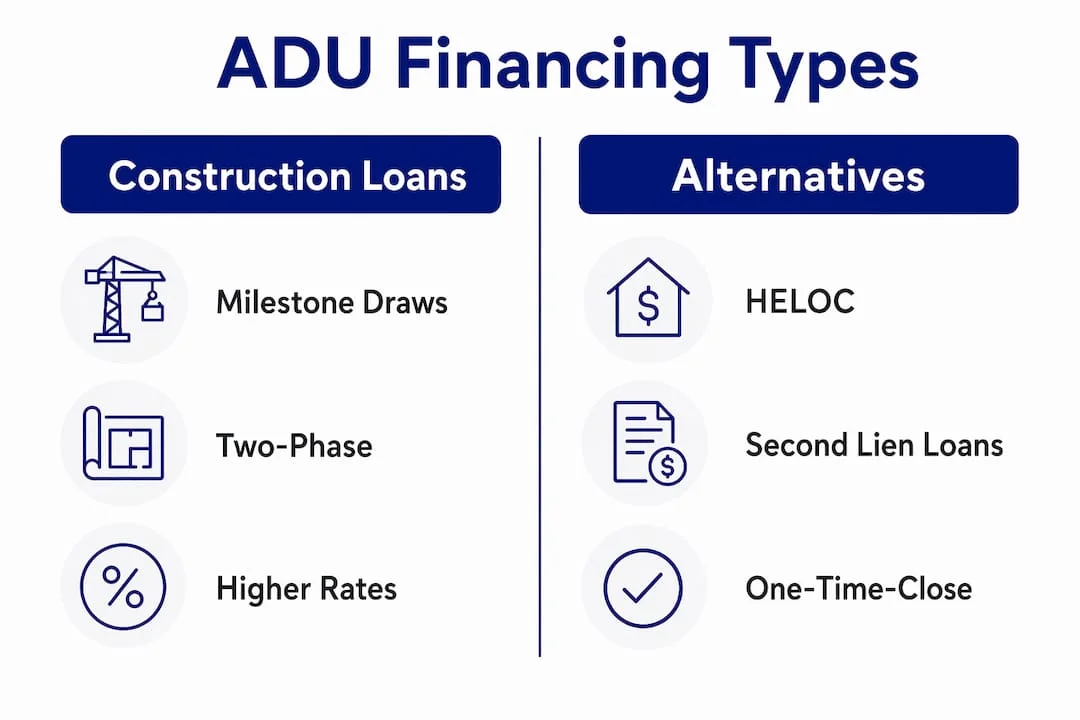
ADU-specific second lien loans offer a different angle. These products allow borrowing up to 80% to 90% of the completed ADU’s appraised value, which means the lender underwrites the finished unit rather than just your current equity. Funds are released in 3 to 4 scheduled draws during a 6 to 12 month construction period. The major advantage is that your existing primary mortgage stays untouched, preserving any low rate you locked in previously.
| Financing type | Typical rate (2026) | Funding limit | Best for |
|---|---|---|---|
| One-time-close construction loan | 9.0%–12.0% (construction), 6.5%–7.5% (permanent) | Based on project cost | Borrowers who want one closing and rate certainty |
| HELOC | 7.21%–7.41% (variable) | 80%–85% CLTV | Homeowners with strong equity and flexible draw needs |
| ADU second lien loan | Varies by lender | 80%–90% of completed value | Borrowers preserving a low primary mortgage rate |
| Cash-out refinance | Current market rate | Based on home equity | Borrowers willing to reset their primary mortgage |
The one-time-close versus two-time-close decision deserves its own attention. A one-time-close loan locks your permanent rate upfront, protecting you if rates rise during construction. A two-time-close loan lets you shop for a better permanent rate after construction ends, but it requires re-qualification at that point and adds closing costs for the second transaction. In a rising rate environment, the one-time-close structure carries less risk.
For California homeowners, the California ADU market in 2026 has also seen growth in specialty ADU lenders and credit union products. Consulting both credit unions and specialty ADU lenders before committing gives you a broader picture of what rates and terms are actually available to you.
What lenders expect before approving your ADU loan
Lenders treat ADU financing as underwriting a development project, not just evaluating your credit score. That shift in perspective changes what you need to bring to the table.
Complete project packages with fixed-price bids, architectural plans, and verified draw schedules are required before most lenders will move forward. A vague contractor estimate or preliminary sketch will not satisfy underwriting. You need a fully documented project before the loan conversation becomes serious.
Follow these preparation steps before submitting your application:
- Secure permit-ready plans. Lenders want to see that your project has a realistic path to permit approval. Unpermitted or speculative designs raise red flags.
- Get fixed-price bids from licensed contractors. Variable or open-ended bids signal cost overrun risk. A fixed-price contract gives the lender confidence in your total project cost.
- Build a draw schedule aligned with construction milestones. Work with your contractor to map each payment stage to a verifiable completion point.
- Prepare cash reserves. Lenders require proof that you can cover 10% to 20% of unexpected costs. This is not optional. Cost overruns are common in residential construction.
- Vet your contractor’s track record. Lenders assess contractor reliability as part of the underwriting process. A contractor with completed ADU projects and verifiable references strengthens your application.
- Understand your after-repair value. If the appraisal comes in lower than your estimated completed value, your maximum loan amount drops, potentially creating a funding gap mid-project.
Pro Tip: Budget at least 15% above your contractor’s fixed bid as a personal contingency reserve. Appraisal shortfalls and permit delays are the two most common sources of mid-project funding gaps, and both are largely outside your control.
Understanding hidden building costs before you finalize your budget is one of the most practical steps you can take. Soil conditions, utility connections, and fire sprinkler requirements in California can add significant cost that no initial bid captures.
The ADU types you choose also affect your loan requirements directly. A detached backyard cottage carries different construction costs and appraisal assumptions than a garage conversion or a Junior ADU. Know your unit type before you approach a lender.
How market conditions shape your loan choice in 2026
Interest rate conditions in 2026 make the construction-to-permanent loan structure more relevant than it was in the low-rate era. Construction phase rates between 9.0% and 12.0% feel steep, but the conversion to a 6.5% to 7.5% permanent rate is the number that matters for long-term cash flow.
A few factors define how lenders assess your specific situation:
- Rental income projection: Lenders factor projected ADU rental income into their underwriting when evaluating debt-to-income ratios. A well-documented rental analysis strengthens your application.
- After-repair value appraisal: The lender’s appraiser determines your maximum loan ceiling. If the appraisal falls short of your project cost estimate, you face a funding gap that requires personal cash to close.
- Equity and credit profile alignment: Borrowers with strong equity and a 720+ credit score access better rates and terms. Borrowers near the 680 minimum qualify but face tighter conditions.
- Lender specialization: Not all lenders understand ADU underwriting. A lender experienced with ADU projects in California will move faster and ask better questions than a generalist bank.
“Lenders treat ADU financing as a business project, underwriting rental income, permits, and contractor reliability, not just personal credit.” , Mortgage Vintage
That framing is the most useful mental shift you can make. Approach your loan application the way a developer approaches a project pro forma: with documentation, numbers, and a clear exit strategy.
Key takeaways
The most effective ADU construction loan strategy combines a well-documented project package, realistic cash reserves, and a lender experienced in ADU underwriting.
| Point | Details |
|---|---|
| Construction loan structure | Funds release in milestone draws, then convert to a permanent mortgage at completion. |
| Rate expectations in 2026 | Construction phase rates run 9.0%–12.0%; permanent rates convert to 6.5%–7.5%. |
| HELOC comparison | HELOCs cover 80%–85% CLTV at lower rates but carry variable rate risk and higher draw-period payments. |
| Lender documentation | Fixed-price bids, permit-ready plans, and draw schedules are required before underwriting begins. |
| Appraisal risk | A lower-than-expected after-repair appraisal reduces your loan ceiling and can create mid-project funding gaps. |
Start your ADU project with the right foundation
Financing an ADU starts long before you submit a loan application. Lenders want permit-ready plans, fixed bids, and a credible construction timeline. Uni Construction provides exactly that foundation: custom ADU designs, structural engineering, and permit-ready drawings built for Los Angeles properties. Whether you are planning a backyard cottage, a garage conversion, or a Junior ADU, having a complete project package in hand puts you in the strongest possible position with any lender. Explore Uni Construction’s ADU design services in Los Angeles to see how a professional design-to-permit process sets your financing up for success.
FAQ
An ADU construction loan is a short-term financing product that releases funds in milestone-based draws during the build phase, then converts to a permanent mortgage once construction is complete. It is designed specifically for homeowners building Accessory Dwelling Units.
Most lenders require a minimum credit score of 680, along with a 10% to 20% down payment on the total project cost. Borrowers with scores above 720 typically access better rates and terms.
HELOCs are the most popular ADU financing method, used by 56% of borrowers, and offer more flexible draw access at lower current rates. However, they carry variable rate risk and higher monthly payments during the draw period compared to construction loans.
A one-time-close loan locks your permanent rate before construction begins, protecting you from rate increases. A two-time-close loan allows you to shop for a better permanent rate after completion but requires re-qualification and adds a second set of closing costs.
Yes. Lenders underwriting ADU construction loans factor projected rental income into your debt-to-income calculation, which can improve your qualifying position when supported by a documented rental analysis.