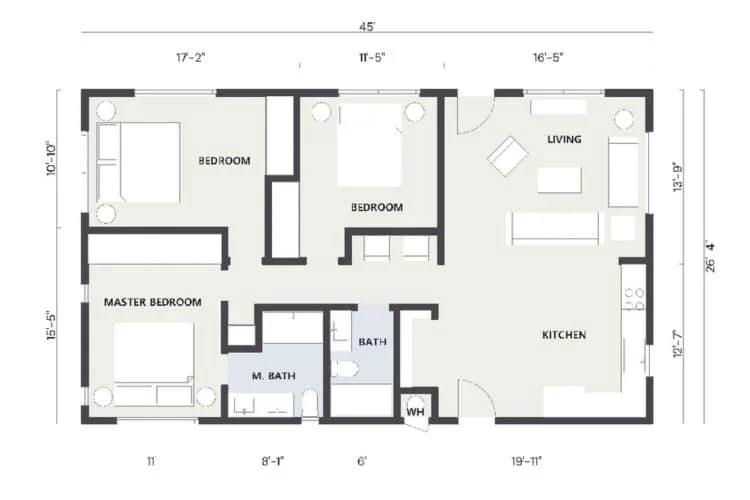



ADU rental income potential in California is defined by unit size, location, and the legal framework governing tenancy, with monthly rents ranging from $1,100 to over $3,200 depending on market and configuration. An accessory dwelling unit (ADU) is the industry term for what many homeowners call a backyard cottage, garage conversion, or in-law suite. California’s housing shortage, combined with state-level legislation that has progressively removed barriers to ADU construction, has made these units one of the most reliable income-generating assets available to residential property owners. Whether you own a single-family home in Los Angeles or a multi-unit parcel in Sacramento, understanding what drives ADU rental income is the first step toward making a profitable decision.
1. ADU rental income potential in California: what the numbers look like
Rental income for California ADUs spans a wide range: studios typically earn $1,100 to $1,800 monthly, one-bedroom units bring in $1,800 to $2,400, and two-bedroom configurations reach $2,400 to $3,200 or more in high-cost markets. These figures reflect the state’s severe housing shortage, which keeps vacancy rates low and tenant demand high across most metro areas.
Location is the single largest variable. Los Angeles neighborhoods, Diamond Bar and Pomona serve different groups of renters, so compare homes close to the actual property. Match bedroom count, usable floor area, private access, parking and condition. A compact detached ADU with its own outdoor space can attract a different rent from an attached conversion even when both have one bedroom.

The table below retains the article’s regional rental examples and adds a local comparison checklist. Treat the listed ranges as starting assumptions, then verify current comparable listings for the property before using a figure in a financial plan.
| City | Studio | 1-Bedroom | 2-Bedroom |
|---|---|---|---|
| Los Angeles | $1,400–$1,800 | $1,800–$2,400 | $2,400–$3,200 |
| Diamond Bar / Pomona | Verify recent studio comparables | Verify recent one-bedroom comparables | Verify recent two-bedroom comparables |
| Bay Area | $1,600–$2,200 | $2,400–$3,000 | $3,200–$3,800+ |
| Sacramento | $1,100–$1,400 | $1,400–$1,900 | $1,900–$2,500 |
Pro Tip: Before finalizing your ADU size, check active rental listings within a half-mile radius of your property. The gap between a studio and a one-bedroom in your specific zip code may justify the additional construction cost.
2. How location and ADU size drive rental price differences
ADU rental profitability in California is not uniform, even within the same city. A detached ADU in Silver Lake commands a premium over a garage conversion in the San Fernando Valley, even when both are one-bedroom units. Proximity to transit, walkability scores, and school district quality all push rents upward in ways that raw city-level data cannot capture.
Unit size has a compounding effect on income. Moving from a studio to a one-bedroom typically adds $400 to $600 per month in Los Angeles, while the jump from one-bedroom to two-bedroom adds another $400 to $800. That incremental revenue, sustained over 12 months, can represent the difference between recovering construction costs in 8 years versus 12 years. Understanding California ADU market trends helps investors model these timelines accurately before breaking ground.
ADU type also matters. Detached backyard units consistently outperform attached or garage-conversion ADUs in rental surveys because tenants pay a premium for privacy and separate outdoor space. Junior ADUs (JADUs), which are carved from existing home square footage, typically rent at the lower end of the range but carry significantly lower construction costs, making their return on investment competitive.
3. Legal and regulatory factors shaping ADU rental income
California’s AB 1482 Tenant Protection Act is the primary state-level rent control law affecting ADU landlords. New ADUs are exempt from AB 1482 rent caps for 15 years from the date of the certificate of occupancy. This exemption is a rolling window, meaning it advances annually and must be actively maintained with proper written notice to tenants.
The notice requirement is not optional. Landlords who fail to provide tenants with the exact statutory written language lose the exemption by default, and the unit becomes subject to AB 1482’s annual rent increase cap of 5% plus local CPI (not to exceed 10%). That single administrative oversight can cost thousands of dollars in foregone rent increases over the life of a tenancy.
Key regulatory factors every California ADU landlord must understand:
- AB 1482 exemption: Applies to ADUs less than 15 years old, but only when the landlord delivers the required written notice at lease signing.
- Single-family ownership exemption: Properties owned by individual landlords (not corporations or REITs) may qualify for an additional AB 1482 exemption, provided the tenant receives proper notice.
- Local ordinances: Cities like San Francisco, Los Angeles, Oakland, and Santa Monica enforce stricter local rent control that can override state exemptions for older units, though new ADUs generally remain protected under state law.
- Just-cause eviction rules: AB 1482 also imposes just-cause eviction requirements on covered units, limiting your ability to remove tenants without documented legal grounds.
“The 15-year exemption window rolls forward annually, making it critical for ADU owners to track their unit’s certificate of occupancy anniversary date and re-serve notice at each new tenancy.”
4. Tax implications and deductions for ADU rental income
California ADU income tax treatment follows federal passive activity rules. Rental income must be reported on Schedule E and is subject to both federal income tax and California state income tax through the Franchise Tax Board. The good news is that the IRS and FTB allow substantial deductions that reduce your net taxable income considerably.
Allowable deductions for ADU rental income include:
- Depreciation: The ADU structure (not land) depreciates over 27.5 years under residential rental property rules, generating a non-cash deduction each year.
- Mortgage interest: If you financed the ADU construction through a home equity loan or cash-out refinance, the interest portion is deductible against rental income.
- Maintenance and repairs: Routine upkeep, appliance replacements, and landscaping costs tied to the ADU are fully deductible in the year incurred.
- Utilities: If you pay water, gas, or electricity for the ADU, those costs reduce your taxable rental income.
- Property management fees: Any fees paid to a property manager or leasing agent are deductible as ordinary business expenses.
On the property tax side, building an ADU triggers only a supplemental assessment based on the new construction value, typically adding $2,500 to $4,000 annually for a unit valued between $250,000 and $350,000. Your existing property’s Prop 13 base value is not reassessed. That added tax burden is offset multiple times over by monthly rental income in virtually every California market.
Pro Tip: If your adjusted gross income exceeds $100,000, passive loss deduction rules phase out. A CPA who specializes in rental properties can optimize your passive income strategy and prevent costly surprises at tax time.
5. Design and construction choices that maximize rental income
The physical design of your ADU directly determines how much rent you can charge and how quickly you fill vacancies. Flexible layouts, separate utilities, and modern finishes attract higher-paying tenants and reduce the time a unit sits empty. These are not cosmetic preferences. They are measurable rent drivers.
The comparison below illustrates how design choices affect rental outcomes:
| Feature | Budget Build | Premium Build |
|---|---|---|
| Layout | Fixed single-use rooms | Open-plan with flex space |
| Utilities | Shared with main house | Separate meters |
| Entrance | Shared or side access | Private entrance, dedicated path |
| Finishes | Builder-grade | Mid-to-high grade kitchen, bath |
| Estimated rent premium | Baseline | $200–$500/month above baseline |
A private entrance alone can add $150 to $300 per month in rent in Los Angeles, because tenants value the psychological separation from the primary household. Separate utility meters eliminate billing disputes and make the unit more attractive to long-term tenants who want predictable costs. Strategies for optimizing space in property development confirm that efficient floor plans with multi-use areas consistently outperform single-purpose layouts in rental desirability.
The income and value benefits of ADUs are most pronounced when design quality aligns with the local rental market. Overbuilding finishes in a mid-tier Sacramento neighborhood yields diminishing returns, while underbuilding in a premium Los Angeles neighborhood leaves real money on the table.
6. Strategies for maximizing ADU rental income through multiple units
Assembly Bill 976 eliminated the owner-occupancy requirement in 2025, allowing California property owners to rent both the primary residence and the ADU simultaneously. This single legislative change effectively doubled the rental income potential for many homeowners who previously had to live on-site to comply with local rules.
California law now permits most single-family lots to accommodate one standard ADU and one Junior ADU (JADU). A property in Los Angeles could generate $2,200 per month from a one-bedroom detached ADU and an additional $1,400 from a JADU conversion inside the main house, producing $3,600 in combined monthly rental income from a single parcel. That figure represents a meaningful income stream against the backdrop of California’s high cost of living.
The long-term versus short-term rental decision deserves careful analysis. Platforms like Airbnb and Vrbo can generate higher nightly rates, but many California cities, including Los Angeles and Santa Monica, have enacted strict short-term rental ordinances that limit or prohibit non-owner-occupied short-term rentals. Long-term leases offer lower per-night revenue but provide stable, predictable income with fewer regulatory risks.
Pro Tip: If you are considering a Junior ADU, review the specific JADU design requirements before finalizing plans. JADUs have distinct size limits and efficiency kitchen requirements that affect both construction cost and rental appeal.
Key takeaways
California ADU rental income potential is maximized when location-appropriate design, legal compliance, and tax strategy are treated as equally important as construction quality.
| Point | Details |
|---|---|
| Rental income range | Studios earn $1,100–$1,800/month; two-bedrooms reach $3,200+ in high-cost markets. |
| AB 1482 exemption | New ADUs are exempt from rent caps for 15 years, but only with proper written tenant notice. |
| Tax deductions reduce liability | Depreciation, mortgage interest, and maintenance deductions significantly lower taxable rental income. |
| Design drives rent premiums | Private entrances and separate utilities can add $200–$500/month above a baseline build. |
| AB 976 doubles income potential | Owners can now rent both the main house and ADU simultaneously, removing the prior occupancy restriction. |
What we have learned building ADUs across Southern California
After working with hundreds of homeowners across Los Angeles and the surrounding region, the pattern is consistent: the landlords who earn the most from their ADUs are not necessarily the ones who spent the most on construction. They are the ones who made deliberate decisions early, starting with unit size relative to local demand, then design features that justify premium rents, and finally legal compliance that protects their income from regulatory erosion.
The AB 1482 exemption issue is where I see the most preventable damage. Landlords assume the exemption is automatic. It is not. The written notice requirement is a procedural step that many skip, and the cost of that oversight compounds every year the tenancy continues. I have seen landlords locked into below-market rents for years because they never served the correct notice at lease signing.
The 2025 elimination of owner-occupancy requirements changed the calculus for investors significantly. Properties that were previously limited to a single rental unit can now generate income from two units simultaneously. That shift, combined with growing ADU demand across California, makes 2026 one of the strongest years on record to build and rent an ADU. The investors who act now, with the right design and the right legal foundation, will be the ones collecting above-market rents five years from now.
, Uni Construction
Build the ADU that earns what your market will support
Uni Construction designs and builds ADUs specifically engineered for California’s rental market. Every project starts with a site analysis that accounts for local rent comparables, zoning rules, and permit requirements, so your unit is sized and finished to maximize monthly income from day one. The team handles custom design, permit-ready drawings, structural engineering, and full construction management, removing the guesswork from a process that has real financial consequences if done wrong. If you are ready to move from evaluating income potential to generating it, explore Uni Construction’s ADU design services in Los Angeles and request a project consultation.
FAQ
California ADU rents average $1,800 to $2,000 for typical units, with studios starting around $1,100 and two-bedroom units reaching $3,200 or more in high-cost markets like Los Angeles and the Bay Area.
New ADUs are exempt from AB 1482 rent control for 15 years from the certificate of occupancy date, but landlords must serve exact written notice to tenants at lease signing to claim the exemption.
ADU rental income is reported as passive activity on Schedule E and is subject to federal and California state income tax, with deductions available for depreciation, maintenance, mortgage interest, and utilities.
Yes. Assembly Bill 976 removed the owner-occupancy requirement effective 2025, allowing California property owners to rent both the primary residence and the ADU simultaneously.
Building an ADU triggers only a supplemental assessment on the new construction value, typically adding $2,500 to $4,000 annually, without reassessing your existing property’s Prop 13 base value.