

Accessory dwelling units (ADUs), also called granny flats, in-law units, or backyard cottages, are the fastest-growing residential housing category in California, driven by a combination of state policy reforms, a severe housing shortage, and shifting household demographics. California recorded 38,910 ADU permits in 2024, a record that reflects years of deliberate legislative action and rising homeowner interest. That number is not an accident. It is the direct result of laws that removed local barriers, timelines that gave developers certainty, and a housing market so expensive that ADUs became one of the few financially viable ways to add supply. If you are a homeowner or investor trying to understand why this sector keeps growing, the answer sits at the intersection of policy, economics, and family need.
Why ADU demand grows in California: the policy foundation
California’s ADU surge did not happen organically. It was engineered through a sequence of state laws that systematically stripped away local government authority to block or delay ADU construction. Understanding this legislative history is the clearest way to see why the step-function increases in permits align so precisely with specific bill signings.
The key milestones look like this:
- SB 1069 (2016): Reduced parking requirements and setback rules, making it legal to build ADUs on lots that previously could not accommodate them.
- AB 2299 (2016): Required local governments to ministerially approve ADU applications, removing discretionary review that had allowed cities to reject projects on subjective grounds.
- AB 68 (2019): Eliminated owner-occupancy requirements and reduced minimum lot size restrictions, opening ADU construction to rental property owners and smaller parcels.
- SB 13 (2019): Capped impact fees and prohibited local agencies from imposing fees on ADUs under 750 square feet, directly reducing construction costs.
- SB 543 (2025): Imposed enforceable 15-business-day completeness reviews and 60-day approval timelines, with clear appeal processes when agencies miss deadlines.
Each law closed a loophole that local governments had used to slow or prevent ADU construction. The cumulative effect is what researchers call a “clarity dividend.” When rules are clear and timelines are enforceable, developers and homeowners can plan with confidence. That confidence translates directly into permit applications.
Los Angeles illustrates the geographic concentration effect. The city accounts for approximately 37% of all statewide ADU permits, a share that reflects both its population density and its early adoption of streamlined local processes. As other cities catch up with state requirements, that share is gradually decentralizing.
Pro Tip: If you are planning an ADU project, review your city’s compliance with SB 543 timelines before submitting. Agencies that have not updated their processes are legally required to approve applications within 60 days regardless, which gives you a clear enforcement path if they stall.
How California’s housing crisis fuels ADU construction
California’s housing shortage is the structural force behind ADU demand. The state has chronically underbuilt housing relative to population growth for decades, and the result is a market where median home prices in many counties exceed $800,000. That price level excludes most first-time buyers and puts enormous pressure on renters, families, and older residents on fixed incomes.
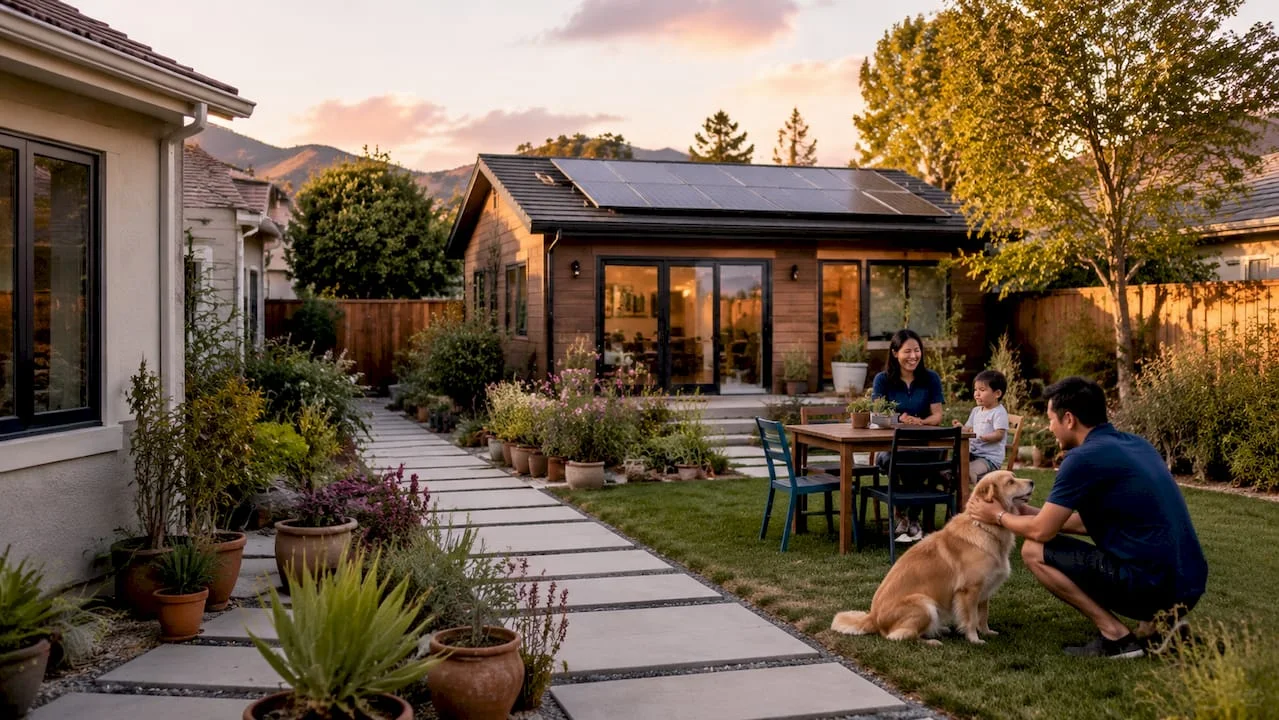
The California Department of Housing and Community Development (HCD) frames ADUs explicitly as an affordable and innovative housing option because they solve the cost problem from both sides. For builders, ADUs avoid the two largest expenses in conventional housing development: land acquisition and major infrastructure investment. A homeowner building a backyard cottage already owns the land. The utility connections already exist. The permitting pathway is simpler than a full subdivision.
The cost advantages compound quickly:
- No land purchase cost, which typically represents 20 to 30 percent of a new home’s total cost in California
- Wood frame construction rather than the steel or concrete required for multifamily buildings
- No elevator, parking structure, or shared corridor requirements
- Lower soft costs because the project is attached to an existing permitted property
For homeowners, the income potential is substantial. A well-located ADU in Los Angeles or the Bay Area can generate $1,500 to $3,000 per month in rental income, depending on size and finish level. That income can offset a mortgage, fund retirement, or cover the ADU’s construction cost within a few years.
“ADUs are one of the most cost-effective tools available to increase California’s housing supply because they leverage existing infrastructure and land without requiring new public investment.” , California Department of Housing and Community Development
The unique cost structure of ADUs makes them feasible for individual homeowners in a way that conventional multifamily development simply is not. That accessibility is a primary reason why the increasing popularity of ADUs continues to outpace other housing types in California’s residential permit data.
How multigenerational living trends drive ADU popularity
Multigenerational living is not a new concept in California, but it has accelerated sharply as housing costs have risen and family caregiving needs have grown. The data from Realtor.com makes the scale clear: over 6% of active California listings are marketed with ADU-related features, and those listings attract 13% more online views than comparable homes without ADUs. Buyers are actively searching for properties that can accommodate multiple generations under one roof while preserving privacy.
The cultural dimension matters here. Asian and Hispanic communities in California have long maintained multigenerational household traditions, and ADUs fit naturally into those patterns. A detached backyard unit gives aging parents their own kitchen and entrance while keeping them close enough for daily support. An adult child returning from college or a family caregiver can live on the property without the awkwardness of sharing a primary residence.
| Use Case | Who Benefits | Key Advantage |
|---|---|---|
| Aging parent housing | Adult children and parents | Proximity with independence |
| Adult child return | Young adults and parents | Reduced housing cost burden |
| Family caregiver unit | Families with care needs | On-site support without shared living |
| Rental income unit | Homeowner investors | Monthly revenue from existing land |
The economic durability of multigenerational ADUs is a point that often gets overlooked. A unit built for a family member can convert to a rental if circumstances change, and a rental unit can convert back to family use when needed. Multigenerational ADUs serve dual roles that reduce exposure to rental market volatility in a way that purely investment-oriented units cannot.
Pro Tip: When designing an ADU for a family member, build in features that make it rentable later: a private entrance, a full kitchen, and at least one dedicated parking space. This preserves your flexibility without adding significant cost upfront.
What permitting reforms actually mean for your project timeline
The practical impact of SB 543 on ADU projects is significant and worth understanding in detail. Before this law, permitting timelines in California cities varied wildly. Some jurisdictions processed ADU applications in 30 days. Others took six months or more, creating financing problems because lenders often require permit approval before releasing construction funds.
SB 543 changed the rules in three concrete ways:
- 15-business-day completeness review: The local agency must tell you within 15 business days whether your application is complete or what is missing. This eliminates the indefinite “pending review” status that previously allowed agencies to delay without consequence.
- 60-day approval timeline: Once an application is deemed complete, the agency has 60 days to approve or deny it. Missing this deadline triggers an automatic approval pathway under state law.
- Clear appeals process: If an agency denies an application or misses a deadline, the law specifies the appeal mechanism, giving applicants a defined legal path rather than an open-ended dispute.
San Jose pioneered a related approach with pre-approved standard ADU plans, which allow homeowners to pull permits for pre-designed units without a full custom review. This model reduces both cost and timeline by eliminating the design review phase entirely for qualifying projects. Cities across California are now studying San Jose’s approach as a template.
For investors, predictable permitting timelines reduce what practitioners call “queue risk,” the uncertainty about when a project will be approved and whether financing terms will still be valid at that point. Removing that uncertainty makes ADU projects bankable in a way they were not five years ago. You can review the full ADU project timeline to understand how these reforms affect your schedule from design through construction.
What economic and lifestyle benefits make ADUs worth building
The case for building an ADU in California rests on several distinct advantages that apply whether you are a homeowner looking for income or an investor building a portfolio.
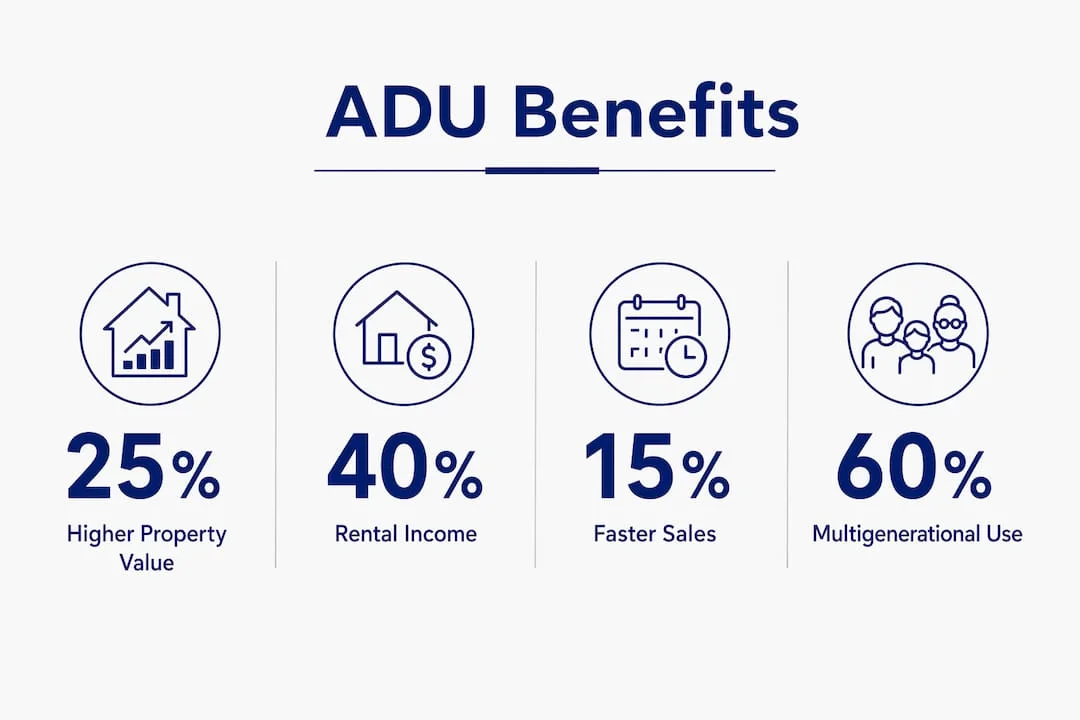
On the financial side, ADUs generate rental income without requiring a separate property purchase. The construction cost per square foot in California typically runs lower than a comparable standalone home because of shared infrastructure and simpler permitting. The return on investment timeline is shorter than most real estate investments because the land cost is zero.
On the lifestyle side, ADUs offer flexibility that conventional housing cannot match. A unit built today for rental income can house an aging parent in ten years. A unit built for a family member can generate income when that person moves on. This adaptability is particularly valuable in California, where household compositions change frequently due to high mobility and economic pressure.
ADU-equipped properties also sell faster and at higher prices. Listings with ADU features attracted 13% more online views and sold with greater competitive velocity than standard homes, according to Realtor.com’s 2025 data. That market premium reflects buyer recognition of the income and flexibility value embedded in the property.
For investors specifically, the California ADU market analysis for 2026 shows that multigenerational ADUs represent more stable assets than purely rental-oriented units because family use reduces vacancy risk and turnover costs. The construction market intelligence platform Shovld tracks these trends in real time, and their construction market insights consistently show ADU development outperforming other residential categories in California on a risk-adjusted basis.
Key takeaways
ADU demand in California grows because state policy reforms, housing affordability pressures, multigenerational living trends, and predictable permitting timelines have combined to make ADU construction the most accessible and financially viable housing option available to California homeowners and investors.
| Point | Details |
|---|---|
| Policy drives permit volume | Laws like SB 1069, AB 68, and SB 543 removed local barriers and created enforceable timelines that directly increased permit applications. |
| Cost structure is uniquely favorable | ADUs eliminate land acquisition and major infrastructure costs, making them feasible for individual homeowners unlike conventional multifamily development. |
| Multigenerational demand is structural | Over 6% of California listings feature ADU-related units, driven by cultural traditions, caregiving needs, and housing cost pressure. |
| Permitting certainty attracts investors | SB 543’s 15-day and 60-day timelines reduce queue risk and make ADU projects financeable with greater confidence. |
| Market premium is measurable | ADU-equipped homes attract 13% more online views and sell faster, confirming buyer recognition of their income and flexibility value. |
What we’ve learned building ADUs across Southern California
After working on ADU projects across Los Angeles and surrounding communities, the pattern we see most often is this: homeowners who wait for the “perfect” moment to build an ADU lose years of rental income and family flexibility that they cannot recover. The policy environment in California has never been more favorable, and the financial case has never been clearer.
What surprises most clients is how much the permitting process has improved. Three years ago, a Los Angeles ADU permit could take four to eight months. Today, with SB 543 in effect and a well-prepared application, the same process runs closer to 60 to 90 days. That shift is not marginal. It changes the entire financial model of a project.
The investors who are doing this well are not chasing the highest possible rental yield. They are building units that work for families first and renters second. A unit with a private entrance, a full kitchen, and thoughtful soundproofing serves both purposes without compromise. That dual-purpose design is what separates a good ADU investment from a great one.
The one thing I would tell every California homeowner right now: do not let ADU financing options slow you down before you understand what is available. California’s ADU financing programs, including HCD-backed loan programs and home equity products specifically structured for ADU construction, have expanded significantly. The money is more accessible than most people realize.
, Uni Construction
Build your ADU with Uni Construction’s expert team in Los Angeles
Uni Construction has guided hundreds of Los Angeles homeowners and investors through every stage of ADU development, from initial design consultation through permit approval and construction. The team handles custom ADU designs, permit-ready drawings, structural engineering, and full project management, so you are not navigating the process alone.
Whether you are planning a backyard cottage, a garage conversion, or a junior ADU, Uni Construction’s local expertise in Los Angeles means your project moves faster and avoids the costly mistakes that come from working with teams unfamiliar with California’s specific requirements. Visit the ADU design Los Angeles page to explore service packages, review completed projects, and schedule a consultation with the Uni Construction team.
FAQ
ADU demand grows because state laws like SB 1069, AB 68, and SB 543 removed local barriers to construction while California’s housing shortage and rising home prices make ADUs one of the most cost-effective ways to add housing supply. California recorded 38,910 ADU permits in 2024, a record driven by this combination of policy and market pressure.
The primary benefits include rental income without land purchase costs, flexible housing for aging parents or adult children, and a measurable increase in property value and sale speed. ADU-equipped homes attract 13% more online views than standard listings, according to Realtor.com.
Under SB 543, local agencies must complete a completeness review within 15 business days and issue a decision within 60 days of a complete application. Submitting a fully documented application upfront is the most reliable way to meet these timelines without delays.
ADUs are specifically well-suited for multigenerational households because they provide a private, self-contained living space on the same property as the primary home. Over 6% of California real estate listings now market ADU-related features, reflecting strong demand from families seeking this arrangement.
Detached backyard units, garage conversions, and junior ADUs (JADUs) are the most common options in Los Angeles, each suited to different lot sizes and budgets. Reviewing the ADU types for Los Angeles available on your property is the best starting point for matching the right unit to your goals.