


An ADU change order is a written, signed agreement to change the scope, price or schedule of your project after the contract is signed. You manage change orders well by doing four things. Decide what counts as a change. Get every change in writing before the work starts. Check the price and the schedule impact before you sign. Keep a paper trail from day one. This guide walks through each step for California homeowners and investors building a backyard cottage, garage conversion or attached unit.
TL;DR
- A change order modifies the original scope, cost or time. Fixing work that does not match the contract or code is the contractor’s job and expense, not a change order.
- In California, changes to a home improvement contract must be in writing and signed by both parties.
- A valid change order states the extra work, the amount added or subtracted, and the effect on the payment schedule or completion date.
- Most change orders trace back to upgrades you request, surprises in the ground, plan errors or code corrections. Most of those can be reduced before construction starts.
- If extra work has already started without paperwork, stop, document, and get a signed change order before you pay for it.
What counts as a change order on an ADU
A change order is a negotiated modification to the original project scope, cost or time. That is how the AIA contract documents guidance separates it from something else entirely: correcting work that does not conform to the contract documents or code requirements. Correction is the contractor’s responsibility and expense. It does not belong on a change order.
This distinction saves homeowners real money. Here are two situations that look alike on site and are not.
| Situation | Change order? | Who pays |
|---|---|---|
| You decide to move the kitchen window and add a second bathroom vanity | Yes, it is new scope you requested | You, at the agreed change order price |
| The framing was built differently from the approved plan sheet | No, it is nonconforming work | Contractor, to correct |
| The inspector requires a code correction the plans should have caught | Depends on the contract and who made the error. Ask for the reasoning in writing | Negotiated, based on the contract |
| Excavation reveals an unmapped utility line in the footprint | Often yes, if the contract treats it as an unforeseen condition | Per the contract terms for site conditions |
Some states also give contractors a right to cure. This means a set notice and timeframe to correct nonconforming work before an owner can pursue further remedies, as the AIA guidance notes. Read your contract for any notice-and-cure language before you send a angry email. A proper written notice protects you.
Why ADU change orders happen
The usual causes are owner-requested upgrades, unforeseen site conditions such as utility conflicts, design errors or omissions, and code-compliance changes, according to a construction law firm’s overview of change order disputes. On ADUs, each one has its own flavor.
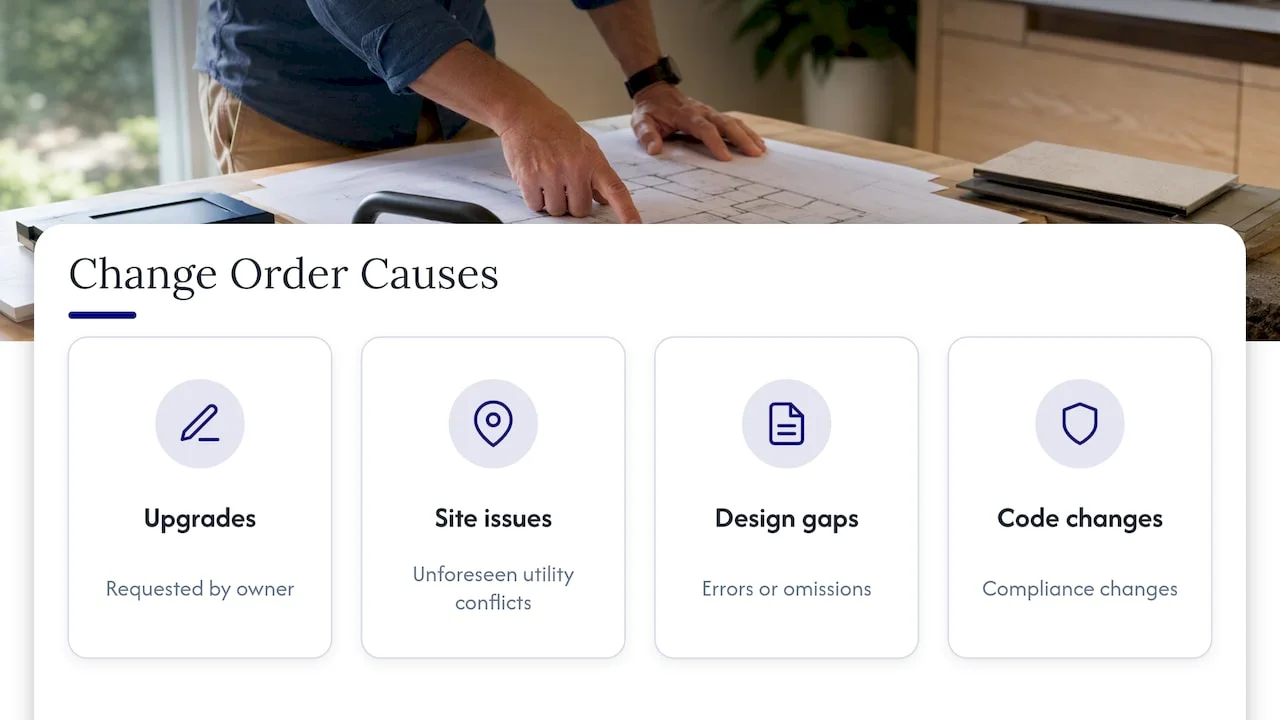
Upgrades you request
These are the easiest to control, and the most common source of budget creep. A different flooring, a larger window package, an added closet. Every one is reasonable alone. Ten of them make a five-figure change. Settle finishes and fixtures in writing before the contract is signed, using an allowance list with named products and amounts.
Site conditions
Backyards hide things. Old sewer laterals, buried irrigation, unexpected soil, tree roots, a gas line where a survey said there was none. A site evaluation before design cuts this risk, but it never removes it. Your contract should say what happens when the ground does not match the plans, and who pays for it.
Design errors and omissions
When plans lack detail, the gaps get filled on site, with a price attached. Complete, coordinated architectural and structural drawings are the cheapest change order prevention there is. If a structural change is proposed mid-build, such as moving a wall that carries lateral loads, the engineer has to review it. Our partners’ explanation of California ADU shear wall requirements shows why a casual wall move can ripple through the engineering.
Code and permit changes
Plan check comments, inspector corrections and local rules can all alter the scope. The CSLB advises that permits are obtained through your local city or county and that you should contact your local building department for additional ADU rules, per its ADU fast facts guide. Our guides to the California ADU permit application and residential zoning for ADUs cover what to settle before you submit, so fewer corrections show up later.
What California requires in writing
California is clear on the basics. According to the CSLB home improvement contracts consumer guide, changes to the contract must be in writing and signed by both parties. A text message, a verbal “go ahead” or a thumbs-up emoji on site is not enough.
The CSLB’s sample home improvement contract also spells out what a valid change order has to identify:
- The scope of the extra work.
- The amount to be added to or subtracted from the contract price.
- The impact on the progress payment schedule or the completion date.
The same sample says that if subcontractors are used for extra work, the contractor must provide, on request, a list with their names, contact information, license numbers and classifications. Ask for it. It tells you who is actually on your property and whether they are properly licensed.
The sample contract also notes that failing to follow the change order procedure does not preclude a contractor from recovering for work performed, through legal or equitable remedies meant to prevent unjust enrichment. In plain terms: skipping the paperwork does not mean you get free work. It means you lose control of the price and give up your best evidence. Digital signature tools can make the process faster, and this overview of the construction change order process explains how a documented, signed workflow keeps everyone on the same page.
This article is general information, not legal advice. If a dispute is already large, talk to a California construction attorney.
A change order form that holds up
Whatever format you use, make it specific enough that a stranger could understand what was agreed. A good ADU change order includes:
- A number and date. Change Order 1, 2, 3, in sequence.
- A description tied to the documents. Reference the plan sheet, detail or specification section, or describe the field condition, for example “unmapped sewer lateral found at the northeast corner of the footprint.”
- A line-item price. Labor, materials, subcontractor cost, and the contractor’s markup if the contract allows one. A single lump sum with no breakdown is hard to evaluate.
- Effect on the schedule. Number of working days added, or an explicit statement of zero days.
- Effect on payments. How the payment schedule changes, and the new contract total.
- Permit impact. Whether the change needs revised plans, engineering or a plan check resubmittal, and who is handling that.
- Signatures from both parties before work begins.
Also keep a running log of all change orders and the current contract total. At any time you should be able to say: original price, approved changes, new total.
How to review a proposed change
Treat every change order as a mini-negotiation. The AIA’s explanation of change order fundamentals says an architect or professional consultant can help review proposals to make sure costs are reasonable, quantities are accurate and the requested schedule extension is justified. The architect’s job also includes checking that proposed work is not already covered and that costs are not counted twice.
You can apply the same checks yourself:
- Is it already in the contract? Compare against the drawings and scope. If the item was shown on the plans, it is not extra.
- Does the quantity make sense? Ask for square footage, linear feet or counts.
- Is the price consistent? Compare unit prices with those in the original bid. If an item is replacing something, is the deduct credited?
- Is the time realistic? A small change should not add weeks. If it does, ask which tasks are actually delayed.
- Is anything double counted? Overlapping labor lines and markup on markup are common.
- Does it need a designer or engineer? If the change touches structure, egress, energy compliance or plumbing and electrical layout, get the design professional’s sign-off first.
You are allowed to say “give me a day to review.” A good contractor expects it.
When you find something unexpected
Unforeseen conditions are where change orders get messy, because the pressure to keep moving is high. The workable sequence is simple:
- The affected work stops. Crews can move to other tasks.
- The contractor photographs and videos the condition and tells you the same day.
- The designer or engineer evaluates and proposes a fix.
- The contractor prices the fix and its schedule effect.
- You review it and sign before the fix proceeds.
Pausing for a day or two to finalize a written change order is far cheaper than the legal fees and years of delay that can follow litigation over disputed work, as the California firm Wilke Fleury argues. The same firm says that when quick action is truly needed, a follow-up email confirming the discussion is valuable evidence, but it never replaces a formal signed change order. Use the email as a bridge, not a destination.
If you disagree, or extra work has already started
This happens more than anyone admits: a crew does something “to save time,” and the invoice arrives later. Here is what to do.
- Stop the work in question. Tell the contractor in writing, politely and clearly, that no further extra work is authorized until a change order is signed.
- Ask for the paperwork. Request a written description, price breakdown and reason for the change.
- Compare against the contract. Was it nonconforming work being corrected? Then it is not billable to you. Was it really new scope? Then negotiate the price.
- Do not withhold everything in anger. Dispute the specific item. Keep paying for undisputed work according to the schedule.
- Gather records. Signed change orders, emails, project logs and photos can be decisive evidence in disputes, according to a construction law firm, and consistent adherence to contract procedures helps prevent disputes in the first place.
- Escalate in order. Start with a meeting, then a written notice under the contract’s dispute clause, then mediation. Bring in a California construction attorney or the CSLB for licensing issues if talks fail.
Remember the unjust enrichment point above. If work really was done and benefited you, a flat refusal to pay can backfire. Negotiate a fair number and document it.
Perspective: how we keep change orders small
We see change orders as a symptom, not a cost of doing business. On ADU projects, the cheapest change is the one decided during design. That is why our design, engineering and construction work together: the person drawing the wall knows what the framer will need and what the plan checker will ask.
Three habits matter most. First, finalize layout, finishes and utility connections before permit submittal, not after. Second, walk the site with the designer and engineer so unusual conditions show up on paper, not in a trench. Third, price every change in writing before work starts, and show you the effect on your schedule, not only your budget.
Our contract types guide explains how the contract structure itself shapes who carries risk when something changes. Read it before you sign anything.
, Uni Construction
Choose a team that handles design and build together
When the same team designs, engineers and builds your ADU, a change order has one owner to answer for it instead of three parties pointing at each other. We offer design and construction services, including owner’s representation and construction management, plus drafting, structural engineering and permit-ready drawings for detached, attached, garage conversion and junior ADUs. If you already have a contractor and want a second set of eyes on a change order, our owner’s rep service is built for exactly that.

To see how we work, look through our completed ADU projects or start from our ADU types page.
A pre-construction checklist to prevent change orders
Most of the work happens before the first shovel. Use this list.
- Complete drawings. Architectural, structural, mechanical, electrical and plumbing, plus energy compliance. Our backyard design process guide shows the stages.
- Site evaluation. Survey, utility locations, soil considerations, setbacks and easements. See our overview of LA County ADU development regulations if you build in the county.
- Allowances with named products. Flooring, tile, fixtures, appliances, windows and doors.
- Contract clauses. Change order procedure, unforeseen conditions, markup on changes, schedule effect, dispute steps.
- Local rules. Confirm requirements with your local building department, as the CSLB recommends.
- A contingency. Set aside your own reserve, separate from the contract price, so a surprise does not become a crisis. Many owners hold a percentage of the budget. Choose one with your lender or advisor.
- A decision rule. Agree on who can authorize changes on your side, and make it you or a named representative. Never a family member who happens to be on site.
Frequently asked questions
In California, changes to a home improvement contract must be in writing and signed by both parties, according to the CSLB. That includes small changes, because small ones add up and become the hardest to prove later. If it changes scope, price or time, write it down.
It depends on your contract and on who made the error. Work that does not conform to the contract documents or code is the contractor’s responsibility and expense. A missing or incorrect design detail may be handled differently, so ask for a written explanation before you agree to pay.
The CSLB sample contract says failing to follow the change order procedure does not rule out recovery through legal or equitable remedies. So you may still face a claim, but you also hold the leverage of the contract terms. Dispute the specific item in writing and keep records, and see a California construction attorney if the amount is large.
Take as long as you need to review the scope, quantities and schedule effect, and ask your designer or architect to check it. A short pause for a signed document is far cheaper than a dispute. Ask the contractor which work can continue in other areas while you decide.
Yes. Garage conversions have their own surprises, such as slab condition, existing electrical and insulation. A detailed site evaluation and complete drawings reduce them. See our garage conversion design page.
Sources
- AIA Contracts: Rejection and correction of work
- AIA Contracts: The fundamentals of change orders
- CSLB: Sample Home Improvement Contract
- CSLB: Home Improvement Contracts Consumer Guide
- CSLB Fast Facts: Tips for Building a Residential ADU
- Putterman Law: Change order disputes and scope creep
- Wilke Fleury: Why change orders matter
- Construction change order process
- California ADU shear wall requirements explained