

Every month an ADU sits unfinished, it costs you money. Schedule slips convert projected rental income into carrying costs, force contractor re-quotes at higher material prices, and compress the IRR you modeled at underwriting. The ADU construction timeline isn’t a project management detail , it’s a direct input into your returns.
Before you read further, three things you can do right now:
- Add a 3–6 month schedule buffer to every phase of your financial model, not just construction.
- Require permit-complete deliverables before your construction loan closes.
- Ask your design partner whether pre-approved plans or prefab delivery are available for your site , both shorten permit and build phases materially.
The sections below walk through each project phase and its realistic duration, the most common delay drivers, how to quantify the dollar impact of a slip, what SB 543 changes for permit risk in 2026, and a practical modeling and mitigation framework you can apply to your next deal.
Why ADU construction timelines matter to investors
The core mechanism is simple: ADUs produce zero rental income during construction. Every week the project runs long, you pay interest on your construction loan, property taxes, insurance, and soft-cost carry , while collecting nothing. A 6-month delay on a project with $3,000 in monthly carrying costs adds $18,000 to your all-in basis before you lease a single day. That’s not a rounding error; on a $150,000 ADU build, it’s a 12% cost overrun from schedule alone.

The importance of ADU timelines compounds when you factor in re-quote risk. Material prices move. A contractor who bid your framing in January may reprice in July if lumber or steel costs have shifted. Material price volatility has forced re-quotes and increased all-in project costs in recent cycles, and a schedule slip is often what opens that window. The investor who closes fast avoids the reprice. The one who drifts into a new pricing regime absorbs it.
What does a typical ADU project timeline look like?
A realistic ADU timeline runs from initial feasibility through lease-up. Each phase carries its own duration range and its own delay risk. The table below reflects California conditions, with notes on where pre-approved plans and prefab delivery create meaningful shortcuts.
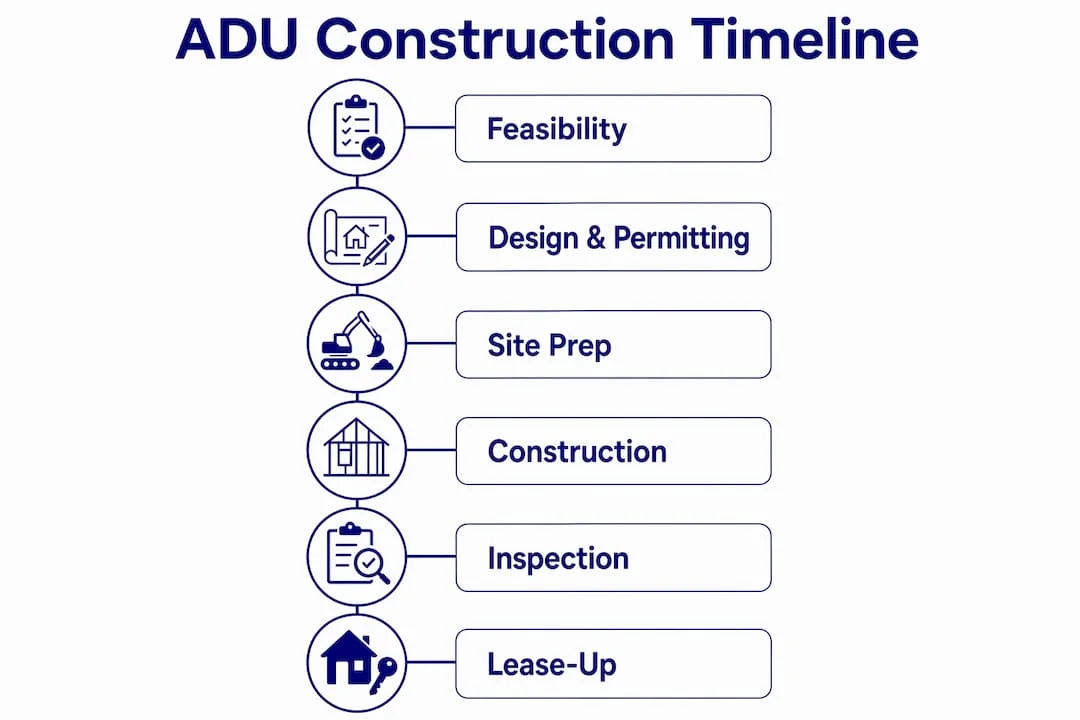
| Phase | Typical Duration | Notes |
|---|---|---|
| Feasibility and site evaluation | 1–2 weeks | Zoning check, utility capacity, setback review |
| Design and engineering | 6–12 weeks | Custom plans; pre-approved plans cut this to under 30 days in many jurisdictions |
| Permit submission and plan check | 4–12 weeks | City-dependent; SB 543 sets a 60-day approval clock |
| Permit approval and issuance | 1–2 weeks | Deemed-approved consequence if agency misses shot clock |
| Construction mobilization | 1–3 weeks | Contractor scheduling, material procurement |
| Construction and build | 6–12 months (detached); 3–6 months (conversion/attached) | Prefab options can compress detached builds to 6–9 months |
| Final inspection and certificate of occupancy | 2–4 weeks | Utility connections often the bottleneck |
| Lease-up and rent stabilization | 4–8 weeks | Vacancy buffer before stabilized cash flow |
Detached new-build ADUs frequently run 6–12 months for construction alone; attached or conversion projects typically complete faster. Pre-approved plans often cut permit processing to under 30 days in jurisdictions with established programs, which meaningfully compresses the front end of the schedule. For investors modeling a Los Angeles project, local build-time examples show the full range from streamlined conversions to complex detached builds.
What causes ADU schedules to slip?
Most delays cluster around a handful of high-impact categories. Knowing them before you commit capital lets you price the risk or walk away.
- Permitting problems. Incomplete applications trigger correction rounds that can add 4–8 weeks per cycle. Local ordinance conflicts, missing Title 24 energy compliance documentation, and Coastal Commission processes (where applicable) have historically pushed coastal ADU permits to 12–18 months, though recent legislation has addressed much of that exposure.
- Design complexity and scope changes. Custom finishes, unusual site constraints, and unforeseen structural conditions mid-construction all extend schedules. Each owner-initiated change order resets contractor scheduling and can trigger a new plan-check round.
- Supply chain and labor. Subcontractor availability is tighter than it looks on paper. A framing crew booked two months out means two months of mobilization delay before a nail goes in. Material lead times for windows, HVAC equipment, and electrical panels have stretched in recent cycles.
- Utility and site work. Sewer lateral upgrades, new electrical service panels, and water meter upsizing can each add weeks. Off-site utility work that requires coordination with the utility company, not just the city, is one of the least-modeled delay sources in ADU underwriting.
- Third-party approvals. HOA review processes, easement conflicts, and neighbor appeals add unpredictable time. Some jurisdictions still allow third-party design review that has no statutory shot clock.
For a deeper look at how these risks compound, the ADU investment pitfalls guide covers nine categories where California investors have lost time and money.
How do schedule slips translate into dollar losses?
The financial impact of construction timeline delays operates through four channels: interest carry, hard-cost escalation, re-quote exposure, and deferred income.

Carrying costs accumulate whether or not the project is moving. A construction loan at 9% annual interest on a $200,000 draw costs roughly $1,500 per month in interest alone. Add property taxes, builder’s risk insurance, and any management or oversight fees, and monthly carry on a mid-size detached ADU runs $2,000–$3,000. Development deals require large reserves to survive the gap between construction start and stabilized income , investors who don’t budget for this gap end up in distress.
The table below models a sample project to show IRR sensitivity to schedule slippage. These are illustrative figures investors can adapt to their own deal parameters.
| Scenario | Construction Cost | Monthly Carry | Delay | Added Cost | Stabilized Monthly Rent | Approximate IRR Impact |
|---|---|---|---|---|---|---|
| Base case | , | $3,000 | , | , | $2,000–$3,000 | Baseline |
| Conservative (3-month slip) | , | $3,000 | 3 months | , | $2,000–$3,000 | IRR reduced by about 2 points |
| Stress (6-month slip + re-quote) | , + $12,000 re-quote | $3,000 | 6 months | , | $2,000–$3,000 | IRR reduced by 4–6 pts |
A significant delay with a contractor re-quote can add substantial costs to your basis on a project that was already tight. That’s the difference between a deal that pencils and one that doesn’t.
Pro Tip: Size your interest reserve for 6–12 months beyond your projected completion date, not just to the expected finish. Keep a hard-cost contingency of 7–10% of construction costs to absorb re-quotes. Conservative structures survive cycles; tight ones break at the first change order.
What does SB 543 change for permit risk in 2026?
SB 543 is the most investor-relevant California ADU law change in years. It codifies a 15-business-day completeness review and a 60-day permit approval clock for ADU and JADU applications, with a deemed-approved consequence if agencies miss the deadline. That last part matters: if a city fails to act within 60 days on a complete application, the permit is deemed approved by operation of law.
What this means for underwriting: You can now model permit approval as a bounded risk rather than an open-ended one. A complete, well-prepared application submitted to a compliant jurisdiction should resolve within 60 days. That’s a planning assumption you couldn’t make with confidence before 2026.
Pre-approved plans amplify the benefit. Pre-approved plans often cut permit processing time markedly in jurisdictions with established programs and reduce design fees significantly versus custom plans. They also improve bid accuracy, making fixed-price contracts easier to obtain. For coastal properties, recent legislation enables concurrent processing and a 60-day shot clock, eliminating the 12–18 month coastal permitting exposure that used to kill ADU deals near the water.
The HCD’s 2026 ADU Handbook confirms that local agencies failing to comply with state ADU law timelines must apply state law directly, removing a layer of local discretion that historically caused delays. For investors in Los Angeles County, the 2026 LA County ADU regulations guide covers how local agencies are adapting to these requirements.
How should you model timeline risk in your financials?
Modeling ADU timeline risk isn’t complicated, but most investors skip it. The result is a base-case model that looks great and a deal that underperforms the moment anything slips.
The core metrics to track are: time-to-stabilization (from permit submission to first stabilized rent check), monthly cash burn during construction and lease-up, interest reserve balance at each milestone, and contingency as a percentage of hard costs. Run three scenarios every time.
- Base case. Use the phase durations from the timeline table above. Assume permit approval in 60 days (SB 543 compliant), construction per your contractor’s schedule, and lease-up in 6 weeks.
- Conservative case. Add 25% to every phase duration. Permit takes 75 days. Construction runs 25% longer. Lease-up extends to 10 weeks. Recalculate monthly carry, total interest, and IRR.
- Stress case. Model a 6-month total delay plus a contractor re-quote of 8–12% on hard costs. This is the scenario where a deal either survives or requires recapitalization.
For each scenario, run a sensitivity test at +3, +6, and +12 months of total schedule extension. A deal that holds acceptable IRR at +6 months is fundable. One that breaks at +3 months needs a better capital structure before you proceed.
A numbered step approach to convert schedule risk into capital requirements:
- List every phase with its base-case duration and a conservative-case duration.
- Multiply the duration difference (in months) by your monthly carry cost.
- Add that figure to your hard-cost contingency to get your total schedule-risk reserve.
- Confirm your construction loan has extension options that don’t require recapitalization.
- Stress-test your refinance timing: if permanent financing requires stabilized occupancy, model what happens if stabilization is 6 months late.
Capital durability , the ability of a project’s financial structure to remain viable throughout the full development cycle , is the variable that separates investors who survive delays from those who don’t. Projects financed with tight contingencies and inflexible terms break when conditions deviate from plan. A three-month slip cascades into higher financing costs, which eats the contingency, which forces recapitalization at the worst moment.
What practical steps reduce ADU timeline risk?
When permitting becomes predictable through shot clocks and pre-approved plans, the dominant remaining schedule risks shift to contractor capacity and site-specific utilities. That’s where strong project governance makes the largest marginal improvement.
Underwriting actions:
- Build conservative schedule buffers into every phase, not just construction.
- Size hard contingencies at 7–10% of construction costs.
- Require interest reserves that extend 6–12 months beyond projected completion.
- Tie financing draws to milestone completion, not calendar dates.
Procurement strategies:
- Use pre-approved ADU plans wherever your jurisdiction supports them. They cut permit time, reduce design fees, and make fixed-price bids easier to obtain.
- Evaluate prefab or modular delivery. Prefab options can shorten on-site construction and compress the overall schedule when paired with fast permits, often converting a 10–18 month timeline into a 6–9 month one.
- Vet contractors for completion track records on comparable ADU projects, not just general construction experience.
Contract strategies:
- Use fixed-price or guaranteed maximum price (GMP) contracts where the scope is well-defined.
- Include milestone-based draws, liquidated damages, and clear change-order pricing to allocate schedule risk and provide enforcement mechanisms if contractors miss milestones.
- Define a qualified change-order process that requires written approval before any scope change proceeds.
Pro Tip: Hire a permit expeditor for complex or coastal sites. The fee is small relative to the cost of a single plan-check correction round. Require permit-complete deliverables before your construction loan closes , this single step eliminates the most common source of early-phase delays.
What should your ADU underwriting checklist include?
Use this checklist in your diligence meeting with your design-build partner or lender. Any item you can’t check off is a risk you’re accepting, not ignoring.
- Site survey completed , confirmed setbacks, lot coverage, and easements.
- Utility capacity confirmed , sewer, water, and electrical capacity for the proposed ADU type and size.
- Permit strategy defined , pre-approved plan eligibility assessed; jurisdiction’s SB 543 compliance status verified.
- Realistic schedule with milestone dates , phase-by-phase, not just a single completion date.
- Contractor proof of performance , references and completion records on comparable ADU projects.
- Financing term alignment , loan maturity, extension options, and draw schedule match the project timeline.
- Reserves confirmed , interest reserve sized for 6–12 months beyond projected completion; hard-cost contingency at 7–10%.
- Permit application completeness reviewed , all required documents, Title 24 compliance, and structural engineering included before submission.
Red flags that warrant walking away or renegotiating:
- Jurisdictional ambiguity on ADU rules or a pending local ordinance that conflicts with state law.
- Required Coastal Development Permit without concurrent processing available.
- No pre-approved plans option and a jurisdiction with a history of multiple plan-check rounds.
- Contractor unwilling to provide a schedule guarantee or milestone-based contract.
- Utility capacity insufficient and off-site upgrade required with no confirmed timeline from the utility.
For investors working through the ADU permit process for the first time, the procedural detail behind each checklist item is worth reviewing before your first diligence call.
Key Takeaways
ADU construction timeline risk is a direct financial variable: every month of schedule slippage adds carrying costs, erodes IRR, and can trigger re-quotes that permanently increase your all-in basis.
| Point | Details |
|---|---|
| Timeline = realized return | Schedule slips add carrying costs and re-quote exposure that directly reduce IRR and cash-on-cash returns. |
| SB 543 improves permit predictability | A 15-business-day completeness review and 60-day approval clock let California investors model permit timing with higher confidence. |
| Model with buffers and reserves | Size interest reserves for 6–12 months beyond projected completion; keep hard-cost contingency at 7–10% of construction costs. |
| Pre-approved plans and prefab shorten schedules | Pre-approved plans often cut permit processing to under 30 days in jurisdictions with established programs; prefab delivery can compress a 10–18 month build to 6–9 months. |
| Uni Construction reduces timeline risk | Uni Construction delivers permit-ready design, pre-approved plan strategy, and design-build execution to help investors protect schedule and returns in California. |
The timeline risk most investors underestimate
The conventional wisdom on ADU investing focuses on rent yield and property value uplift. Those numbers are real, but they’re also the last thing that materializes. What shows up first , and what most underwriting models treat as a footnote , is the cost of time.
The investors who consistently outperform on ADU deals aren’t the ones who found the best rent market or the cheapest contractor. They’re the ones who treated the schedule as a financial instrument from day one. They sized reserves for the realistic worst case, not the optimistic base case. They chose pre-approved plans not because they were cheaper on paper, but because a 30-day permit beats a 90-day permit by two months of carry. They hired design-build partners who could commit to milestone dates and back them with contract language.
SB 543 is a genuine shift in the risk profile of California ADU investing. Enforceable shot clocks and deemed-approval consequences transfer permit uncertainty from the applicant to the agency. That’s a structural improvement, not a marketing claim. But it only helps investors who submit complete applications with permit-ready drawings. A sloppy submission still triggers a correction round, and a correction round still costs you weeks.
The gap between a good ADU deal and a great one is usually measured in months, not in rent per square foot.
Uni Construction helps investors protect ADU returns from day one
Investors who work with Uni Construction get permit-ready design, pre-approved plan strategy, structural engineering, permit expediting, and design-build delivery under one roof , the exact combination that shortens the front end of the schedule and keeps the back end on track.
For investors in Los Angeles and Southern California, Uni Construction’s ADU design and build services are structured to move from feasibility to permit submission faster than a fragmented design-then-contractor approach. The team handles Title 24 compliance, zoning review, and structural engineering in-house, which eliminates the coordination delays that typically add weeks between design and permit submission. If your site qualifies for a pre-approved plan, Uni Construction can identify that in the first site evaluation and route your project accordingly.
Schedule a permit-readiness review with the Uni Construction team to get a realistic phase-by-phase timeline for your specific site before you commit capital.
Useful sources for ADU permit timing and regulatory guidance
-
SB 543 statutory text: California Legislative Information , primary source for the 15-business-day completeness review and 60-day approval clock.
-
HCD 2026 ADU Handbook: California HCD , authoritative guidance on state ADU law, local ordinance compliance, and financing options.
-
ADU Pilot SB 543 analysis: ADU Pilot , practical breakdown of how SB 543 affects permit timelines and pre-approved plan programs.
-
Local permit turnaround estimates: Contact your city’s building and safety department directly, or check the department’s online permit portal for current plan-check queue times.
-
Uni Construction permit-readiness resources:
- 2026 ADU Timeline Guide , step-by-step phase durations for California projects.
- California ADU Market Analysis , rent, absorption, and valuation context for investor modeling.
- ADU Construction Risk Management , contingency sizing and schedule risk tactics for California homeowners and investors.