


A construction draw schedule is a pre-agreed, milestone-based funding plan that releases construction loan money in stages only after verified work is completed, rather than disbursing the full loan amount upfront. Also called a construction payment schedule or draw disbursement plan, this document is negotiated between the borrower and lender before a single shovel hits the ground. It protects lenders from funding incomplete work, gives contractors a predictable cash flow structure, and keeps project owners accountable to a defined construction financing timeline. Parties involved in every draw cycle include the borrower, general contractor, lender, and often a third-party inspector. Standard forms like AIA G702 and G703 are the industry-recognized tools used to document and certify each draw request.
What is a construction draw schedule and how does it work?
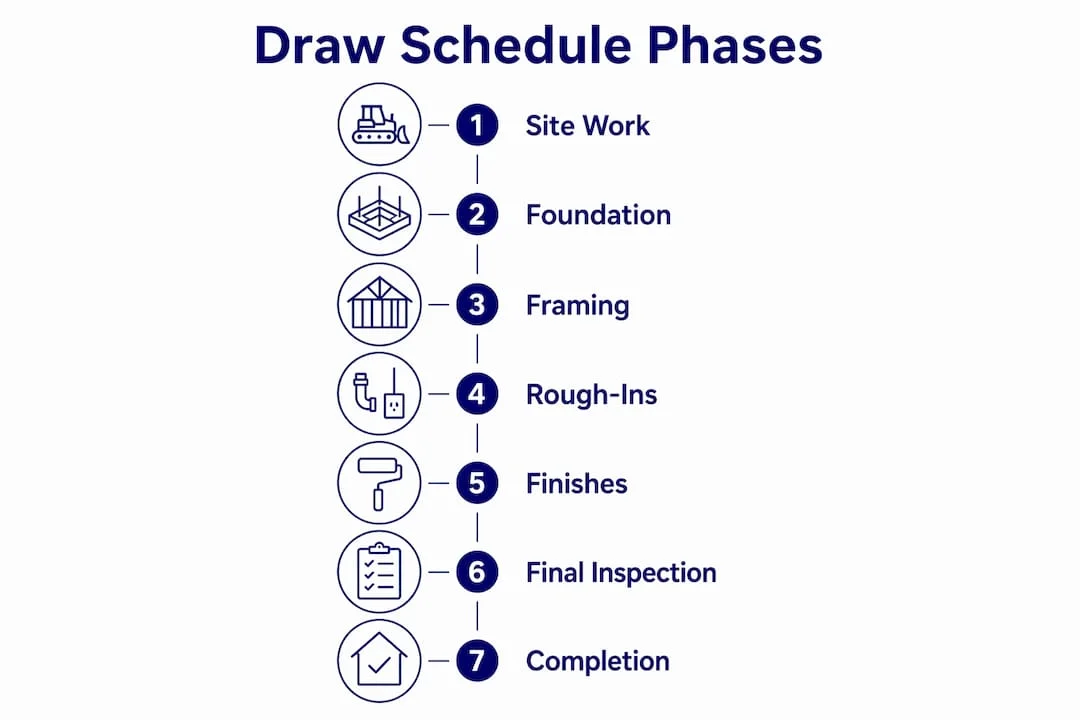
A construction draw schedule is structured around milestone-based releases such as foundation, framing, rough-ins, finishes, and final completion, with each stage requiring verification before funds move. The lender does not simply trust that work was done. An inspector, architect, or owner’s representative physically confirms progress before the disbursement is approved. This staged release mechanism is the core financial control mechanism in construction lending.
The schedule is not a contractor’s billing preference. It is a binding financial document that defines the exact conditions under which loan proceeds are released. Deviating from it without lender approval creates legal and financial exposure for all parties. Think of it as the financial backbone of the entire project, not an administrative formality.
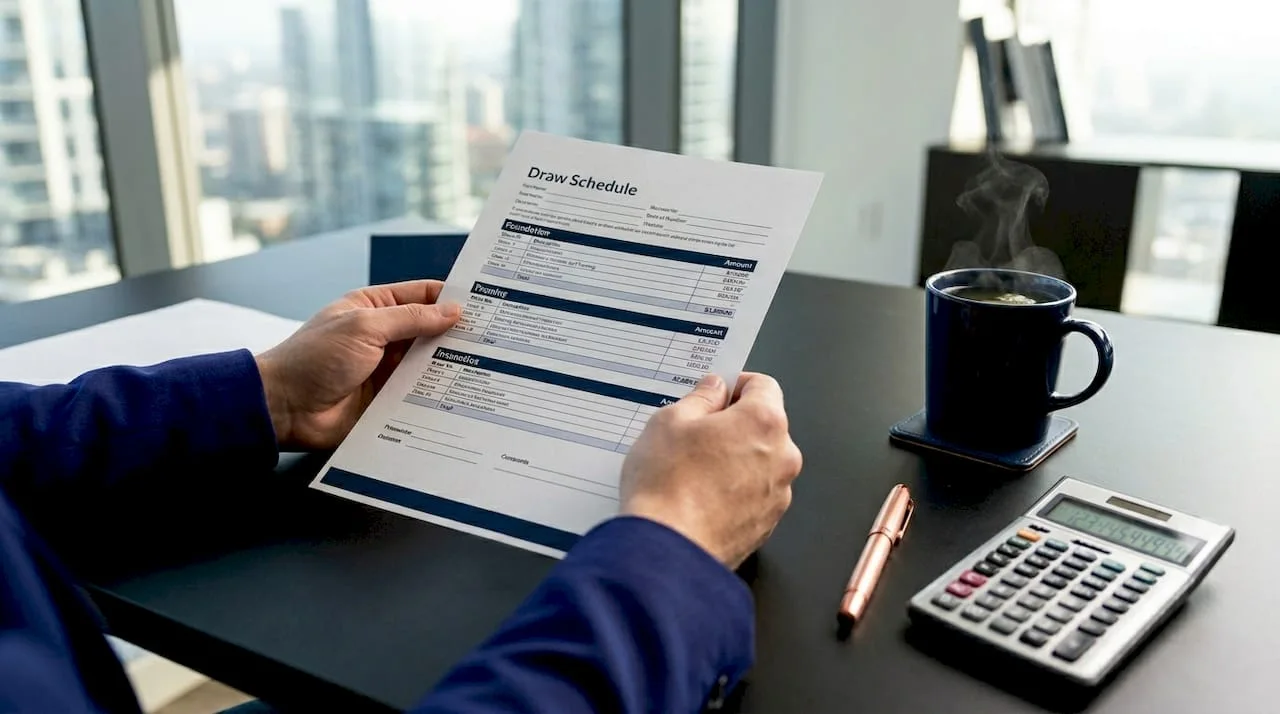
One distinction worth knowing early: draws release loan funds, while pay applications request payment from the owner. Confusing the two increases cash flow misunderstandings and documentation errors that delay funding. Contractors and developers who treat these as interchangeable concepts consistently run into lender friction.
What are the typical phases and milestones in a draw schedule?
Residential construction loans typically have 5 to 7 draws tied to major milestones, while commercial projects may run 12 to 24 or more draws over the project life. This difference reflects the complexity and duration of commercial work, where monthly percentage-of-completion draws are more practical than waiting for discrete milestones.
The table below shows the most common residential draw phases, what each covers, and typical budget allocation ranges:
| Phase | Description | Typical allocation |
|---|---|---|
| Site work and foundation | Excavation, grading, footings, slab or foundation pour | 15–20% |
| Framing and dry-in | Structural framing, roof sheathing, windows, exterior wrap | 20–25% |
| Mechanical rough-in | Plumbing, electrical, HVAC rough-in, insulation | 15–20% |
| Interior finishes | Drywall, flooring, cabinetry, fixtures, paint | 20–25% |
| Final completion | Punch list, certificate of occupancy, site cleanup | 10–15% |
Each phase requires a milestone verification before the next draw is released. For residential ADU projects in Los Angeles, inspections tied to the phases of residential construction often align directly with city permit inspection checkpoints, which makes coordinating draw timing with permit milestones both practical and efficient.
Pro Tip: Map your draw schedule directly to your permit inspection schedule. When a city inspector signs off on framing or rough-in, that same event can trigger your draw request, eliminating redundant site visits and compressing your funding timeline.
For commercial projects, draws are typically calculated as a percentage of total work completed to date, verified monthly. This approach requires more granular cost tracking but gives lenders continuous visibility into project progress rather than waiting for discrete phase completions.
How does the draw request and approval process work?
The draw request process follows a defined sequence, and skipping any step causes delays. Here is the standard workflow from submission to funding:
- The general contractor compiles the draw request package, including AIA G702 (application for payment) and G703 (continuation sheet), subcontractor invoices, conditional lien waivers for the current period, unconditional lien waivers from prior periods, progress photos, and any approved change orders.
- The project architect reviews and certifies the amount requested against work completed.
- The owner or borrower reviews and signs off on the package before it goes to the lender.
- The lender orders a third-party inspection or reviews internal documentation to verify progress.
- The lender reconciles all documents, confirms lien waiver completeness, and approves disbursement.
- Funds are released to the borrower or directly to the contractor, depending on loan structure.
From submission to funding typically takes 5 to 14 business days, with inspections alone consuming 2 to 5 days of that window. That timeline means a contractor who submits a draw request on day one of a new phase should not expect funds before day 7 at the earliest. Planning cash flow around that reality is not optional.
A draw request package can range from 20 to 500 or more pages depending on project complexity. AIA G702 and G703 forms must reconcile exactly. Any arithmetic mismatch between the G702 summary and the G703 line-item continuation sheet triggers an automatic rejection, even if all the underlying work is complete and verified. This is one of the most common and most preventable causes of funding delays.
Pro Tip: Before submitting any draw package, run a dedicated reconciliation check between your G702 totals and every G703 line item. A five-minute arithmetic review prevents a two-week funding delay.
Retainage also enters the picture at this stage. Most lenders withhold 5 to 10% of each draw as a holdback until substantial or final completion. That means a $100,000 draw request may only yield $90,000 to $95,000 in actual disbursement. Contractors and developers who fail to account for this in their cash flow projections routinely find themselves short on working capital mid-project.
What are the best practices for creating and managing a draw schedule?
Creating an effective draw schedule requires decisions made before construction starts, not during it. The following practices separate projects that fund smoothly from those that stall at every draw cycle:
- Negotiate draw terms with the lender upfront. The number of draws, milestone definitions, and retainage percentages are all negotiable before loan closing. Accepting default lender terms without review often results in a schedule misaligned with actual construction sequencing.
- Align draw timing with subcontractor payment cycles. If your framing sub expects payment within 30 days of completion, your draw request for the framing phase needs to be submitted the day framing is done, not two weeks later.
- Build in buffer for inspection and approval delays. A draw schedule that assumes same-week lender approval will fail. Add 10 to 14 business days of buffer between milestone completion and expected fund receipt.
- Establish documentation checklists before the first draw. Every party should know exactly what documents are required for each draw before the project starts. Discovering a missing lien waiver requirement at draw three is a cash flow crisis, not an administrative inconvenience.
- Use verifiable, objective milestone triggers. Standardized milestone mapping with smart triggers tied to verifiable events reduces disputes and funding delays, particularly for portfolio developers managing multiple projects simultaneously.
- Maintain version control on all draw documents. Change orders, revised schedules, and updated cost breakdowns must be tracked and attached to the relevant draw package. Lenders reviewing draw three should not be seeing change orders that were approved at draw one for the first time.
Clear documentation and milestone definitions reduce lender verification friction and accelerate funding across every draw cycle. This is not a soft benefit. It directly compresses the 5 to 14 day approval window.
Pro Tip: Plan your draw schedule backward from the lender’s inspection and review timeline, not forward from your construction schedule. Backward planning from lender timelines improves cash flow forecasting and prevents the payment gaps that stall projects.
For ADU developers working through the 2026 ADU construction timeline, aligning draw milestones with permit inspection checkpoints is particularly effective because city inspections and lender inspections can often be coordinated as a single site visit.
How do retainage and lien waivers affect cash flow management?
Retainage and lien waivers are the two financial mechanisms most likely to create unexpected cash flow problems in an otherwise well-structured draw schedule. Understanding both in detail is not optional for any professional managing construction financing.
Retainage is the percentage of each draw withheld by the lender until substantial or final completion. Retainage can create a working capital tie-up of 18 to 30 months, representing a significant constraint during the construction period. On a $500,000 project with 10% retainage, $50,000 sits in the lender’s hands until a certificate of occupancy is issued or the final punch list is closed. That capital is unavailable for overhead, subcontractor payments, or materials procurement.
The table below summarizes the key characteristics of retainage and lien waivers within a draw schedule:
| Mechanism | Typical terms | Timing of release | Risk if mismanaged |
|---|---|---|---|
| Retainage | 5–10% withheld per draw | Substantial or final completion | Working capital shortfall over 18–30 months |
| Conditional lien waiver | Issued with current draw request | Upon submission of draw package | Funding hold if missing from package |
| Unconditional lien waiver | Issued after prior draw payment | Required with next draw submission | Funding rejection if prior period waiver absent |
Lien waiver sequencing is a common source of funding holds. Lenders require conditional waivers for the current draw period and unconditional waivers confirming that prior draws have been paid. Submitting the wrong type, or submitting them out of sequence, causes the same outcome as missing documentation entirely: the draw is held until the error is corrected.
Pro Tip: Create a lien waiver tracking log that records which subcontractors owe conditional waivers for the current draw and which owe unconditional waivers from the prior period. Review it before every package submission, not after.
Managing retainage expectations with subcontractors is equally important. Subs who do not understand that 5 to 10% of their contract value will be withheld for 12 to 18 months will price that uncertainty into their bids or create disputes at project closeout. Transparent communication about retainage terms at contract execution prevents both outcomes.
Key takeaways
A construction draw schedule is the single most important financial control document in a construction loan, and its effectiveness depends entirely on documentation precision, milestone clarity, and backward planning from lender timelines.
| Point | Details |
|---|---|
| Core definition | A draw schedule releases loan funds in stages tied to verified construction milestones, not contractor requests. |
| Draw phases | Residential projects typically use 5 to 7 milestone-based draws; commercial projects use 12 to 24 or more. |
| Approval timeline | Expect 5 to 14 business days from draw submission to funding; plan cash flow around this window. |
| Retainage impact | Lenders withhold 5 to 10% per draw, creating working capital constraints for up to 18 to 30 months. |
| Documentation accuracy | AIA G702 and G703 must reconcile exactly; mismatches trigger automatic rejection regardless of work completion. |
Why draw schedules deserve more strategic attention than they get
After working through dozens of ADU and residential construction projects in Los Angeles, the pattern is consistent: the projects that hit cash flow crises are almost never the ones with construction problems. They are the ones where the draw schedule was treated as a lender formality rather than a financial management tool.
The most expensive mistake I see is contractors and developers who submit draw packages reactively, after they have already run short on cash. By that point, the 5 to 14 day approval window is not an inconvenience. It is a crisis. The fix is not faster lender processing. It is submitting draw requests the moment a milestone is complete, with a fully reconciled package, so funding arrives before the cash gap opens.
The second pattern worth noting is the underestimation of lien waiver complexity. Conditional versus unconditional waivers are not interchangeable, and the sequencing requirement trips up experienced contractors who have simply never had it explained clearly. One misplaced waiver type holds an entire draw. On a project with 10 subcontractors, the probability of at least one error is high without a tracking system.
Digital documentation tools have meaningfully improved this process. Coordinating inspection scheduling, lien waiver collection, and AIA form reconciliation through a single platform reduces the manual error rate that causes most funding delays. The technology is not the point. The discipline of treating every draw cycle as a structured financial event, with defined checklists and verification steps, is what actually moves projects forward without interruption.
View the draw schedule as a cash flow forecast, not a payment request form. Every decision made at the design and loan structuring stage, from milestone definitions to retainage percentages, has a direct downstream effect on working capital availability throughout the build.
, Uni Construction
How Uni Construction supports draw schedule coordination on ADU projects
Managing a construction draw schedule on an ADU project in Los Angeles requires more than a spreadsheet. It requires construction milestones that align with city permit inspections, documentation that satisfies lender requirements, and a project team that understands how funding timelines affect construction sequencing.
Uni Construction coordinates the full design-to-build process for ADU projects across Los Angeles and the San Gabriel Valley, with direct experience aligning construction phases with draw schedule requirements. From permit-ready drawings that map to lender-recognized milestones to on-site coordination that supports inspection scheduling, the team structures projects so that funding and construction move in sync. Explore ADU design and construction services in Los Angeles to see how Uni Construction manages the full project lifecycle, including construction financing coordination, from the first design consultation through final completion.
FAQ
A construction draw schedule is a pre-agreed plan that releases construction loan funds in stages, with each release tied to a verified construction milestone such as foundation, framing, or final completion. It protects both the lender and the borrower by confirming work is done before money moves.
Residential construction loans typically have 5 to 7 draws tied to major milestones, while commercial projects may use 12 to 24 or more draws based on monthly percentage-of-completion calculations.
A standard draw request package includes AIA G702 and G703 forms, subcontractor invoices, conditional and unconditional lien waivers, progress photos, inspection reports, and any approved change orders. Packages can range from 20 to 500 or more pages depending on project complexity.
Retainage is a 5 to 10% holdback on each draw that the lender withholds until substantial or final project completion. It can tie up working capital for 18 to 30 months and must be factored into cash flow planning from the start of the project.
The most common causes are arithmetic mismatches between AIA G702 and G703 forms, missing or incorrectly sequenced lien waivers, incomplete documentation packages, and inspection scheduling delays. Most of these are preventable with a pre-submission checklist reviewed before every draw package is submitted.