


Most property owners hear “value engineering” and immediately think it means cutting corners to save money. That framing is wrong, and it costs people tens of thousands of dollars on their ADU projects. ADU value engineering explained properly means something more precise: a structured process of evaluating every design and material decision to deliver the same or better performance at a lower lifecycle cost. Done right, it protects your design intent, accelerates your timeline, and maximizes what your ADU actually returns. This guide covers the principles, cost drivers, financial strategies, and practical steps you need to apply it on your next project.
Key Takeaways
| Point | Details |
|---|---|
| VE is not cost-cutting | Value engineering preserves function and quality while reducing unnecessary cost through structured analysis. |
| Early application matters most | Decisions made in the design phase have the greatest impact on total project cost and return. |
| Site work dominates budgets | Foundation, utilities, and permits often cost $40,000 to $100,000, making them the top VE priority. |
| Financial returns are significant | ADUs can return 100% or more of construction cost through appreciation and rental income combined. |
| Professional collaboration is critical | Engaging designers, builders, and appraisers early produces better decisions and fewer costly surprises. |
What ADU value engineering really means
Value engineering (VE) is a formalized methodology, not a gut-feel negotiation tactic. The six-step VE process involves gathering information, analyzing functions, brainstorming alternatives, evaluating options, developing the best solutions, and implementing them. Each step is deliberate, and together they ensure that every dollar spent is earning its place in the design.
For ADU projects, this matters enormously. You are working within tight lot constraints, strict zoning codes, and a budget that needs to pencil out against real rental income or resale value. There is no room for spending money on features that do not contribute to performance, livability, or valuation.
The most important distinction to grasp early is this: value engineering replaces costly features with alternatives that deliver equal or superior function, safety, and aesthetics. Swapping a custom millwork built-in for a high-quality modular cabinet system is VE. Buying the cheapest cabinet available and calling it VE is not. The first preserves function. The second compromises it.
- Function analysis: Ask what each design element actually does, not just what it looks like
- Lifecycle cost focus: Evaluate total cost over 20 to 30 years, not just upfront price
- Early-stage commitment: VE decisions made before contracts are signed carry far more weight than changes made mid-construction
- Team-based process: VE works best as early collaboration between designers, builders, and estimators working simultaneously
Pro Tip: Apply value engineering during schematic design, before structural drawings are complete. Changes at that stage cost almost nothing. Changes during construction can cost 10x more.
Major cost drivers and how to engineer them
Site work is where most ADU budgets take their biggest hit. Foundations, utility connections, and permits typically run $40,000 to $100,000 in California ADU projects. Utility connections alone can reach $15,000 to $30,000 depending on how far your ADU sits from the mainlines. That figure has nothing to do with your countertop selection, and yet many owners spend hours debating finish materials while ignoring the single largest cost lever on their project.
Optimal site placement relative to existing utility infrastructure is one of the highest-return VE decisions you can make. Site work often dominates ADU construction cost, and placing your ADU closer to utility mainlines and service panels can save more than all your finish upgrades combined.
Here are the primary cost drivers ranked by their value engineering impact potential:
- Site placement and utility routing: Minimize distance from mainlines; use existing connections where code allows
- Foundation type: Slab-on-grade is typically the most cost-effective; raised foundations add cost but may be required by site conditions
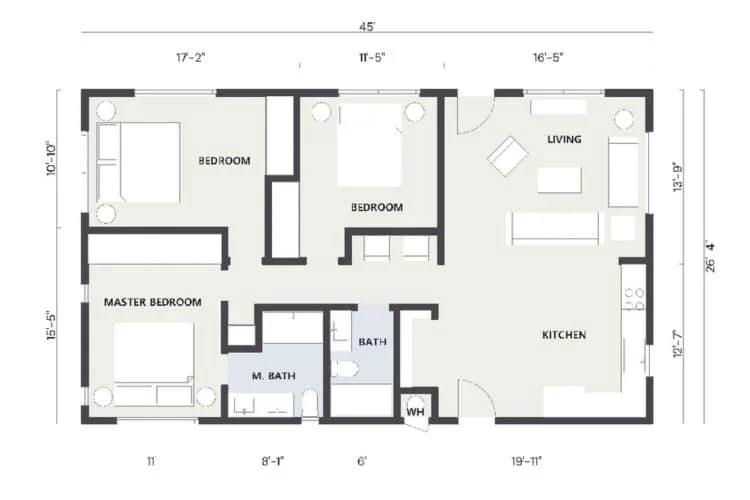
- Structural system: Simple rectangular footprints reduce framing labor and material waste compared to complex shapes
- Roofline: A single-slope or simple gable roof costs significantly less than a hip or complex roofline
- Permitting strategy: Using pre-approved ADU plans under AB 1332 can compress the permitting timeline and reduce design fees
- Material specification: Select materials based on durability per dollar, not brand recognition
| Cost Area | Traditional Approach | VE-Optimized Approach | Typical Savings |
|---|---|---|---|
| Site placement | Default location near property line | Locate near utility mainlines | $8,000 to $20,000 |
| Roof design | Complex hip or multi-plane | Simple gable or shed roof | $5,000 to $15,000 |
| Foundation | Raised with crawlspace | Slab-on-grade where applicable | $10,000 to $25,000 |
| Permitting | Custom drawings from scratch | Pre-approved or permit-ready plans | $3,000 to $8,000 |
| Finishes | High-end standard selections | Durable mid-range with VE substitutions | $5,000 to $12,000 |
Pro Tip: Before you finalize your ADU’s location on the lot, get a utility routing analysis from your design-build team. That single conversation can redirect thousands of dollars back into your budget.
How value engineering improves your financial returns
This is where value engineering for ADUs moves from a construction concept to a genuine investment strategy. The financial benefits extend well beyond what you save during the build.

ADUs can return 100% or more of their construction cost through a combination of property appreciation and rental income. Properties with ADUs appreciate 22% more than comparable properties without them, and rental yields in high-demand California markets run 8 to 12% annually. Those numbers assume a well-designed, permitted, and appraised ADU, which is exactly what a value-engineered project produces.
Tax strategy is another layer most owners miss entirely. Engineering-based cost segregation studies can significantly accelerate depreciation schedules on rental ADUs. These studies now cost under $1,000 and can return 20x to 30x the study fee in first-year tax savings. That is not a marginal benefit. It is a major cash flow move that takes less than a few hours to initiate.
Detached ADUs typically add more value than attached ADUs or garage conversions because of the privacy and market appeal they offer buyers and tenants. This is a value engineering insight because it informs your design choice before you break ground. Choosing the right ADU type for your lot and market is itself a form of VE.
To fully capture these returns, focus on these financial documentation practices:
- Record all rental income formally: Appraisers using the income approach need documented lease agreements and rental history
- Preserve all permit records: Proper permits and documentation are crucial for appraised value; an unpermitted ADU can reduce rather than increase your property’s worth
- Get an ADU-specific appraisal: Standard appraisers may undervalue an ADU if they lack local comp data; use appraisers experienced with ADU income properties
- Track construction costs by component: This supports accurate cost segregation for tax purposes
Prefab vs. traditional construction: a value engineering comparison
One of the most consequential decisions in ADU value engineering is choosing between prefabricated or modular construction and traditional stick-built construction. Both have legitimate roles. The right choice depends on your site, your timeline, and your investment goals.
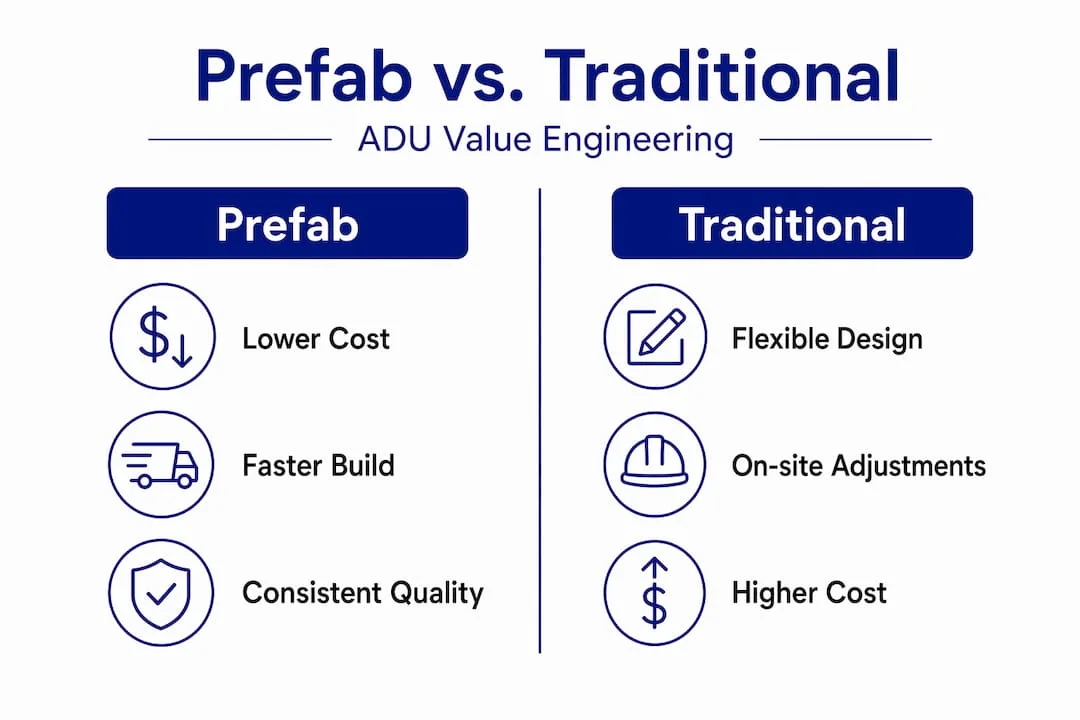
Prefabricated ADUs can save 10 to 20% on total installed cost and compress the timeline significantly by overlapping off-site manufacturing with the permitting process. That timeline compression matters more than most people realize. Shorter timelines reduce carrying costs, minimize exposure to labor and material price escalation, and get your rental income clock running sooner. Timeline compression via prefab construction yields financial advantages that do not show up in baseline cost estimates but are very real in your actual cash flow.
Traditional stick-built construction offers greater design flexibility, easier integration with existing structures, and no transportation constraints. It is the better choice for irregular lots, hillside sites, or projects requiring significant customization to match a primary residence’s architecture.
From a value engineering standpoint, the decision criteria look like this:
- Choose prefab or modular when your lot is accessible, your design is relatively standard, and minimizing timeline and cost predictability are top priorities
- Choose traditional construction when your site has access limitations, your design requires close integration with the main home, or local zoning requires specific architectural compatibility
- Consider hybrid approaches where prefab structural panels or bathroom pods are integrated into an otherwise site-built project for targeted efficiency gains
For garage conversions specifically, the factors that determine project success are often site-specific and rarely fit a pure prefab model, making traditional or hybrid construction the more value-engineered choice in those cases.
Practical steps to apply value engineering to your ADU
Value engineering does not happen automatically. It requires intentional structure from the start of your project. Here is how to actually implement it:
- Hire a design-build team before finalizing your concept. When designers and builders work together from day one, cost feedback loops happen in real time. You avoid designing something that your contractor will then have to value-engineer under budget pressure.
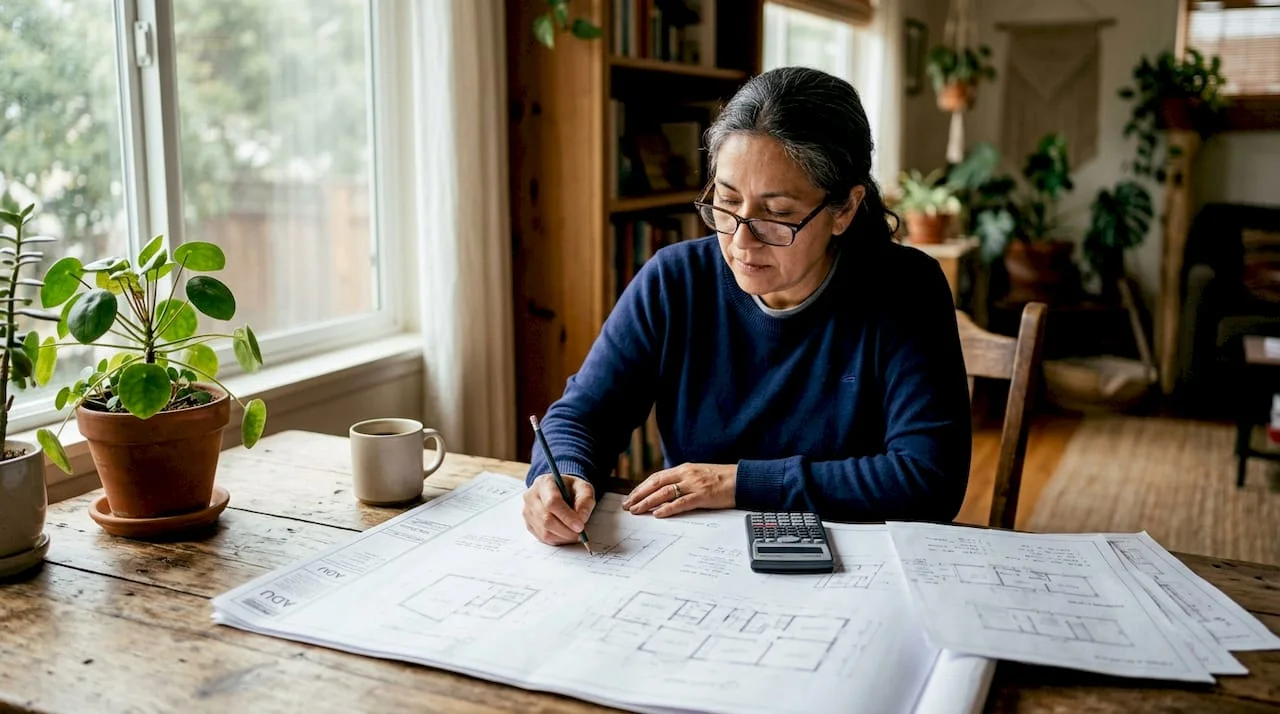
- Use 3D renderings and BIM tools during design. BIM and 3D visualization enable proactive evaluation of VE alternatives before anything is built. You can compare structural options, rooflines, and material choices visually without paying for the changes in the field.
- Track costs by line item as designs evolve. Each design change should trigger a cost update. This keeps the budget connected to the design in real time rather than producing a surprise at the end of schematic design.
- Resolve permitting strategy early. Delays in permitting extend carrying costs and increase exposure to price escalation. The ADU approval process in Los Angeles involves specific timelines that your VE strategy should account for.
- Consult an appraiser before finalizing design. Understanding what features will actually increase appraised value, versus what you personally prefer, shapes better decisions about where to spend and where to save.
Pro Tip: Ask your design team to produce a “value matrix” early in schematic design: a simple table listing each major building system, its estimated cost, and its functional contribution to rentability or resale value. This one tool clarifies trade-offs faster than any conversation.
My take on where ADU value engineering goes wrong
I have worked on enough ADU projects to see the same mistake repeat itself. Most property owners treat value engineering as a rescue operation. The budget comes in over estimate, the contractor suggests cutting a few things, and the owner agrees under pressure. That is not value engineering. That is reactive cost management, and it almost always produces inferior outcomes because the decisions happen fast, without analysis, and against a background of stress.
The projects that turn out best are the ones where the owner came in asking “what is the most efficient way to achieve this outcome?” rather than “how do we build exactly what I drew and then figure out the cost?” Early-stage design decisions carry enormous financial weight. Choosing a rectangular floor plan over an L-shaped one, or locating the ADU closer to the main house utilities, can save more than months of later negotiation over finishes.
I have also seen owners over-correct in the other direction, cutting costs so aggressively that they compromise durability. Skimping on waterproofing, insulation, or mechanical systems to save money upfront creates recurring maintenance costs that erode returns over a 10 to 20 year hold. The goal is always lifecycle value, not lowest bid.
The most financially sophisticated ADU owners I have worked with think about design, construction cost, rental income, tax strategy, and appraised value as one integrated problem. When you pull those threads together at the start, value engineering happens naturally.
, Uni Construction
Work with a team that engineers value from day one
At Uni Construction, value engineering is not a phase we add after a budget blows up. It is built into how we approach every ADU project from the first design conversation. Our team integrates licensed architectural drafting, structural engineering, and construction consulting so that cost and performance decisions happen simultaneously, not sequentially. We work extensively in the Los Angeles area with property owners who want expert ADU design and construction that genuinely pencils out. Whether you are exploring a detached backyard unit, a garage conversion, or a new construction ADU, we offer custom 3D renderings and permit-ready drawings that give you clarity before you commit to a single material or structural system. Explore the full range of ADU types and design options to see which approach aligns with your property and investment goals.
FAQ
ADU value engineering is a structured process that evaluates design and material decisions to deliver the same or better performance at a lower lifecycle cost. It is distinct from simple cost-cutting because it preserves function, safety, and design intent.
Value engineering is most effective during the schematic and design development phases, before structural drawings are finalized and before contracts are signed. Changes made at that stage cost almost nothing compared to mid-construction revisions.
The savings depend on project complexity, but strategic decisions around site placement, foundation type, roof design, and permitting strategy can realistically reduce costs by $30,000 to $70,000 on a typical California ADU project without sacrificing quality.
Done correctly, it does not reduce appraised value. Appraisers evaluate ADUs based on permitted status, rental income documentation, and comparable sales. A well-engineered ADU with proper permits and documented rental history can support strong appraised value regardless of where costs were optimized.
Not always. Prefab ADUs can save 10 to 20% on total cost on accessible, standard lots, but sites with access constraints or complex integration requirements often favor traditional construction for better overall value.