

Most residential and ADU Title 24 reports in California typically fall within a low to moderate cost range, with straightforward single-family alterations near the lower end and larger new construction homes or multi-system ADUs toward the higher end. Small commercial jobs almost always get a custom quote instead of a flat rate. Complexity, conditioned square footage, and how fast you need the paperwork back all move the number.
Quick math: A typical detached ADU report usually starts at a modest baseline price, and additional fees such as rush service or mid-project revisions increase the total cost accordingly, generally making early planning beneficial to avoid higher charges.
Your next move depends on where you are in the process:
- Already have plans? Send them to a Title 24 consultant now for a scoped quote instead of a rough estimate.
- Still designing? Loop in compliance review before you finalize HVAC and glazing choices, since those decisions swing the price.
- Working with a design-build firm? Ask whether Title 24 compliance is bundled into your permit-ready package or billed separately.
Key Takeaways
Title 24 report costs in California depend more on when you order the report and how complex your HVAC and envelope design are than on square footage alone.
| Point | Details |
|---|---|
| Typical price range | Most residential and ADU reports run $199 to $500 depending on size and complexity. |
| Complexity drives cost | Multiple HVAC zones, solar/battery systems, and high glazing ratios push quotes higher. |
| Commercial projects get quoted | Small commercial jobs under 5,000 square feet are individually priced, not flat-rate. |
| Order early to save money | Bringing in compliance review during design avoids rush and revision fees later. |
| Confirm your code cycle | Permits submitted after January 1, 2026, require the 2025 Building Energy Efficiency Standards. |
| Uni Construction integrates compliance | Uni Construction bundles Title 24 review into design and structural work to reduce revision risk. |
Title 24 Report Cost by Project Type and Tier
Pricing scales with building type, not just square footage. Here’s how the tiers generally break down for California residential and light commercial work.
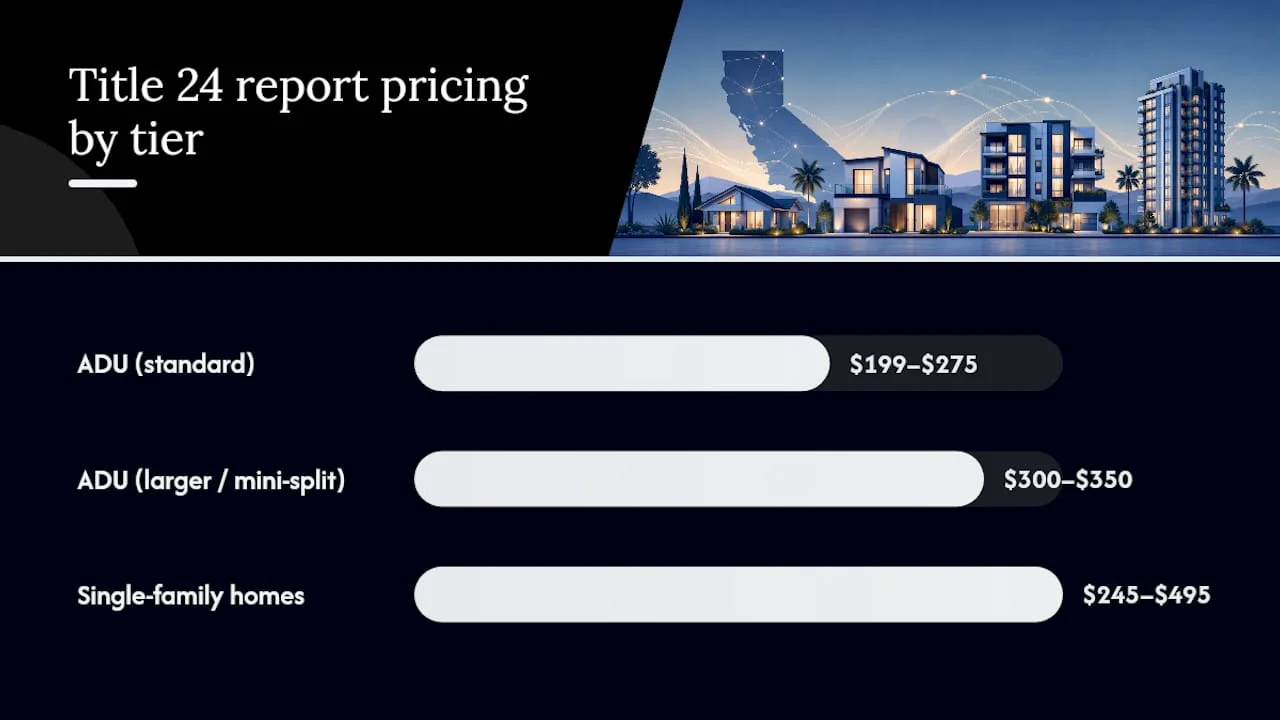
Accessory Dwelling Units (ADUs). Flat-rate ADU reports commonly start at $199–$275 for a standard detached or attached unit under roughly 1,200 square feet with typical HVAC. Larger ADUs, or ones with mini-split zoning per room, tend to land closer to $300–$350.
Single-family homes. New construction and major remodels usually fall between $245 and $495, depending on conditioned floor area, number of HVAC zones, and whether the project pursues the Prescriptive or Performance compliance path. A straightforward 1,800 square foot remodel with one HVAC system sits at the lower end; a 3,500 square foot custom home with radiant heat and multiple zones sits at the top.
Multifamily and small commercial. Once you cross into duplexes, triplexes, or commercial tenant improvements, flat pricing mostly disappears. Industry pricing data shows that small commercial projects under 5,000 square feet are commonly quoted individually rather than tariffed, because occupancy type and form requirements (NRCC forms, for instance) vary too much for a one-size number.
Here’s what that looks like in practice with three worked examples:
- Example 1: Standard ADU, normal turnaround. A base fee applies with no rush or revisions.
- Example 2: ADU with a rush request. The base fee plus a rush fee increases the total accordingly.
- Example 3: Single-family remodel with an address change mid-permit. The base fee plus an address or revision fee reflects typical additional costs.
These examples assume the project doesn’t add units, change HVAC design after modeling starts, or require a second registry submission. Each of those changes the math, which is why the next section matters.
What Drives Your Title 24 Quote Up or Down
Two projects of the same square footage can get quotes $150 apart. The variables below explain why.
- Conditioned floor area and classification. New construction, additions, and alterations are all treated differently. An alteration that only touches HVAC and water heating triggers a narrower compliance scope than a full addition with new conditioned space.
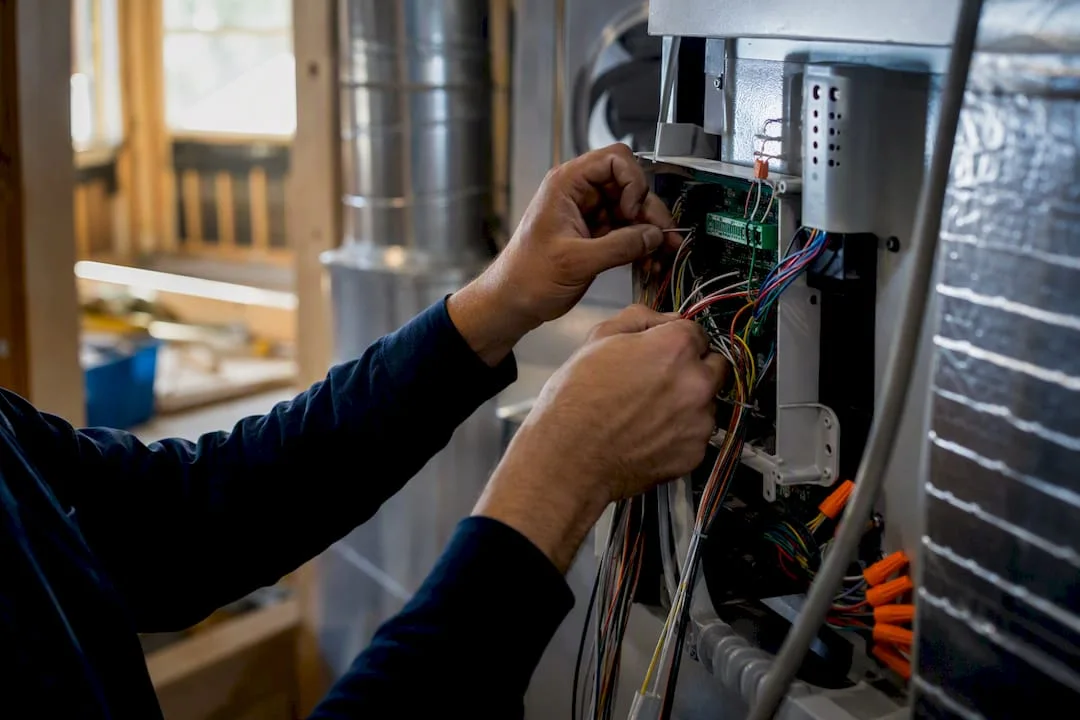
- System complexity. Multiple HVAC zones, high window-to-wall glazing ratios, and non-standard envelope assemblies all add modeling time. A house with three mini-splits costs more to model than one with a single central system.
- Solar and battery design. Homes adding solar PV or battery storage need that equipment reflected in the compliance model, which adds a modeling step most flat-rate ADU quotes don’t include.
- Number of units. Multifamily projects require separate CF1R forms per unit type in many cases, which is part of why they’re quoted rather than flat-priced.
- Turnaround and registration. Faster delivery and registry work through CHEERS or CalCERTS both affect the final invoice, covered in more detail below.
For custom homes chasing tighter budgets, the Performance Path lets a consultant trade off envelope quality against equipment efficiency to find the cheapest legal path to compliance, rather than hitting fixed prescriptive minimums on every component.
Pro Tip: Lock your HVAC layout before you request your Title 24 quote. Changing zoning after modeling starts is one of the most common (and avoidable) sources of revision fees.
What’s Actually Included in a Title 24 Report Package
A quote that just says “Title 24 report” without listing deliverables is a quote you should question. A complete package typically includes:
- The CF1R (Certificate of Compliance) and, where applicable, CF2R installation certificates.
- Registration with a state-approved registry, CHEERS or CalCERTS, so the completed forms are recognized by your local plan checker.
- Plan-sized PDFs formatted to match your submittal set, not just a standalone report.
- A defined number of included revisions, plus a stated policy for what happens beyond that limit.
Turnaround tiers usually track directly with price: standard delivery (roughly three to five business days) sits at the base rate, while one- or two-day rush delivery adds a flat surcharge. Vendor pricing pages commonly bundle registry fees and a limited revision round into the base price, so ask your consultant to spell out exactly what “included” covers before you pay, since that’s where surprise line items tend to hide.
Budgeting and Timing Your Title 24 Report
Build a small contingency into your permit budget to cover reasonable revisions or modest rush requests, helping to avoid schedule disruptions.
- Order the report during design, not at permit submission. Getting compliance input while you’re still finalizing HVAC and glazing choices lets the consultant flag issues before drawings are locked, which keeps revision fees off your invoice entirely.
- Ask four questions before you pay anything: What forms are included? Which registry handles registration, and who submits it? How many revisions are covered? What triggers a rush or address-change fee?
- Confirm your code cycle. Permits submitted on or after January 1, 2026, must comply with the 2025 Building Energy Efficiency Standards. A report built on the previous code edition after that date will likely get rejected at plan check, forcing a redo you’ll pay for twice.
How Uni Construction Approaches Title 24 Compliance
Uni Construction folds Title 24 compliance into the design phase rather than treating it as a separate, bolt-on step after drawings are finished. That matters because industry guidance consistently points to early integration as the single biggest lever for avoiding late revisions.
Services relevant to this process include:
- Custom ADU design and permit-ready drawing packages.
- Coordinated HERS/CHEERS registration handled alongside structural and architectural drafting.
- Structural engineering review that catches envelope or HVAC conflicts before they hit the compliance model.
On one recent detached ADU project, catching a mismatched HVAC zoning plan during the drafting phase, rather than after Title 24 modeling was already underway, avoided what would have been a rush revision fee and a week of schedule slippage.
Coordinating drafting and compliance under one workflow is exactly why that kind of catch happens before it costs money instead of after.
The Real Lesson in California’s Title 24 Pricing
The conventional advice out there treats Title 24 cost as a single number you look up and budget for. That’s backwards. The price isn’t really about the report itself. It’s a downstream reflection of decisions made earlier in design, particularly HVAC layout and glazing.
Homeowners who treat Title 24 as a permit-stage formality, something you order after drawings are done, are the ones who end up paying rush fees and revision fees on top of the base quote. The people who get the $225 flat rate instead of the $470 total are the ones who brought a consultant in while the HVAC plan was still on the table.
If there’s one thing worth prioritizing here, it’s sequencing, not shopping for the lowest base price. A slightly higher quote from a consultant embedded in your design process will almost always beat a cheaper quote from someone who only sees your plans after they’re locked. The 2025 code cycle adds another reason to get this right the first time: a report built on the wrong edition doesn’t just cost more, it gets rejected outright.
, Uni Construction
Get a Scoped Title 24 Quote From Uni Construction
Uni Construction builds Title 24 compliance into the same workflow as your architectural drawings and structural engineering, instead of handing it off to a separate vendor after your plans are already set. That’s the practical advantage: one team catches HVAC and envelope conflicts before they turn into a rush fee or a rejected submittal.
If you’re planning an ADU, start with the ADU design and permit-ready package for Los Angeles, or browse ADU types to confirm which category your project falls under, since that classification affects your Title 24 scope. Homeowners further along in drafting can also check drafting services to see how compliance review fits into an existing plan set.
To get a real number instead of a guess, send your site plans, project type (ADU, addition, or new construction), and target turnaround to Uni Construction for a scoped quote.
Sources
- California Energy Commission , Building Energy Efficiency Standards (2025)
- 2025 Guide to Title 24 (California Building Standards Commission)
- Title 24 Calcs , Pricing
- Title 24 Stakeholders , 2025 Measures and Performance Path