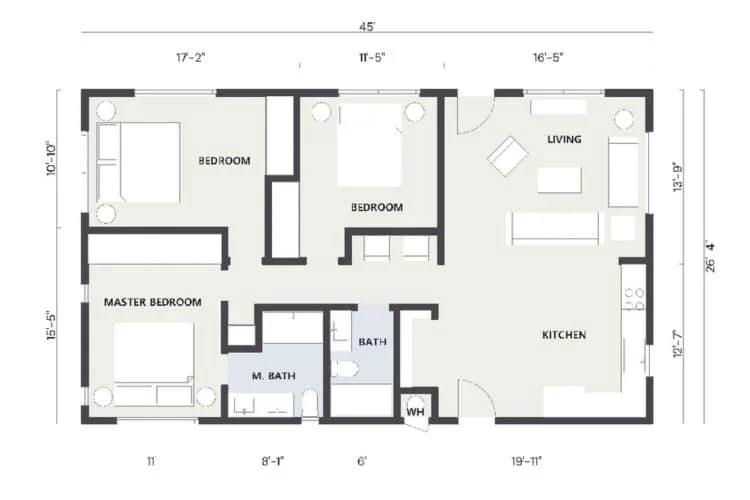


ADU utility connection is the full process of establishing compliant water, sewer, gas, and electrical services for an Accessory Dwelling Unit, and it is a legal requirement for occupancy in California. The California Building Standards Commission, local municipal permit offices, and utility providers like Southern California Edison and PG&E all play a role in approving these connections. Getting the process wrong, or starting it too late, is the single most common reason ADU projects run over schedule. This guide covers the adu utility connection explained step by step, from the first permit application through meter activation, so you can plan with accurate expectations.
How does water and sewer connection work for ADUs in California?
Water and sewer hookups are the foundation of any ADU utility setup. California plumbing code requires that detached ADUs have separate sewer connections to the public sewer or trunk sewer under Section 311.1, unless the local utility explicitly permits sub-metering. That requirement shapes nearly every site plan from the start.
For water service, you have two main options: a shared meter with the primary residence or a dedicated meter for the ADU. Shared meters reduce upfront installation costs but create billing complications when the ADU is rented. Separate utility meters eliminate owner billing risk entirely but add infrastructure cost and installation time. The right choice depends on whether you plan to rent the unit or house family members.
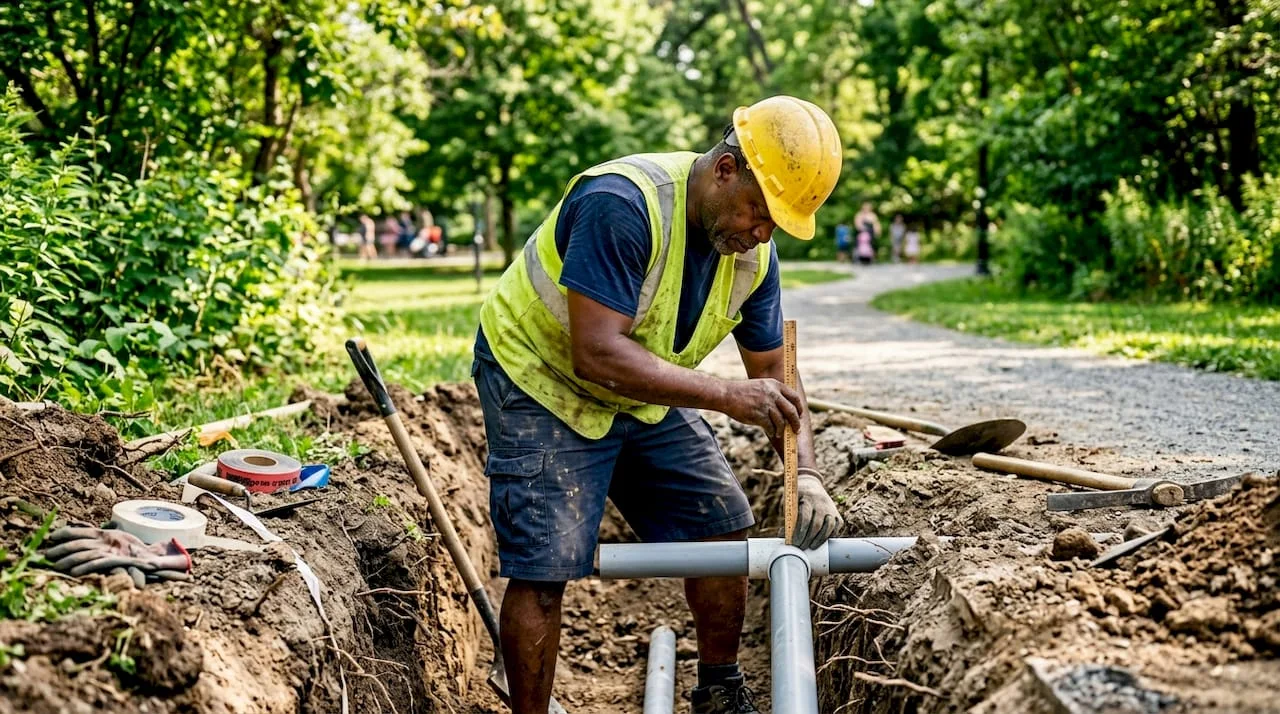
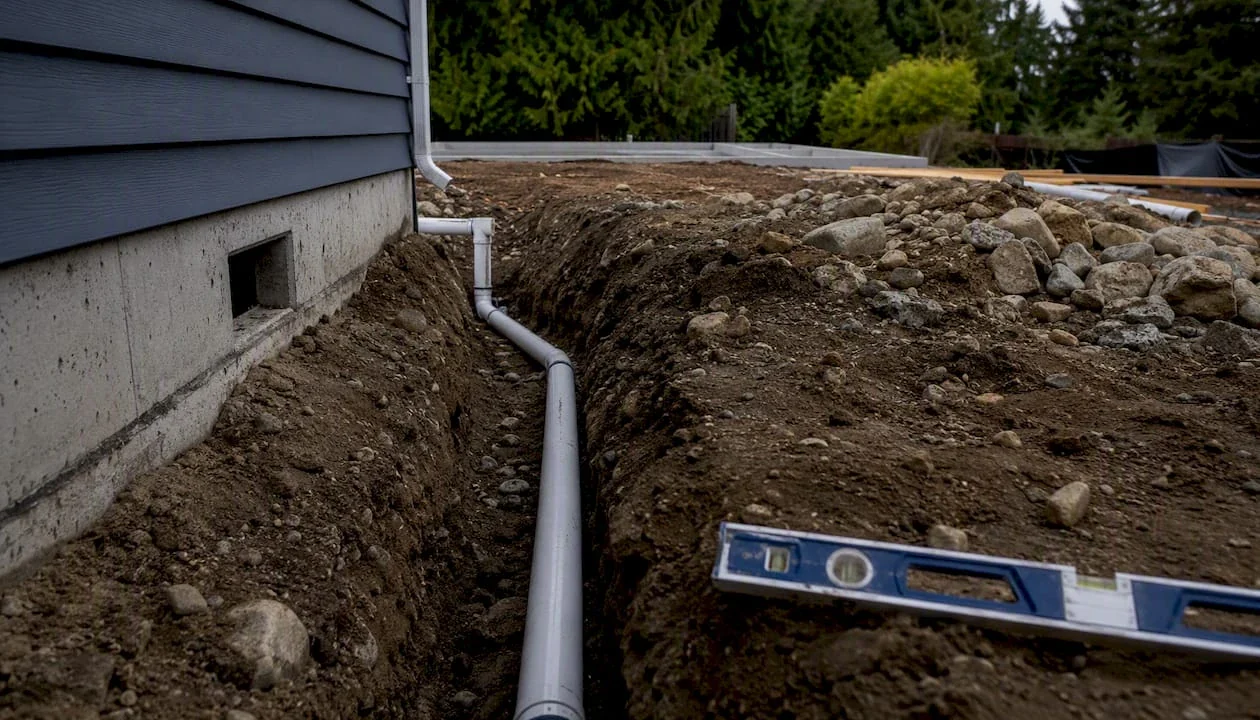
The physical work involves trenching from the main service line to the ADU, installing shutoff valves, and connecting to the existing water main at an approved point. Site-specific factors like slope, distance from the main line, and obstacles such as tree roots or hardscape all influence complexity and cost. Steep lots may require ejector pumps for sewer lines, which adds both equipment cost and a maintenance obligation.
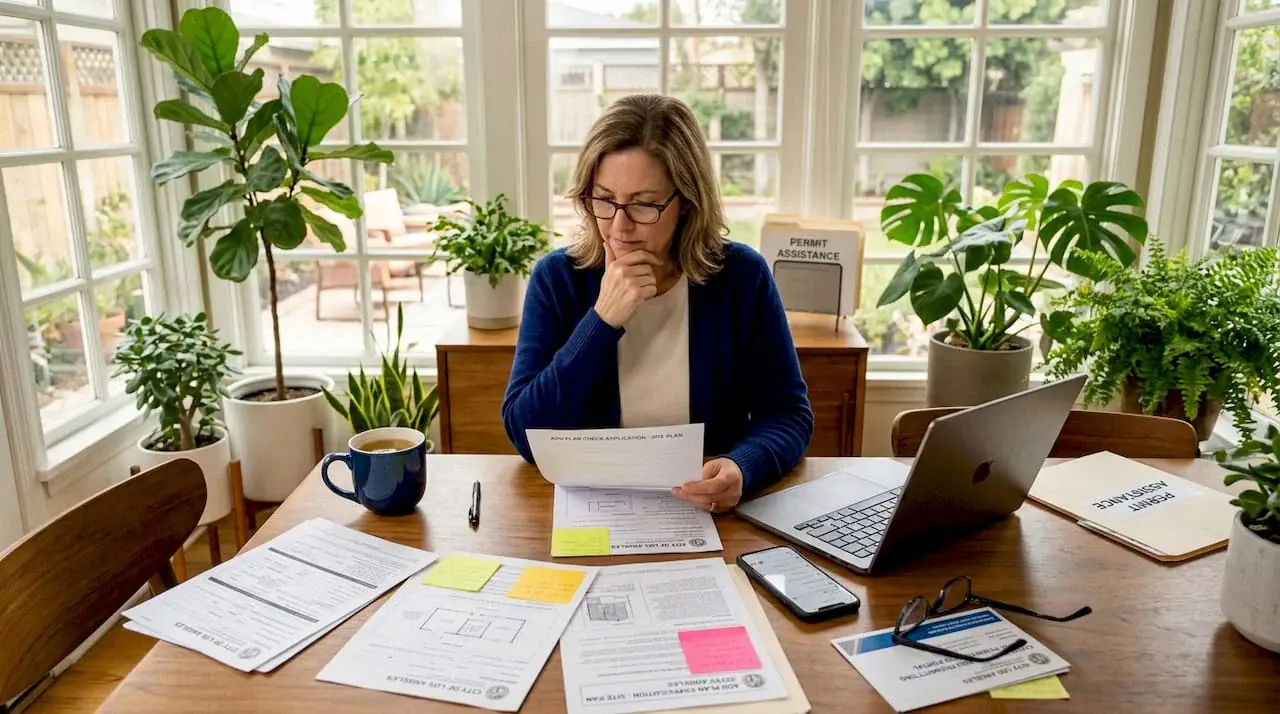
Permitting for water and sewer requires submitting plumbing plans to the local building department and coordinating approvals with the municipal water district. Some districts require a separate will-serve letter before they approve your building permit. Start this coordination before you finalize your site plan.
Pro Tip: Request a will-serve letter from your local water district at the same time you submit your building permit application. Waiting until after permit approval can add weeks to your schedule.
| Connection type | Pros | Cons |
|---|---|---|
| Shared water meter | Lower upfront cost, simpler installation | Billing disputes with tenants, no independent shutoff |
| Separate water meter | Direct tenant billing, independent control | Higher installation cost, longer setup time |
| Shared sewer lateral | Less trenching, lower cost | Capacity limits if main line is undersized |
| Separate sewer connection | Code-compliant for detached ADUs, no shared capacity risk | More excavation, higher permit fees |
What are the electrical connection essentials for ADUs?
Electrical service for an ADU comes in three configurations: a dedicated meter, a submetered panel fed from the main house, or a shared panel with the primary residence. Each option carries different cost, permitting, and long-term billing implications.
A dedicated meter gives the ADU full electrical independence. Southern California Edison and PG&E both require a load calculation before approving a new service point. That calculation determines whether the existing transformer on your street can handle the added load. Transformer upgrades are one of the most common sources of major delays, and the property owner pays for the replacement when existing equipment cannot support the ADU’s electrical demand. Costs for transformer work can reach tens of thousands of dollars depending on the scope.
Submetering is a middle-ground option. The ADU draws power from the main panel, and a submeter tracks its consumption separately. This avoids a new utility service application but requires the main panel to have sufficient capacity. Many older Los Angeles properties run 100-amp panels that cannot support an additional dwelling without an upgrade.
The permitting workflow with Southern California Edison or PG&E involves submitting a service application, receiving a design package, signing a construction contract, and then scheduling inspection and meter activation. Each step has its own queue.
- Dedicated meter: requires new utility service application, load calculation, and possible transformer work
- Submetered panel: requires main panel capacity check and submeter installation permit
- Shared panel: lowest cost but creates billing complications and may violate local rental regulations
- All-electric builds: simplify permitting and eliminate gas line installation costs, making them increasingly favored in California
Pro Tip: Submit your electrical service application to Southern California Edison or PG&E on the same day you submit your building permit plans. The utility queue runs independently of the city queue, and parallel processing cuts months off your total timeline.
What is the ADU utility connection application and timeline process?
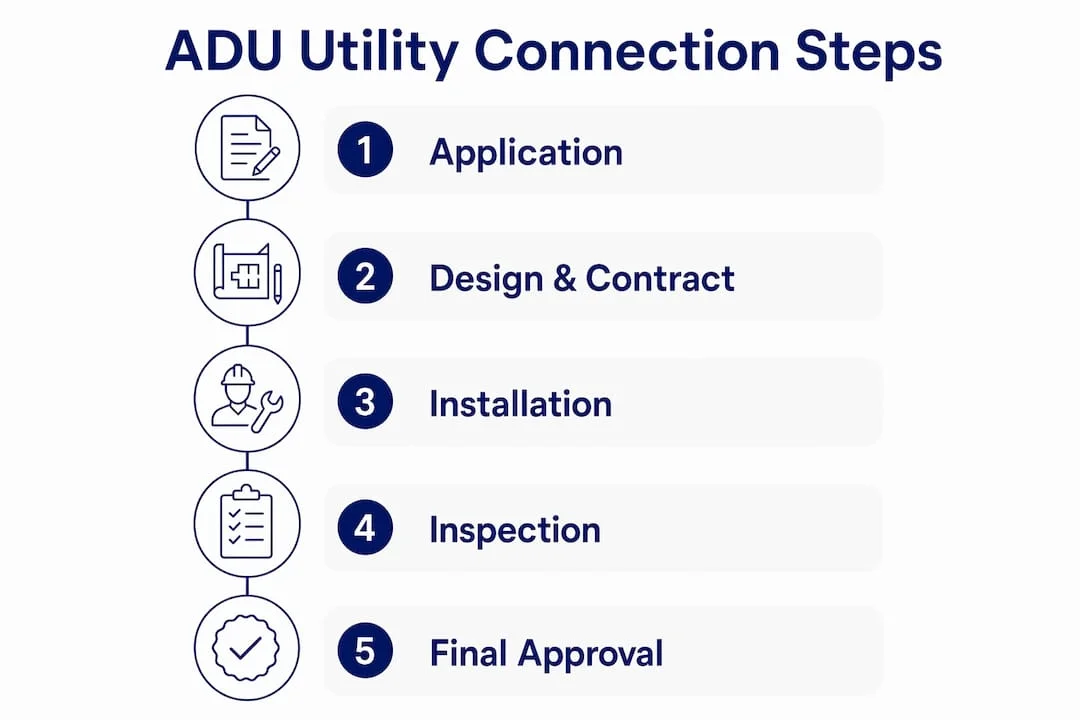
The adu utility connection process follows five distinct phases: application, design and contract, installation, inspection, and meter activation. Each phase involves a different agency or utility department, and delays in one phase push every phase after it. Concurrent submission of utility applications and building permit plans is the industry best practice for keeping total timelines at 10–12 months rather than well over a year.
California’s SB 1196 sets strict service activation deadlines for utility companies serving ADUs and JADUs, with financial penalties for non-compliance. That law gives you legal standing to push back when a utility misses its deadlines. Know your rights under SB 1196 before you start the process.
The step-by-step sequence looks like this:
- Conduct a utility capacity feasibility check before finalizing your ADU design
- Submit building permit plans and utility service applications on the same day
- Receive the utility design package and review connection requirements
- Sign the utility construction contract and pay any required fees
- Schedule and complete utility infrastructure installation (trenching, conduit, meter base)
- Pass city and utility inspections for each service
- Request meter activation and receive final sign-off for occupancy
Early capacity assessments reduce project risk by identifying transformer limitations, undersized water mains, or sewer capacity issues before you commit to a design. Discovering a problem after permits are issued forces costly redesigns. The 2026 ADU timeline for Los Angeles projects reflects these realities and builds utility activation into the critical path from day one.
What are the common mistakes in ADU utility connections?
The most expensive mistakes in the adu utility connection process share one cause: late planning. Homeowners who treat utility connections as a final construction step, rather than a parallel track, routinely face delays of three to six months beyond their original completion date.
Reusing an existing meter without utility approval is a frequent error. It creates billing disputes, violates utility tariffs, and can result in the utility requiring a full new service installation after the fact, at full cost. Always get written approval before sharing any meter.
Underestimating trenching costs is another common problem. Rocky soil, long runs from the main service, and existing underground utilities all drive up excavation costs well beyond initial estimates. Site conditions on sloped lots in areas like the Hollywood Hills or Pasadena foothills add complexity that flat-lot estimates do not capture.
- Submitting utility applications after construction starts, creating a timeline gap of months
- Skipping a load calculation before designing the electrical system
- Assuming the existing sewer lateral has capacity for a second dwelling
- Ignoring gas line permitting when the ADU includes a gas range or water heater
- Failing to budget for transformer replacement or panel upgrades
Pro Tip: Add a 15–20% contingency to your utility connection budget specifically for infrastructure upgrades. Transformer replacements and sewer lateral extensions are the two most common unplanned costs, and both are non-negotiable if the utility requires them.
Review the ADU feasibility checklist for Los Angeles properties before finalizing your budget. It covers utility capacity evaluation as a core step, not an afterthought.
What are the best practices for ADU utility connections?
The best practices for ADU utilities come down to timing, documentation, and design choices that reduce friction with utility providers. Start every project by checking whether your property can support the added utility load. That single step prevents the most expensive surprises.
| Best practice | Why it matters |
|---|---|
| Submit utility applications with building permits | Parallel processing cuts total wait time to 10–12 months |
| Request will-serve letters early | Confirms water and sewer capacity before design is finalized |
| Choose all-electric construction | Avoids gas line permits and reduces upfront connection costs |
| Conduct a load calculation before design | Prevents transformer upgrade surprises during construction |
| Keep written records of all utility correspondence | Protects you if billing disputes or service delays arise |
| Match meter type to long-term ADU use | Rental units benefit from separate meters; family units may share |
All-electric ADU builds are gaining traction across California because they simplify the permitting process and eliminate gas line installation costs. Heat pumps and induction cooktops meet California’s Title 24 energy standards without requiring a new gas service application. For most new ADU projects in Los Angeles and surrounding cities, going all-electric is the faster and less expensive path.
Document every conversation with your utility provider in writing. Verbal commitments from utility representatives carry no weight when a project stalls. Email confirmations, signed contracts, and dated approval letters are your only protection against schedule disputes. For guidance on how accessory units connect to existing home infrastructure, the garden room connection guide from Complete Property offers a useful parallel perspective on utility planning for secondary structures.
Key Takeaways
Successful ADU utility connections in California require parallel applications, early capacity checks, and meter choices aligned with long-term use.
| Point | Details |
|---|---|
| Submit applications concurrently | File utility and building permit applications on the same day to target a 10–12 month total timeline. |
| Separate sewer connections are required | California plumbing code mandates independent sewer hookups for detached ADUs under Section 311.1. |
| Transformer upgrades are a real cost | Existing transformers often cannot support ADU electrical load, and replacement costs fall on the property owner. |
| All-electric builds reduce friction | Choosing all-electric eliminates gas line permitting and lowers upfront utility connection costs. |
| Early capacity checks prevent redesigns | Identifying water, sewer, or electrical limitations before permit submission avoids costly mid-project changes. |
What I’ve learned from managing ADU utility connections in Los Angeles
The biggest misconception homeowners bring to ADU projects is that utility connections are a construction task. They are not. They are a regulatory and infrastructure task that runs on a completely separate timeline from framing, roofing, or finishing work. The utility queue does not care about your contractor’s schedule.
The projects that finish on time share one habit: the utility application goes in on the same day as the building permit. Every project that waits until after permit approval adds months to the schedule, not weeks. That delay is not recoverable. You cannot rush a transformer replacement or a sewer lateral extension.
Electrical transformer capacity is the issue I see underestimated most often. Homeowners budget for wiring and panels but do not account for the possibility that the transformer serving their block is already at capacity. When that happens, the utility requires an upgrade, the property owner pays for it, and the project waits. Running a LA County ADU regulations review early in the process surfaces these risks before they become budget crises.
The 2026 regulatory environment in California is actually more favorable than it was three years ago. SB 1196 gives homeowners real leverage over utility companies that miss service deadlines. Use it. Document every missed commitment and reference the statute when following up. Utilities respond differently when they know you understand the law.
My consistent advice: treat utility planning as a design constraint, not a construction task. The meter type you choose, the location of your service panel, and the routing of your sewer lateral all affect your ADU’s long-term operating costs and rental viability. Make those decisions early, with full information, and the rest of the project follows a predictable path.
, Uni Construction
How Uni Construction supports your ADU utility planning in Los Angeles
Utility connection requirements are built into every project Uni Construction manages, from the first feasibility review through final inspection. Getting the utility setup right from the start is what separates a project that finishes on schedule from one that stalls for months waiting on a transformer or a will-serve letter.
Uni Construction’s ADU design services in Los Angeles include permit-ready drawings that account for water, sewer, and electrical connection points, load calculations, and coordination with local utility providers. The team handles the documentation, the concurrent submissions, and the follow-up that keeps utility approvals moving in parallel with city permits. If you are planning an ADU in Los Angeles and want to avoid the utility delays that derail most projects, contact Uni Construction before you finalize your design.
FAQ
ADU utility connection is the process of establishing water, sewer, gas, and electrical services for an Accessory Dwelling Unit to meet California legal occupancy requirements. It involves separate permits, utility applications, and inspections for each service type.
The total timeline runs approximately 10–12 months when utility applications are submitted concurrently with building permits. Waiting until after permit approval can push the total timeline well beyond a year.
California plumbing code under Section 311.1 requires detached ADUs to have a separate sewer connection to the public sewer, unless the local utility explicitly permits sub-metering.
Transformer upgrades are the leading cause of electrical connection delays. When the existing transformer cannot support the ADU’s added load, the utility requires a replacement at the property owner’s expense, which can take months to complete.
All-electric ADUs simplify the permitting process by eliminating the need for a gas line application and reduce upfront connection costs. California’s Title 24 energy standards support all-electric designs, making them a practical choice for most new ADU projects.