

Yes, you can build an ADU on a California property in the coastal zone. State ADU law applies there, but the Coastal Act still applies too, so most projects need a Coastal Development Permit (CDP) on top of the normal building permit. Since AB 462 took effect on October 10, 2025, that CDP has a 60-day clock and can no longer be appealed to the Coastal Commission. This guide explains how to tell whether your lot is in the zone, who reviews your project in Los Angeles, and how flood hazards can change the design.
TL;DR
- State ADU law applies in the coastal zone, but it does not weaken Coastal Act protections for habitat, public access and hazard safety.
- Most new ADUs in the zone need a CDP. Under AB 462, a complete application must be approved or denied within 60 days or it is deemed approved.
- The City of Los Angeles has no certified local coastal program, so an ADU-only CDP goes to the Coastal Commission’s South Coast District Office. Projects with extra work go to City Planning.
- Flood and coastal hazards are reviewed during design. Check them before you commit to a footprint.
What the coastal zone is and how to check your parcel
The coastal zone is a strip of land along the California shoreline whose boundary was set by the Coastal Commission’s official maps, adopted March 1, 1977. The Commission offers digital boundary maps you can search by address or APN. It warns that the digital data is not survey-accurate, so a borderline lot may need a formal boundary determination, according to the HCD ADU Handbook (March 2026).
City and county tools are usually faster:
- Los Angeles: search your address or APN in ZIMAS and open the “Additional” dropdown, where Coastal Zone status is listed (HCD ADU Handbook).
- Newport Beach: the city’s address search tool tells you whether a property is in the Coastal Zone.
- Santa Cruz County: look up your parcel number in the county GIS tool and check the Land Use tab (county CDP page).
Run this check before you pay for design. It decides whether your schedule needs a CDP step.
Do you need a Coastal Development Permit?
The baseline rule is in Public Resources Code 30600: anyone undertaking development in the coastal zone needs a CDP, with limited exceptions. State ADU law does not override this. The one change it makes is that local governments do not have to hold public hearings for ADU CDP applications.
Who reviews the application depends on where you are. About 90% of coastal-zone land is covered by a certified local coastal program (LCP), where the local government reviews new development. In the rest, the Commission permits development directly (Coastal Commission summary).
Local rules differ in practice:
| City | What the city says |
|---|---|
| Coastal Los Angeles property | Confirm the parcel’s coastal-zone status, applicable local coastal program and any coastal development permit requirements with the local authority. Consult the Coastal Commission’s ADU guidance before assuming that a building permit completes the coastal review. |
| Manhattan Beach | All ADUs and JADUs in the Coastal Zone go through a building permit and a CDP. Required parking for the primary home must be kept (city document). |
| Newport Beach | A new ADU in the Coastal Zone may require a CDP (city ADU page). |
Possible exemptions
Public Resources Code 30610 says improvements to existing single-family residences can proceed without a CDP, except for classes of development the Commission specifies as risky. A separate tool is the Categorical Exclusion Order. The Commission’s SB 1077 guidance says it can exempt ADUs and JADUs that clearly pose no significant risk to coastal resources, such as those clustered with existing development in urbanized areas. Whether your lot qualifies is a question for your local planning office, not something to assume.
What AB 462 changed
AB 462 took effect on October 10, 2025. According to the HCD ADU Handbook, local governments and the Commission must approve or deny a complete ADU CDP application within 60 days. If they do not act, it is deemed approved. The CDP review runs at the same time as the normal planning and building permit review, not after it.
The Commission’s SB 1077 guidance adds two points for ADU-only, JADU-only, or ADU-and-JADU-only projects:
- The deadline dropped from 90 days to 60 days.
- CDPs approved locally can no longer be appealed to the Coastal Commission.
SB 543 adds a further layer, again per the HCD handbook: a 15-business-day completeness review, a 60-business-day dispute resolution deadline, and a deemed-complete default if the agency does not respond.
The 60 days start only when the application is complete. A thorough submittal is the best way to protect your schedule. Site plans, elevations, and hazard information that are missing at filing will pause the clock.
SB 1077 also required the Commission, working with HCD, to produce written guidance by July 1, 2026 to help local governments amend their LCPs and simplify ADU permitting. Expect local rules to keep changing, so confirm your city’s current process.
ADU permits in the Los Angeles coastal zone
Los Angeles has no certified LCP. Per the City Planning CDP instructions (November 2025):
- A CDP application for work limited to a new ADU is filed with the Coastal Commission’s South Coast District Office.
- If you propose additional work, such as a major remodel, file with City Planning instead.
- A Mello Act Compliance Review must be filed with City Planning before the building permit is issued.
- The 60-day deemed-approval rule applies to both the city and the Commission.
That means a coastal-zone ADU in LA can involve the Commission, City Planning, and the Department of Building and Safety at once. Our ADU approval process guide for Los Angeles walks through the standard city path, and the California ADU permit application guide covers the paperwork common to all projects.
The LA Department of Building and Safety ADU correction sheet (October 2025) lists the Flood Hazard Management Specific Plan and the Coastal Development Permit bulletin among its supplemental sheets. It also requires CDP clearance for a change of use, density, or number of parking spaces under LAMC 12.20.2. The same sheet gives the city’s standard detached ADU limits:
- Maximum 1,200 square feet
- Minimum 4-foot rear and side setbacks
- Two stories maximum
- Not permitted in the front half of the lot unless it sits at least 55 feet from the front lot line
Plan the site layout against these numbers and the coastal review at the same time. For county-level lots, see our LA County ADU development regulations guide.
How long should you plan for?
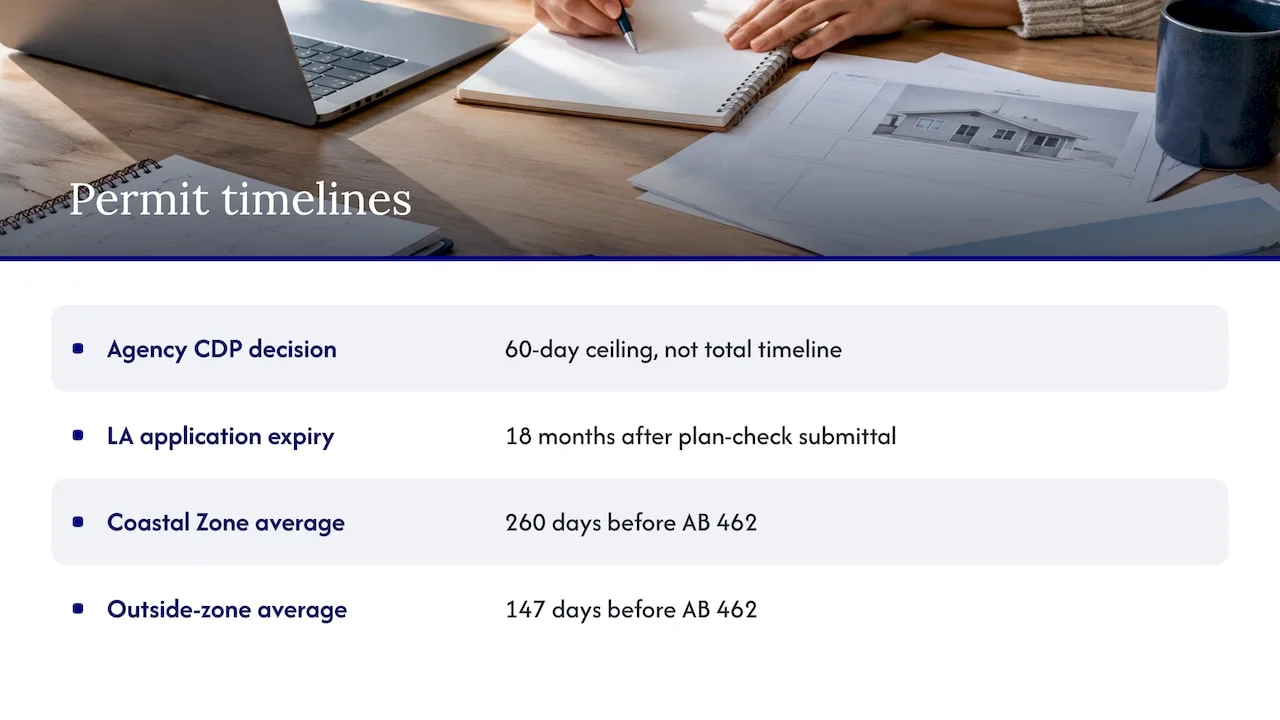
The 60-day CDP window is a ceiling for the agency’s decision, not your total timeline. The HCD handbook notes that in Los Angeles a permit application expires 18 months after plan check submittal, and clearances from other departments can take months. Before AB 462, one published analysis reported that ADU applications in the LA Coastal Zone averaged 260 days to be permitted versus 147 days outside it. That is the gap the new law aims to close. Build a schedule with the CDP running alongside plan check, not after it.
Coastal hazards and flood zones
The Coastal Act requires new coastal-zone development to be safe from flooding, erosion, and other coastal hazards. Reviewers analyze risks such as bluff collapse and sea level rise, and also look at sensitive habitat, wetlands, public access, and adequate infrastructure.
In practical terms, expect these questions on a coastal lot:
- Is the lot near a bluff, wetland, or stream?
- Is it in a mapped flood hazard area?
- Does the ADU change public access or sensitive habitat?
- Can the existing utilities serve it?
Checking flood status in Los Angeles
The city’s Flood Hazard Management Specific Plan exists so Los Angeles meets National Flood Insurance Program standards. The city updated it to conform to federal regulations and maps, which is why it appears on the ADU correction sheet. Start with your address in ZIMAS, then confirm with the city’s Department of Building and Safety whether the plan applies to your lot. If it does, your engineer should account for it in the foundation and floor design before plans are submitted, not after plan check comments arrive.
A lot can be in both the coastal zone and a flood area. Designing for both from day one avoids redraws.
A practical sequence for your project
- Confirm the zone. Use ZIMAS or your city’s lookup, and note the flood and hazard overlays.
- Choose the ADU type. Detached, attached, garage conversion, JADU, or existing floor conversion each trigger different review. See our ADU types.
- Decide the CDP route. In LA, ADU-only goes to the Commission’s South Coast office. Added work goes to City Planning.
- Prepare a complete package. Site plan, elevations, structural, Title 24, and hazard information.
- File the CDP alongside plan check. The 60-day clock runs with the building permit review.
- Clear the Mello Act review before the building permit is issued.
- Build to the approved plans.
Our perspective
We see the same pattern on coastal lots. Owners treat the coastal zone as a reason to wait, when the better move is to design for it from the first sketch. A parcel check, a clear read on the CDP route, and structural and hazard details prepared up front are what keep a project moving.
Our approach is to bring design, drafting, structural engineering, zoning review and Title 24 energy compliance under one roof, so the drawings that go to the agency are complete the first time. A complete submittal matters more now that the 60-day CDP clock starts only on completeness.
Because we handle both design and construction, the person who draws your ADU also knows what it takes to build it. That keeps coastal conditions from becoming surprises in the field. We also stand behind our permit approval guarantee as part of how we work.
Uni Construction
Get your coastal ADU drawn the right way
We design and permit ADUs across Los Angeles and Southern California, including detached units, attached units, garage conversions, JADUs and existing floor conversions. Our team covers zoning review, permit-ready drawings, structural engineering, and construction. If your lot sits near the coast, tell us your address and we will start with the zone and hazard check.
See our ADU design services in Los Angeles or look at completed ADU projects before you reach out.
FAQ
Not always, but usually. Public Resources Code 30600 requires a CDP for development in the coastal zone, with limited exceptions such as certain improvements to existing single-family homes. Your local planning office can confirm whether your specific project is exempt or covered by a categorical exclusion.
For an ADU-only or JADU-only project, check the current state coastal provisions and the local coastal development permit process together. The Coastal Commission’s ADU guidance addresses the relationship between state ADU law and coastal review. Ask the responsible local planner which approval and appeal procedures apply to the actual scope before setting the application schedule.
For work limited to a new ADU, file the CDP with the Coastal Commission’s South Coast District Office. If you propose additional work, file with City Planning. A Mello Act Compliance Review must also be filed with City Planning before the building permit is issued.
A complete CDP application for an ADU is deemed approved if the local government or the Commission does not act within 60 days. The clock starts only when the application is complete, so a thorough submittal matters.
Sources
- California ADU Handbook, HCD (March 2026)
- Coastal Commission: Summary of State ADU Law and the Coastal Act
- Coastal Commission: Final SB 1077 Guidance
- Coastal Commission: SB 1077 page
- Public Resources Code 30600
- Public Resources Code 30610
- LA City Planning: AB 462 CDP Instructions
- LA Building and Safety: ADU correction sheet
- LA City Planning Commission: Flood Hazard Management Specific Plan report
- California Coastal Commission ADU and JADU guidance
- Manhattan Beach ADU permit pathways
- Newport Beach ADU rules
- Santa Cruz County: Is my property in the Coastal Zone?