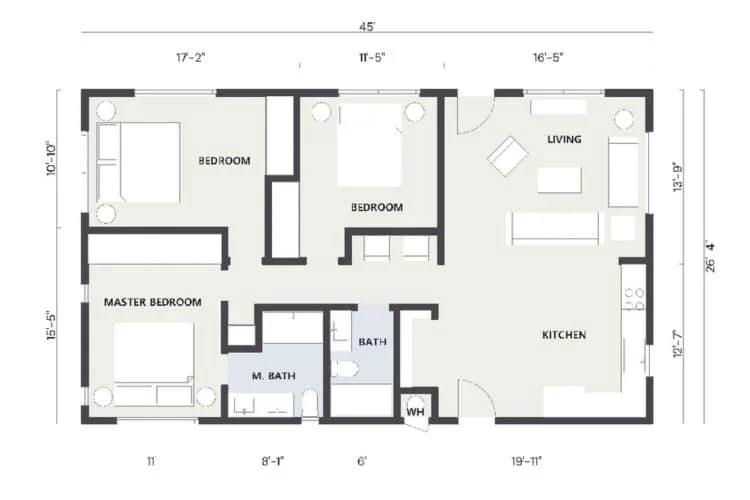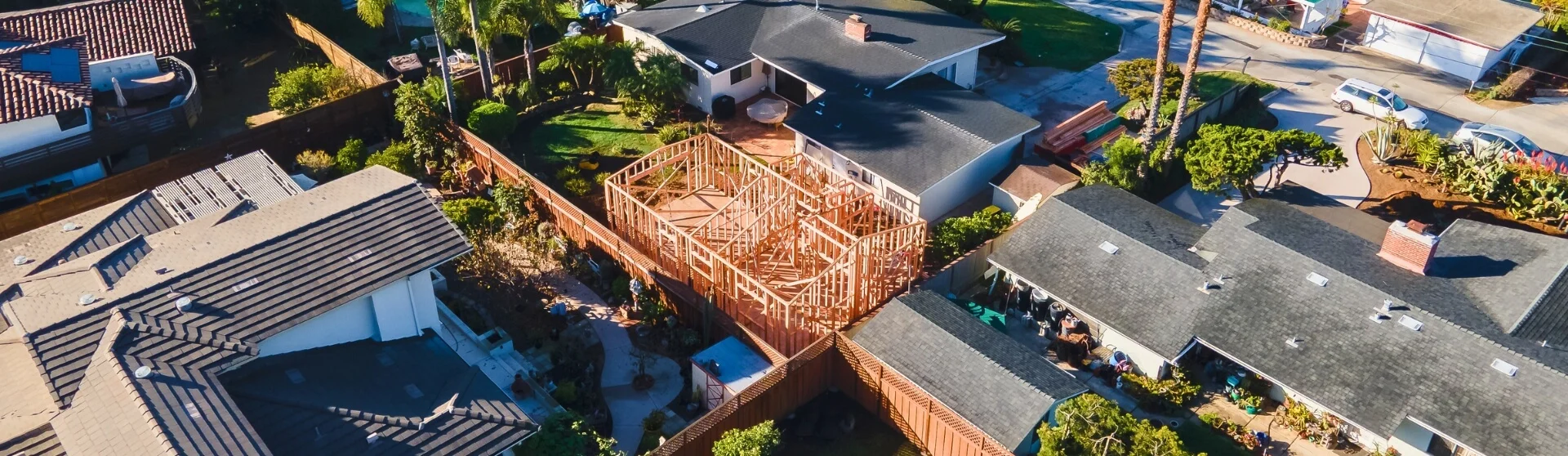



An accessory dwelling unit (ADU) is a self-contained living space with its own entrance, kitchen, and bathroom that generates independent rental income. A room addition, by contrast, expands your existing home’s square footage without creating a separate income stream. The ADU vs room addition value comparison comes down to one core question: do you want rental income and long-term investment returns, or more integrated living space at a lower upfront cost? A permitted detached ADU increases property value by 25%–35% in high-demand California markets, while room additions typically recoup 50%–80% of their construction cost at resale.
Impact-fee threshold note: Under the March 2026 California HCD ADU Handbook, the statewide development-impact-fee exemption includes ADUs with 750 sq ft of interior livable space or less. Above 750 sq ft, applicable impact fees must be proportional. School, utility, plan-check and permit charges follow separate rules.
1. ADU vs room addition: What the value difference actually means
The value gap between these two options is not just about sale price. ADUs generate two separate financial benefits: property value appreciation and monthly rental income. Room additions generate one: increased square footage that appraisers factor into your home’s market value. That distinction shapes every financial decision you make from day one.
Rental income from ADUs ranges from $1,500 to $4,000 per month depending on unit size and market location. At that rate, many California owners recoup their full construction cost within 5–10 years, before they ever sell the property. A room addition offers no equivalent cash flow during ownership.

2. Cost comparison: ADU vs room addition construction expenses in California
Room addition construction costs average $150–$400 per square foot. Detached ADUs run $200–$500 or more per square foot, reflecting the added cost of independent utilities, a separate foundation, and dedicated permitting. That cost gap is real, but it does not tell the whole story.
California law exempts ADUs 750 square feet or less from most development impact fees. That exemption can save $15,000–$30,000 on a standard project. Designing a compact unit under that threshold is one of the most direct ways to control your budget without sacrificing rental viability.
Home additions have shorter build timelines of 3–6 months compared to 10–12 months for ADUs. The longer ADU timeline reflects utility connection requirements, separate inspections, and more detailed plan review. Budget for carrying costs during that window.
| Project type | Cost per sq. ft. | Typical timeline | Fee exemption available |
|---|---|---|---|
| Room addition | $150–$400 | 3–6 months | No |
| Attached ADU | $175–$400 | 6–9 months | Yes, under 750 sq. ft. |
| Detached ADU | $200–$500+ | 10–12 months | Yes, under 750 sq. ft. |
Pro Tip: Design your ADU at 749 square feet or less. That single decision eliminates most development impact fees and can reduce your total project cost by tens of thousands of dollars.
3. How ADUs and room additions contribute differently to property value and ROI
Room addition ROI links directly to square footage and construction quality. Appraisers assign value based on comparable sales of similar-sized homes in the same area. If you spend $100,000 on a room addition, you can reasonably expect $50,000–$80,000 of that to show up in your appraised value at resale.
ADU investment benefits work differently. The property value increase from an ADU reflects both the physical improvement and the income capitalization model appraisers use for income-producing properties. A unit generating $2,500 per month in rent adds value on two fronts simultaneously.
| Factor | Room addition | ADU |
|---|---|---|
| Monthly income | None | $1,500–$4,000 |
| Resale value boost | 50%–80% cost recoup | 25%–35% property value increase |
| Break-even timeline | At resale only | 5–10 years during ownership |
| Tax deductions | None specific | Depreciation, expenses, rental deductions |
Pro Tip: Before committing to an ADU, check local vacancy rates and average rents on platforms like Zillow or Craigslist. A strong rental market cuts your break-even timeline significantly.
4. Financing options and strategies for ADUs vs room additions in 2026
The right financing approach differs sharply between these two project types. Room additions typically use traditional home equity products. ADUs benefit from specialized renovation loan structures that account for income potential.
Key financing options for both project types in 2026:
- Home equity loan: Fixed rate averaging 8.12% as of june 2026. Works well for room additions with predictable costs.
- HELOC: Variable rate averaging 7.43% as of june 2026. Flexible draw structure suits phased ADU construction.
- Fannie Mae HomeStyle loan: Renovation loan based on after-renovation value appraisal. Reduces the appraisal gap problem common with detached ADUs.
- FHA 203(k) loan: Government-backed renovation financing with lower credit thresholds. Useful for owners with limited equity.
- Cash-out refinancing: Replaces your existing mortgage at current rates. Avoid this if your current rate is below 5%, since you forfeit that rate permanently.
Second-lien financing preserves your existing mortgage rate while still accessing equity. For homeowners locked into sub-4% mortgages from 2020–2021, this approach can save thousands in annual interest.
High-cost detached ADUs often face an appraisal gap where traditional appraisals undervalue the project by $80,000–$200,000. Renovation loans solve this by appraising the property based on its completed value, not its current state. For a full breakdown of loan structures, the ADU construction loan guide from Uni Construction covers current terms in detail.
For a broader look at renovation financing options, including how lenders evaluate ADU income projections, AGNY Services provides a useful industry review.
5. Tax benefits and long-term investment considerations: ADUs vs room additions
ADUs carry tax advantages that room additions simply do not. These benefits compound over time and can meaningfully shift your net return.
Key tax advantages exclusive to ADUs:
- California SB 1164 property tax deferral: Eligible ADU owners defer property tax assessment on ADU construction for up to 10 years, reducing carrying costs significantly.
- IRS depreciation: ADU structures depreciate over 27.5 years under standard residential rental property rules, generating annual deductions against rental income.
- Rental expense deductions: Maintenance, utilities, insurance, and property management fees are all deductible against ADU rental income. None of these apply to room additions.
- Business asset treatment: Treating your ADU as a rental business shifts your tax position from homeowner to landlord, unlocking a broader set of deductions.
Many ADU owners miss $3,000–$8,000 in annual deductions due to poor expense tracking. A simple spreadsheet or property management accounting tool closes that gap entirely.
Pro Tip: Open a dedicated bank account for all ADU income and expenses from day one. Clean records make tax filing faster and protect every deduction you are entitled to claim.
6. Use cases and situational advice: When to choose an ADU versus a room addition
The right choice depends on your goals, your lot, and your financial position. Neither option is universally better.
Choose a room addition when:
- You need integrated family space, such as a larger kitchen, extra bedroom, or expanded living area
- Your lot size limits a separate structure
- Your budget is under $150,000 and you want a faster build
- You plan to sell within 3–5 years and want a clean, single-family presentation
- Rental regulations in your area add complexity you prefer to avoid
Choose an ADU when:
- Rental income is a primary goal and your local market supports strong rents
- You want to house family members independently, such as aging parents or adult children
- Your lot meets California’s minimum ADU setback and size requirements
- You plan to hold the property for 7 or more years to realize the full return
- You want to take advantage of California’s ADU-friendly permitting reforms
California’s 2020 ADU law reforms removed many previous barriers, including owner-occupancy requirements and excessive setback rules. Those changes make ADU permitting in 2026 more accessible than at any prior point. For multigenerational households, aging-in-place ADU designs offer an additional layer of long-term value beyond pure financials.
Room additions appeal to buyers who need integrated living space and want to avoid the regulatory complexity of rental units. That is a legitimate priority, and the right answer for a meaningful share of California homeowners.
Key Takeaways
ADUs outperform room additions on long-term investment returns when rental income, tax benefits, and California’s fee exemptions are factored together.
| Point | Details |
|---|---|
| ADU value advantage | Permitted ADUs increase property value by 25%–35% and generate $1,500–$4,000 monthly in rental income. |
| Room addition ROI | Room additions recoup 50%–80% of construction cost at resale but produce no income during ownership. |
| Fee exemption strategy | Designing an ADU 750 sq. ft. or less eliminates most California development impact fees. |
| Tax benefits gap | ADUs qualify for SB 1164 deferral, IRS depreciation, and rental deductions. Room additions qualify for none. |
| Financing approach | Renovation loans like Fannie Mae HomeStyle solve the appraisal gap problem that standard home equity loans cannot. |
What I’ve learned from working on both sides of this decision
After working on ADU and room addition projects across Los Angeles and the San Gabriel Valley, the pattern I see most often is this: homeowners underestimate how much the ADU decision is a business decision, not just a construction decision.
A room addition is straightforward. You spend money, you get space, and the value shows up when you sell. The financial logic is simple and the risk is low. For families who need more room right now and are not interested in being landlords, it is the correct choice.
An ADU requires a different mindset. You are building a rental unit, which means you are taking on a landlord role with all the bookkeeping, tenant management, and tax strategy that entails. The owners who realize the full financial benefit are the ones who treat it like a business from the start, not an afterthought.
The permit complexity is real but manageable. What I find more challenging for clients is the discipline required after construction: tracking income, filing correctly, and staying on top of maintenance to protect the asset. The financial case for ADUs in California is strong. Realizing it takes follow-through.
If you are weighing both options, define your goal first. If you want more space for your family, build the addition. If you want a long-term income asset, build the ADU and commit to running it properly.
, Uni Construction
How Uni Construction helps California homeowners build the right ADU
Uni Construction specializes in ADU design, permitting, and construction across Los Angeles and the surrounding San Gabriel Valley. The team handles everything from initial site assessment and permit-ready drawings to structural engineering and full project management, so you are not coordinating multiple contractors on your own.
Whether you are considering a detached backyard cottage, a garage conversion, or a Junior ADU, Uni Construction tailors the design to your lot, your budget, and your rental income goals. The ADU design services for Los Angeles page outlines current packages, timelines, and what to expect at each project stage. If you are ready to move from comparison to construction, that is the right place to start.
FAQ
A permitted ADU typically increases property value by 25%–35% in California, compared to a 50%–80% cost recoup for room additions. ADUs also generate rental income during ownership, which room additions do not.
Detached ADUs cost $200–$500 or more per square foot in California. Keeping the unit 750 square feet or less eliminates most development impact fees and reduces total project cost.
Renovation loans like Fannie Mae HomeStyle and FHA 203(k) work best for ADUs because they appraise based on after-renovation value, closing the funding gap that standard home equity loans create.
Yes. California SB 1164 allows eligible owners to defer property tax assessment on ADU construction for up to 10 years. Federal IRS rules also allow ADU structures to be depreciated over 27.5 years, with rental expenses fully deductible.
A room addition is the better choice when you need integrated family space, your lot cannot support a separate structure, or you plan to sell within a few years and want a straightforward single-family home presentation.