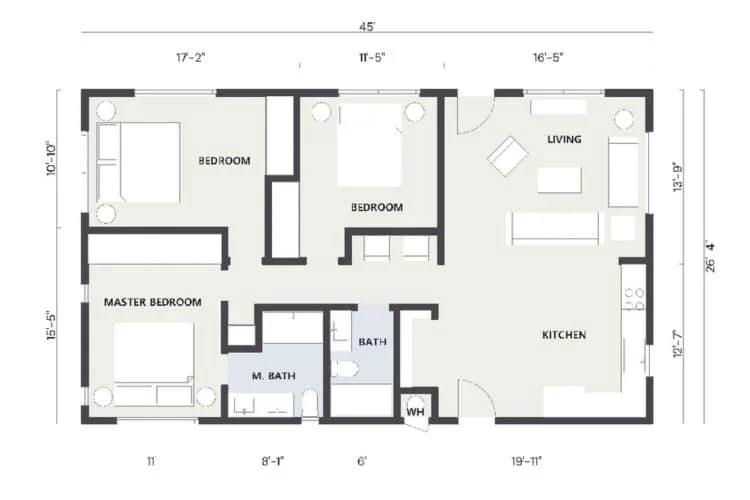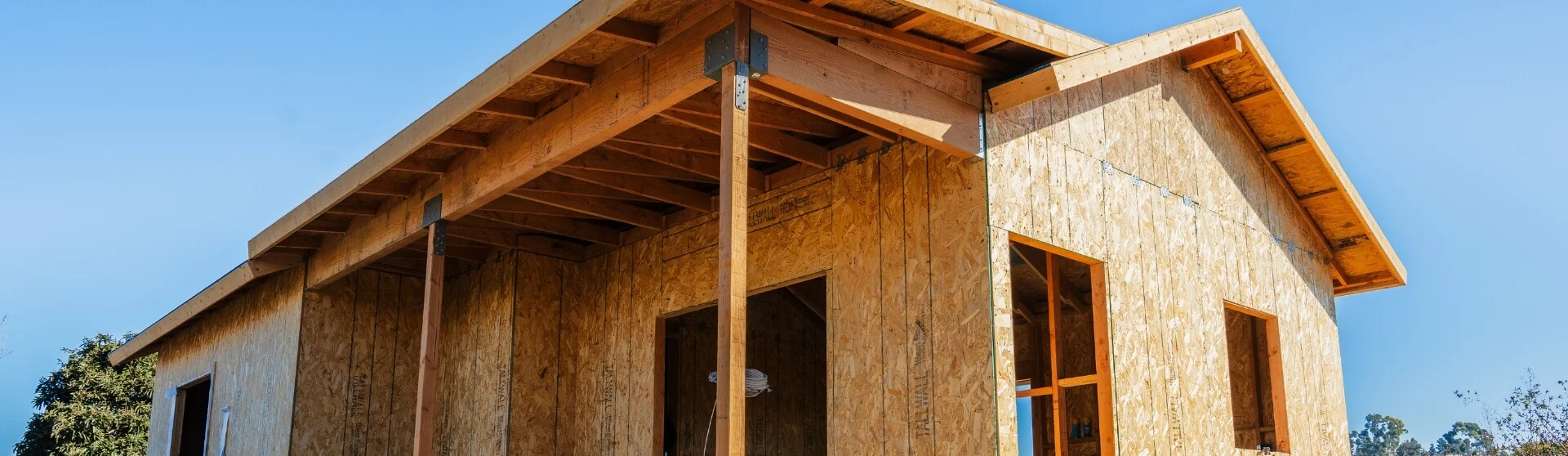



Adding an ADU to your property changes your insurance situation immediately. The single most important action: notify your insurer before construction begins. Failing to do so can result in denied claims or policy non-renewal, because your property’s risk profile and replacement cost both shift the moment you break ground.
Here is what that means practically. Your current homeowners policy was priced and structured around your home as it existed on the day you bought coverage. A new ADU, whether attached or detached, adds square footage, increases rebuild cost, and often introduces new occupants. Insurers need to know about all three.
- Confirm with your agent whether the ADU falls under your existing policy or requires an endorsement or separate policy.
- Check your liability limits, especially if anyone other than family will occupy the unit.
- ADUs may add 20%–30% to a home’s assessed value, which directly affects how much dwelling coverage you need.
- The standard “other structures” cap is typically 10% of your dwelling limit, often far too low to rebuild a detached ADU.
Pro Tip: Talk to your agent during the design phase, not after the permit is pulled. Insurers sometimes have construction or material recommendations that can lower your premium before you pour a single foundation.
How does an ADU change your homeowners policy coverage?
Every major section of a standard homeowners policy can be affected by an ADU. Knowing which ones helps you ask the right questions.
Coverage A (Dwelling): When an attached ADU adds square footage to your home, the dwelling limit must reflect the combined rebuild cost. If your policy was written for a 1,400-square-foot house and you add a 600-square-foot attached unit, that original limit is now underinsured.
Other structures (Coverage B): Detached ADUs typically fall here, and this is where most homeowners get caught. The other-structures limit is commonly set at 10% of Coverage A. On a $500,000 dwelling limit, that is $50,000 , nowhere near enough to rebuild a full backyard cottage.
Standard other-structures coverage was designed for fences and sheds, not a fully permitted dwelling unit with plumbing, electrical, and insulation. Treating a detached ADU as just another outbuilding is one of the most common and costly coverage mistakes homeowners make.
Liability: More occupants mean more exposure. A tenant who slips on a wet step, a guest who falls from a deck , these are real claims. Rental use raises liability risk further, and standard limits may not be adequate.
Personal property and loss of use: If the ADU is furnished, confirm whether your personal property coverage extends to items inside it. If you plan to collect rent, ask about loss-of-rent coverage , most base policies exclude it unless you add an endorsement.
How do insurers classify your ADU?
Classification drives everything. An insurer’s underwriting decision about whether your ADU is part of your primary home or a separate property determines which coverage applies and how much it costs.
The key triggers underwriters look at:
- Physical attachment: An attached garage conversion is treated very differently from a detached backyard cottage.
- Separate utilities: A separate utility meter or independent address is a common red flag that pushes insurers to require a standalone policy.
- Rental status: Renting to a non-family member, especially long-term, almost always changes the classification.
- Occupancy type: Family use, owner-occupancy, or non-related tenants each carry different underwriting weight.
A basement apartment with a shared entrance and no separate address is likely covered under your existing homeowners policy with an updated dwelling limit. A detached backyard cottage with its own address, separate gas and electric meters, and a paying tenant is a different property in underwriting terms and usually needs its own policy.
Pro Tip: Before your city assigns a separate address to your ADU, ask your insurer how that change affects your coverage. Municipal address assignments and separate meter setups are among the most frequent triggers for reclassification.
What policy options do ADU owners actually have?
There is no single right answer here. The right coverage depends on how you use the ADU.

Homeowners policy endorsement works well for ADUs occupied by family members or owner-occupied attached units. You increase the dwelling or other-structures limit and extend liability. It is the simplest path when the ADU is clearly part of your primary residence.
Landlord or dwelling fire policy is the standard choice for long-term rentals to non-family tenants. It covers the structure, provides landlord liability, and typically includes optional loss-of-rent coverage. Budget for the added cost: landlord insurance runs about 25% more than a comparable homeowners policy.
Short-term rental endorsements or home-sharing policies are required for Airbnb or VRBO use in most cases. Some insurers offer month-to-month home-sharing liability endorsements. Others treat ongoing short-term rentals as a business activity and require a commercial policy. Check before you list.
Umbrella policies are one of the most cost-effective protections an ADU landlord or short-term host can carry. They activate after your underlying limits are exhausted and often cover a broader range of incidents than the base policy alone.
Umbrella coverage is specifically recommended for ADU owners who rent or host short-term guests. A $1 million umbrella policy typically costs a few hundred dollars per year , a reasonable trade-off against a large liability claim. If you are financing the ADU, your construction loan lender may also require specific coverage minimums.
When should you tell your insurer, and what do you send them?
The answer to “when” is simple: before you break ground. Here is the full timeline.
- During planning: Notify your insurer as soon as you have a design concept. Provide the ADU type (attached, detached, or JADU), intended use, and estimated build cost. Ask whether an endorsement or a separate policy is needed.
- When the permit is approved: Send the permit number, approved construction plans, and contractor contact information. Confirm your contractor carries their own liability and workers’ compensation insurance.
- During construction: Update your insurer on the scheduled completion date. Builder’s risk coverage may be needed during the construction phase itself.
- At occupancy: Notify your insurer again when the certificate of occupancy is issued. Confirm the policy change in writing and update limits to reflect the completed structure.
- When rental begins: If you are renting, notify your insurer of the tenant’s move-in date, the lease terms, and whether you require renters insurance from the tenant.
Non-permitted construction is a frequent cause of claim denials. Insurers can and do deny claims for damage tied to unpermitted work, even when the underlying peril would otherwise be covered. Permits are not just a city requirement , they are an insurance requirement.
How does an ADU affect your premiums and replacement-cost math?
Replacement cost is what matters to insurers, not market value. A home that sells for $900,000 in Los Angeles might cost $400,000 to rebuild from scratch. Your dwelling limit should reflect the rebuild cost, not the sale price.
| Coverage item | Typical default | ADU impact | Recommended action |
|---|---|---|---|
| Dwelling (Coverage A) | Set at original build cost | Increases with attached ADU square footage | Raise limit to cover combined rebuild cost |
| Other structures (Coverage B) | ~10% of Coverage A | Often insufficient for detached ADU | Increase Coverage A or add endorsement |
| ADU build cost reference | Varies | $150,000–$300,000 for small-to-mid-sized units | Use as baseline for rebuild-cost estimate |
| Assessed value uplift | None | ADUs may add 20%–30% to assessed value | Revisit limits after construction |
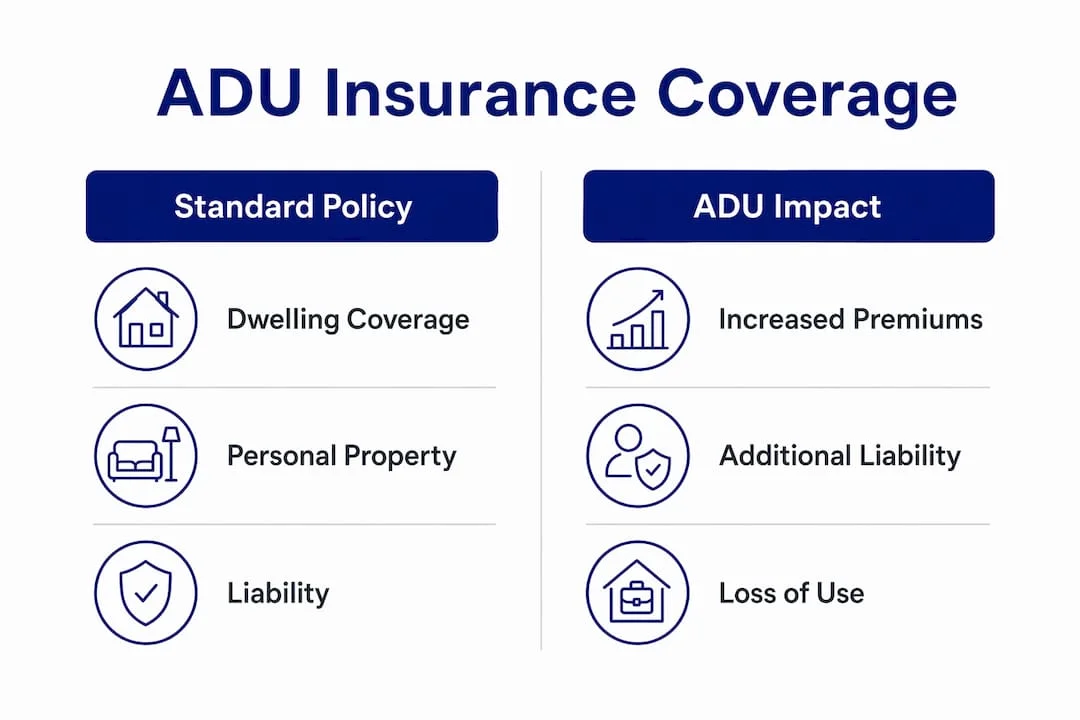
When shopping carriers, ask specifically about credits for fire-resistant construction, hardened roofing, or defensible space , all relevant in California. Understanding how ADU value engineering decisions affect replacement cost can help you right-size coverage from the start.
Renting your ADU: what changes on the insurance side?
Long-term rentals and short-term rentals carry different risks, and insurers treat them differently.
For long-term rentals, a landlord or dwelling fire policy is generally required. It covers the structure, your personal property on-site, landlord liability, and optionally, lost rent if the unit becomes uninhabitable. Standard homeowners policies typically exclude business activity, and collecting rent qualifies.
For short-term rentals, the coverage gap is wider. Many standard policies explicitly exclude commercial activity, and platforms like Airbnb offer host protection programs that are not a substitute for real insurance. Some insurers now offer home-sharing endorsements that cover short-term use, but availability varies by carrier and state.
- Require tenants to carry renters insurance. Tenant renters insurance protects their belongings and reduces the likelihood that a tenant’s property claim lands on your policy.
- Confirm whether your platform’s host protection program coordinates with or replaces your primary coverage.
- Add an umbrella policy if you are hosting guests regularly , the liability exposure from short-term rentals is meaningfully higher than a long-term lease.
Pro Tip: Put the renters insurance requirement in the lease. A verbal agreement is not enforceable when a claim happens.
What if standard insurers won’t cover your ADU?
This happens, particularly in California where wildfire risk has pushed many admitted carriers to tighten underwriting. You have options, but they come with trade-offs.
Surplus lines market: Licensed brokers can access non-admitted carriers who take on risks standard insurers decline. Coverage is usually more expensive and operates under different complaint and guarantee rules than admitted carriers. It is a real solution, not a last resort in the pejorative sense, but understand the differences before you sign.
California FAIR Plan: The state’s insurer of last resort provides basic fire coverage when admitted carriers decline. It is limited in scope and should be treated as a temporary bridge while you work to improve insurability.
The most effective way to improve your placement odds: document everything. Permitted construction, inspection sign-offs, and code-compliant materials all improve underwriter confidence. Carriers are more willing to write a property when the paper trail shows the work was done right. See the ADU investment risk pitfalls that commonly trigger coverage problems.
Pro Tip: Ask your broker to submit a complete documentation package with the first submission , permit history, inspection records, contractor licenses, and photos of completed work. Incomplete submissions slow placement and sometimes result in unnecessary declinations.
Your ADU insurance checklist
Pre-construction:
- Notify your insurer of the ADU type, intended use, and estimated build cost.
- Get a rebuild cost estimate from your contractor or architect.
- Ask your agent whether an endorsement or a separate policy is needed.
- Confirm rental use is permitted under your current policy.
During construction:
5. Provide the permit number and approved plans to your insurer.
6. Confirm your contractor carries liability and workers’ compensation insurance.
7. Ask about builder’s risk coverage for the construction phase.
8. Send the scheduled completion date when it is confirmed.
Post-construction and occupancy:
9. Notify your insurer when the certificate of occupancy is issued.
10. Confirm all policy changes in writing.
11. Update dwelling and other-structures limits to reflect the completed ADU.
12. If renting, require tenant renters insurance and evaluate landlord or umbrella coverage.
Keep a folder , physical or digital , with your policy documents, endorsements, permits, inspection records, and all insurer correspondence. That folder is your proof of disclosure and compliance if a claim is ever disputed.
How Uni Construction helps you build an ADU insurers and lenders accept
The documents insurers ask for during underwriting are the same ones a building department requires for permit approval: architectural plans, structural engineering calculations, a construction timeline, and proof of code compliance. Uni Construction produces all of them as part of its standard design-to-permit workflow.
Permit-ready architectural drawings from Uni Construction’s drafting service give your insurer a clear picture of the structure’s size, materials, and layout , the inputs underwriters use to calculate rebuild cost. Structural engineering coordination documents load paths and foundation design, which matters when an insurer asks whether the construction meets current California building code.
Accurate rebuild cost estimates, documented inspection sign-offs, and contractor coordination are the three things that move a difficult ADU placement from the surplus lines market back to standard admitted coverage. That documentation starts with the design package.
Uni Construction’s completed ADU projects across Los Angeles and the San Gabriel Valley reflect the full permit and inspection cycle, which means the documentation homeowners hand to insurers and lenders is grounded in real project experience, not estimates pulled from a spreadsheet.
Key Takeaways
Notifying your insurer before ADU construction begins is the single most important step to keeping coverage valid and avoiding claim denials.
| Point | Details |
|---|---|
| Notify insurer early | Tell your agent before construction starts; provide ADU type, intended use, and estimated build cost. |
| Other-structures gap | The 10% other-structures default is rarely enough to rebuild a detached ADU; raise Coverage A or add an endorsement. |
| Rental use changes everything | Long-term rentals typically require a landlord policy; short-term rentals need specialized endorsements or commercial coverage. |
| Umbrella coverage for landlords | An umbrella policy is cost-effective excess liability protection for any ADU owner who rents or hosts guests. |
| Uni Construction’s documentation role | Uni Construction’s permit-ready plans and rebuild cost estimates are the exact documents insurers and lenders request during underwriting. |
The part most homeowners learn too late
Most ADU insurance problems are not insurance problems at all. They are documentation problems that show up at the worst possible moment , during a claim.
The pattern is consistent: a homeowner builds an ADU, skips the insurer notification because it feels like a formality, and collects rent for two years without updating their policy. Then a water leak damages both the ADU and the main house. The insurer investigates, discovers the ADU was never disclosed, and the claim for the ADU structure is denied. The homeowner is left covering a five-figure repair out of pocket on a structure they thought was insured.
What the conventional wisdom on ADU insurance gets wrong is the framing. Most guides treat insurer notification as a bureaucratic step. It is actually the moment your coverage either adapts to your new reality or stays frozen in the old one. An insurer cannot cover a risk they do not know exists.
The other underestimated issue: the gap between market value and rebuild cost. California homeowners are used to watching their property values climb, and it is easy to assume that a rising market value means you are well-covered. It does not. Rebuild cost is driven by labor rates, materials, and local construction costs , all of which have risen sharply in California. For planning purposes, a small-to-mid-sized detached ADU is often estimated at $150,000–$300,000, but costs can vary based on design, materials, and region. Your coverage limit needs to reflect the actual rebuild cost, not the number on your original policy declaration page.
Uni Construction can handle the permit and documentation side
Getting your ADU insured correctly starts with having the right paperwork. Uni Construction’s design-to-permit process produces exactly what insurers and lenders ask for: permit-ready architectural plans, structural engineering documentation, and accurate rebuild cost estimates based on actual construction scope.
Whether you are planning a backyard cottage, a garage conversion, or a Junior ADU, Uni Construction’s team can prepare the documentation package your insurer needs to write coverage and your lender needs to protect their collateral. The design work and the insurance paperwork are not separate problems , they are the same project, handled together.
Request a consultation or a rebuild cost estimate at uni-cm.com and get your ADU project started on solid ground.
Useful sources
- Experian: How Do You Insure an Accessory Dwelling Unit? , Covers landlord insurance cost comparison, coverage types, and lender requirements.
- Travelers: What Is an ADU? , Source for the 20%–30% assessed-value uplift estimate.
- Mercury Insurance: Accessory Dwelling Units and Home Insurance , Supports the 10% other-structures limit finding and non-permitted construction claim denials.
- Liberty Mutual: ADUs and Short-Term Rentals , Source for umbrella policy recommendation and tenant renters insurance guidance.
- Starwest Insurance: ADU Insurance , Do You Need a Separate Policy? , Explains separate address and utility triggers for standalone policy requirements.
- Mass.gov: Dwelling on Details , ADU Insurance and Protected Use , State-level guidance on non-renewal notice practices and surplus lines/FAIR Plan alternatives.
- Eugene C. Yates Insurance Agency: ADU Insurance Explained , Source for the $150,000–$300,000 ADU build cost planning range.
This article is general information, not legal or insurance advice. Confirm current coverage requirements and policy terms with a licensed insurance professional for your specific property and situation.