

A general contractor on an ADU project is the licensed professional who manages every phase of construction, from pulling permits to scheduling the final inspection. In California, this role carries specific legal weight. The contractor serves as the single point of accountability for subcontractors, timelines, budgets, and code compliance. Understanding what a general contractor actually does on an ADU build helps you hire the right person and avoid costly mistakes.
What are the licensing requirements for ADU general contractors in California?
The legal baseline is clear. Any general contractor leading an ADU build in California must hold an active Class B (General Building) license issued by the Contractors State License Board (CSLB). No separate ADU license exists. The Class B license is the standard credential for residential construction, and it covers the scope of work an ADU requires.
Holding a Class B license is the minimum. A contractor must also carry general liability insurance and workers’ compensation coverage. These policies protect you as the property owner if a worker is injured on your lot or if property damage occurs during construction.
Subcontractor vetting is part of the GC’s legal duty. When a general contractor hires an electrician, plumber, or roofer, each of those trades must also be licensed and insured. If a subcontractor lacks coverage, liability can fall back on you. Verifying this chain of credentials before work begins is not optional.
- Confirm the contractor’s CSLB license number at the CSLB website before signing anything
- Request certificates of insurance for general liability and workers’ compensation
- Ask for a list of subcontractors and verify their licenses independently
- Confirm the contractor will pull all permits in their firm’s name, not yours
Pro Tip: Check the CSLB license lookup tool at cslb.ca.gov to confirm the license is active, not suspended, and matches the contractor’s legal business name.
What does a general contractor do during an ADU build?
The general contractor’s day-to-day role covers far more than showing up on site. Site-built ADUs require a contractor to execute construction from designer drawings, overseeing bids, permits, schedules, and subcontractor coordination from start to finish. That scope is broad by design. No single trade can manage all of it.

A key fact that surprises most homeowners: a GC typically self-performs only 10–30% of the actual labor. The remaining 70–90% goes to licensed subcontractors for electrical, plumbing, framing, roofing, and finish work. The GC’s real value is not swinging a hammer. It is managing the sequence, quality, and legal compliance of everyone else who does.
The core general contractor tasks on an ADU project break down into five areas:
- Permit procurement. The GC pulls the building permit in the firm’s name and submits all required documentation to the city or county building department. This includes structural drawings, energy calculations, and site plans.
- Subcontractor management. The GC hires, schedules, and supervises every trade. Electrical, plumbing, HVAC, and finish contractors all report to the GC, not to you.
- Procurement and materials scheduling. The GC orders materials, coordinates deliveries, and prevents the supply gaps that stall projects. A delayed window order can push a framing inspection back by weeks.
- Financial accountability. The GC tracks costs against the budget, manages subcontractor payments, and flags scope changes before they become surprise invoices. Review your ADU construction contract types before signing to understand how cost overruns are handled.
- Site safety and risk management. The GC is responsible for OSHA compliance on site. That means fall protection, tool storage, and safe access for inspectors and workers.
Pro Tip: Ask your contractor for a written construction schedule with milestone dates before work begins. A GC who cannot produce one is not ready to manage your project.
How do general contractors manage inspections and regulatory compliance?
Permit management and inspection coordination are among the most technical parts of ADU project management. General contractors pull the building permit in their firm’s name and shepherd the job through every required inspection, including foundation, framing, electrical, plumbing, and final. Each inspection must pass before the next phase of work begins.
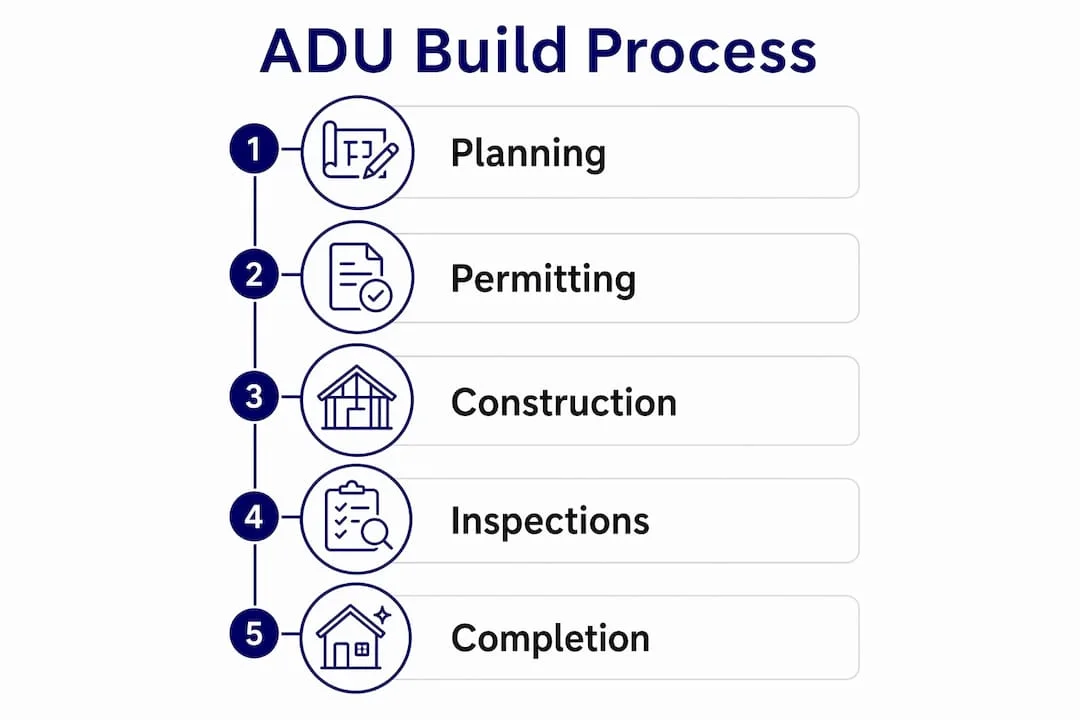
The GC acts as the primary liaison with the city building department. When an inspector flags a deficiency, the GC is responsible for correcting it and scheduling a re-inspection. Delays at this stage are expensive. A failed framing inspection can hold up mechanical rough-in work for days or weeks.
California ADU projects face a specific compliance challenge: local jurisdictions layer their own requirements on top of state law. Los Angeles, for example, has its own ADU ordinance that governs setbacks, height limits, and owner-occupancy rules. A GC unfamiliar with local code can submit drawings that pass state review but fail at the city level. Understanding the California ADU permit process before construction starts reduces that risk significantly.
Homeowners have a role in this phase too. Missing a finish selection deadline, such as choosing tile or cabinetry, can delay rough-in work and push inspection dates. Your GC cannot schedule a final inspection until every system is installed and every finish is complete.
- Foundation inspection: required before concrete pour
- Framing inspection: required before insulation and drywall
- Mechanical, electrical, and plumbing rough-in: required before walls close
- Insulation inspection: required in California for Title 24 energy compliance
- Final inspection: required before the ADU receives a certificate of occupancy
General contractor vs. ADU specialist: which one should you hire?
The distinction matters more than most homeowners realize. A Class B general contractor is legally qualified to build any ADU. But ADU specialists possess focused expertise in ADU-specific zoning ordinances, setback calculations, and utility tie-ins that standard contractors often overlook, leading to permit delays.
| Factor | General contractor | ADU specialist |
|---|---|---|
| Legal qualification | Class B license covers ADU work | Same Class B license required |
| ADU zoning knowledge | Varies widely by contractor | Deep familiarity with local ADU rules |
| Permit experience | General residential permit experience | ADU-specific permit track record |
| Best for | Simpler garage conversions, attached ADUs | Complex backyard cottages, new detached units |
| Cost | Often lower initial bid | May cost more but reduce delay risk |
An experienced general contractor with solid ADU knowledge can manage simpler projects and garage conversions effectively. The risk rises with project complexity. A new detached backyard cottage involves utility connections, separate addressing, and setback calculations that trip up contractors without ADU experience.
When evaluating candidates, ask these questions directly:
- How many ADU projects have you completed in this city or county?
- Can you provide references from ADU clients in the past two years?
- Are you familiar with the local ADU ordinance, including setback and height rules?
- Do you have a relationship with the local building department?
A contractor who hesitates on any of these questions is telling you something. The role of the architect in ADU development also intersects here. A GC who has worked repeatedly with the same ADU architect moves faster through design revisions and permit corrections.
What are best practices for hiring and working with a general contractor?
Hiring the right contractor is only half the job. How you work with them during construction determines whether the project finishes on time and on budget. The property owner remains the ultimate stakeholder. Not walking the site regularly, missing timely finish decisions, or failing to document change orders can cause budget overruns that no contract can prevent.
The most overlooked risk is the GC’s lien rights. Because the GC acts as the hub for all labor and materials, they hold the legal right to place a lien on your property if payment fails. A clear, milestone-based payment schedule protects your title and gives the contractor predictable cash flow.
- Verify the CSLB license and insurance before signing any contract
- Use a milestone-based payment schedule tied to completed phases, not calendar dates
- Walk the site at least once a week and document what you see with photos
- Put every scope change in writing as a signed change order before work begins
- Understand your lien rights and consider a title company or escrow for large payments
Pro Tip: Never pay more than 10% down or $1,000 (whichever is less) as a deposit to a California contractor. This limit is set by state law and protects you from contractors who collect deposits and disappear.
Key takeaways
A general contractor on an ADU project is the licensed project manager who holds legal, financial, and compliance responsibility for the entire build from permit to final inspection.
| Point | Details |
|---|---|
| Class B license is required | Every GC leading an ADU build in California must hold an active CSLB Class B license. |
| GCs subcontract most labor | General contractors self-perform only 10–30% of work; the rest goes to licensed trades. |
| Permit and inspection management | The GC pulls permits in their firm’s name and coordinates every required inspection. |
| ADU specialists reduce permit risk | Specialists with local ADU knowledge lower the risk of zoning errors and permit delays. |
| Milestone payments protect homeowners | Tying payments to completed phases shields your property title from lien exposure. |
What I’ve learned about GCs after years of ADU work in California
The biggest misconception homeowners bring to an ADU project is that a general contractor is just a construction supervisor. That framing undersells the role and leads to bad hiring decisions. The GC’s highest value is risk management, specifically vetting every subcontractor for insurance compliance before they set foot on your property. One uninsured worker injury can expose you to a lawsuit that dwarfs the cost of the ADU itself.
I’ve also seen homeowners underestimate how much their own behavior affects the outcome. A GC can build a tight schedule, but if you take two weeks to pick a window style or approve a change order, that delay cascades through every trade behind it. The best GC relationships I’ve observed treat the homeowner as an active participant, not a passive client.
The other thing worth saying plainly: not every Class B contractor is ready for an ADU. California’s ADU rules at the city level are specific and change frequently. A contractor who built tract homes in the 1990s may not know the current setback rules for a detached ADU in Los Angeles or the utility connection requirements for a garage conversion in Pasadena. Ask for ADU-specific references. The answer tells you everything.
, Uni Construction
How Uni Construction supports California homeowners through the ADU build process
California homeowners planning an ADU need more than a licensed contractor. They need a team that understands the full path from design to certificate of occupancy.

Uni Construction holds a Class B license and specializes in ADU design and construction across Los Angeles and nearby cities and the San Gabriel Valley. The team handles permit-ready drawings, structural engineering, and full construction management under one roof. That integration cuts the gap between design approvals and construction start. Homeowners working with Uni Construction on ADU projects in Los Angeles get a single point of contact from the first site visit through the final inspection. If you are ready to plan your build, the Uni Construction project portfolio shows completed ADUs across the region with full design-build details.
FAQ
A general contractor must hold an active Class B (General Building) license from the Contractors State License Board (CSLB). No separate ADU license exists in California.
General contractors typically self-perform 10–30% of the labor and subcontract the remaining 70–90% to licensed trades like electricians, plumbers, and framers.
Both hold a Class B license, but ADU specialists have focused knowledge of local ADU zoning rules, setback requirements, and utility tie-ins that reduce the risk of permit delays on complex builds.
Use a milestone-based payment schedule tied to completed construction phases. California law also limits the initial deposit to 10% of the contract price or $1,000, whichever is less.
California law allows owner-builders to act as their own GC, but this requires the homeowner to manage all permits, subcontractors, and inspections directly. Most lenders and insurers treat owner-built ADUs as higher risk, which can affect financing and resale value.