

The most scalable ADU construction approach is a turnkey design-build provider that combines repeatable plan libraries, in-house permitting, and standardized delivery. If you are a homeowner adding a single backyard unit or an investor rolling out a dozen garage conversions across Los Angeles and nearby cities, that model consistently outperforms the alternatives on cost predictability, permit throughput, and schedule reliability.
Here are the three service models worth serious consideration, ranked by scalability:
- Turnkey design-build with repeatable plans and in-house permitting (best overall for investors and homeowners alike)
- Factory-prefab partnerships with a dedicated local general contractor (best for investors prioritizing speed on flat, accessible sites)
- Repeatable custom-template programs (best for investors who need jurisdiction-specific customization without starting from scratch each time)
The turnkey design-build model leads because it keeps design, engineering, permitting, and construction under one roof. That single-vendor accountability eliminates the coordination gaps that kill schedules and inflate budgets when you hire an architect, a structural engineer, and a GC separately. For investors running multi-unit rollouts, the compounding effect of faster permit cycles and fewer change orders is substantial.
How to use this article:
- Use the evaluation checklist in Section 5 to score any vendor you are considering
- Use the cost and timeline table in Section 6 to stress-test your pro forma
- Use the vendor questions in Section 5 to disqualify weak candidates quickly
- If you are in California, review the Uni Construction case study in Section 7 for a concrete operational example.
What does “scalable ADU construction” actually mean?
The phrase gets used loosely. A contractor who built three ADUs last year is not a scalable provider. Scalability in ADU construction means the ability to deliver multiple units reliably, at consistent cost and quality, without the program falling apart when volume increases.
Four attributes separate a genuinely scalable service from one that just sounds like it:
Design repeatability. The provider maintains a library of pre-engineered, permit-ready plan sets that can be adapted to a new site without redesigning from scratch. Each adaptation takes days, not months.
Permitting throughput. The firm has established relationships with local plan-check departments, understands each jurisdiction’s specific requirements, and can run multiple permit applications simultaneously. A firm that handles one permit at a time is a bottleneck the moment you have three sites in queue.
Construction capacity. The GC or construction arm has enough crew, subcontractor relationships, and project management bandwidth to run parallel builds. A two-person operation cannot manage four concurrent sites without quality slipping.
Warranty and quality systems. Repeatable delivery requires documented quality checkpoints, not just a handshake warranty. Look for written inspection protocols, defined punch-list processes, and a warranty that survives the project manager’s departure.
Scalability is not the same as cheap, and it is not the same as fast. A prefab unit that ships in six weeks but requires three months of local permitting and site prep is not fast. A low-cost contractor who redesigns every project from scratch is not scalable. The defining characteristic is predictability across multiple units, which requires systems and staffing, not just ambition.
Non-scalable offerings tend to share a few tells: no standard plan library, permitting handled by a third-party expediter with no in-house engineering, and references that are all single-unit homeowners rather than repeat investors.
Who benefits most from scalable ADU services?
The evaluation criteria shift meaningfully depending on whether you are adding one unit to your property or managing a multi-site investment program. Getting clear on your profile first saves time when you reach the vendor checklist.
What delivery models actually scale for ADU programs?
Four models dominate the market. Each has a different cost shape, timeline, and scalability ceiling.
Turnkey design-build
One firm handles design, engineering, permitting, and construction. This is the highest-control model and the one that scales most reliably for investors running multi-unit programs. The firm’s internal coordination eliminates the gaps between design intent and construction reality that generate change orders.
Pros: Single point of accountability, fastest permit cycles when the firm has established plan-check relationships, lowest change-order frequency, easiest to finance.
Cons: Higher base cost than hiring trades separately, less flexibility to swap subcontractors mid-project, quality depends heavily on the specific firm’s systems.
Best for: Investors running three or more units, homeowners who want zero project management burden.
Factory-prefab or modular ADU
The unit is manufactured off-site and delivered to the property for installation. On-site construction time shrinks dramatically, which matters on sites where weather or neighbor relations make extended builds difficult.
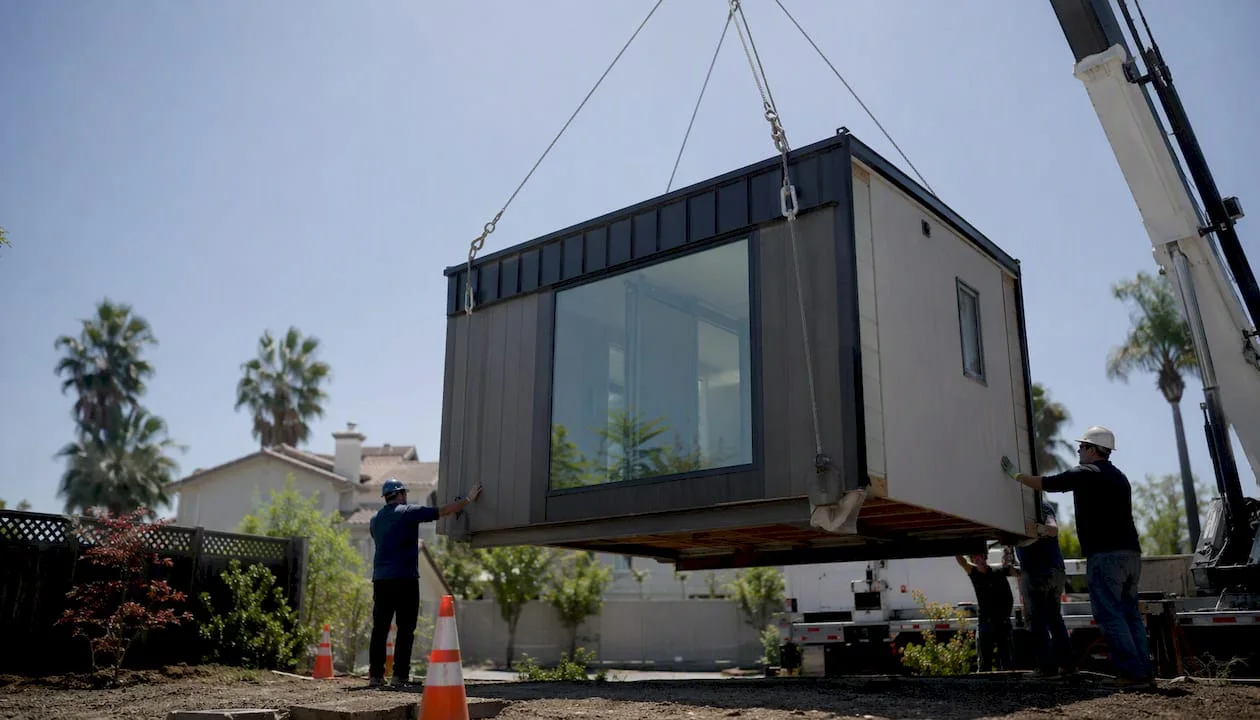
Pros: Faster on-site timeline, factory quality control, reduced weather risk during construction.
Cons: Factory lead times can offset the on-site speed advantage. Local permitting still applies and can take as long as a site-built unit. Site access requirements (crane clearance, setbacks) disqualify many urban lots. Coordination between the manufacturer and the local GC adds a layer of complexity that investors often underestimate.
Best for: Investors with flat, accessible sites in jurisdictions with predictable plan-check timelines.
Pro Tip: Before committing to a prefab model, get the factory’s current lead time in writing and map it against your jurisdiction’s average plan-check timeline. In many California cities, the permit takes longer than the factory build, which means the speed advantage disappears entirely.
Repeatable custom-template programs
A design-build firm maintains a library of pre-engineered templates that can be customized within defined parameters (size, finish tier, layout variant). Each new project starts from a proven base rather than a blank sheet.
Pros: More site adaptability than pure prefab, faster design phase than fully custom, cost predictability from the template base.
Cons: Customization beyond the template parameters triggers redesign costs. Less factory efficiency than true prefab.
Best for: Investors who need jurisdiction-specific adaptations but want the cost and schedule benefits of a repeatable starting point.
Garage conversion rollouts
Converting existing garages to ADUs is the fastest path to a permitted unit on most California properties. The structure already exists, utility connections are nearby, and garage conversion ADU projects typically carry lower hard costs than detached new construction.
Pros: Lower cost per unit, faster permitting in many jurisdictions, no new foundation required in most cases.
Cons: Structural condition of the existing garage varies widely. Ceiling height, setbacks, and existing utility capacity can all create surprises. Not every property has a convertible garage.
Best for: Homeowners and investors with existing garages in good structural condition who want the lowest-cost path to a permitted rental unit.
How do you evaluate and hire a truly scalable ADU contractor?
Use this checklist before signing any contract. It is organized by phase so you can run it sequentially during vendor conversations.
Phase 1: Capacity and delivery
- Ask for the firm’s current active project count and crew size. A firm running 15 projects with 4 employees is overextended.
- Request a sample repeatable plan set. If they cannot show you one, they do not have a plan library.
- Ask how many ADU projects they completed in the last 12 months. Fewer than 10 for a firm pitching scalability is a yellow flag.
- Confirm whether design, engineering, and construction are in-house or subcontracted. Subcontracted permitting is a scalability risk.
Phase 2: Permitting and approvals
- Ask for the firm’s average permit approval timeline in your specific jurisdiction. Vague answers (“it depends”) without data suggest limited local experience.
- Ask how many permits they have active simultaneously. A firm that can run five concurrent applications has real throughput capacity.
- Confirm they handle Title 24 energy compliance in-house. Outsourcing this adds time and a coordination risk.
- Ask specifically about JADU vs. ADU distinctions for your property. A junior ADU has different owner-occupancy requirements and size limits than a standard ADU; a knowledgeable firm explains the trade-offs without prompting.
Phase 3: Project management and communication
- Ask who your single point of contact will be throughout the project, from design through construction.
- Request a sample project schedule showing phase durations and milestone dates.
- Ask how change orders are documented and priced. “We handle it” is not an answer.
Phase 4: Quality control and warranty
- Ask for a written quality inspection checklist used during construction.
- Confirm the warranty terms in writing: duration, what is covered, and who handles warranty claims.
- Request references from at least two repeat clients (investors who have done multiple projects with the firm).
Phase 5: Contracts and payment terms
- Review the contract for fixed-price vs. cost-plus structure. Fixed-price contracts protect investors on rollouts.
- Confirm the payment schedule is milestone-based, not time-based. Paying on completion of defined phases reduces your exposure.
- Ask for a sample change-order clause. Firms with high change-order rates often have loose contract language that makes it easy to add costs.
Red flags that should end the conversation quickly:
- No in-house permitting experience; they use a third-party expediter for all permits
- Cannot show a standard plan library or repeatable floor plans
- References are all single-unit homeowners with no repeat investor clients
- Vague timelines with no milestone dates
- Change-order history is “not something we track”
- No written warranty document
Scoring rubric
Score each vendor on a 30-point scale across six criteria. Investors should weight permitting throughput and repeatable plans more heavily; homeowners should weight warranty and communication.
| Criterion | Max points (investor) | Max points (homeowner) |
|---|---|---|
| Repeatable plan library | 7 | 4 |
| Permitting throughput | 7 | 4 |
| In-house trades (design, engineering, construction) | 5 | 5 |
| Cost consistency / fixed-price contract | 5 | 4 |
| Warranty and quality systems | 3 | 7 |
| Communication and project management | 3 | 6 |
| Total | 30 | 30 |
Score thresholds: 24–30 = hire, 16–23 = probe further with follow-up questions, below 16 = decline.
What do scalable ADU builds actually cost, and how long do they take?
Cost and timeline vary by ADU type, site conditions, and jurisdiction. The ranges below reflect typical California projects; your specific site may fall outside them depending on utility capacity, grading requirements, and local plan-check timelines.
| ADU type | Typical cost range | Design and permitting | Construction | Total typical timeline |
|---|---|---|---|---|
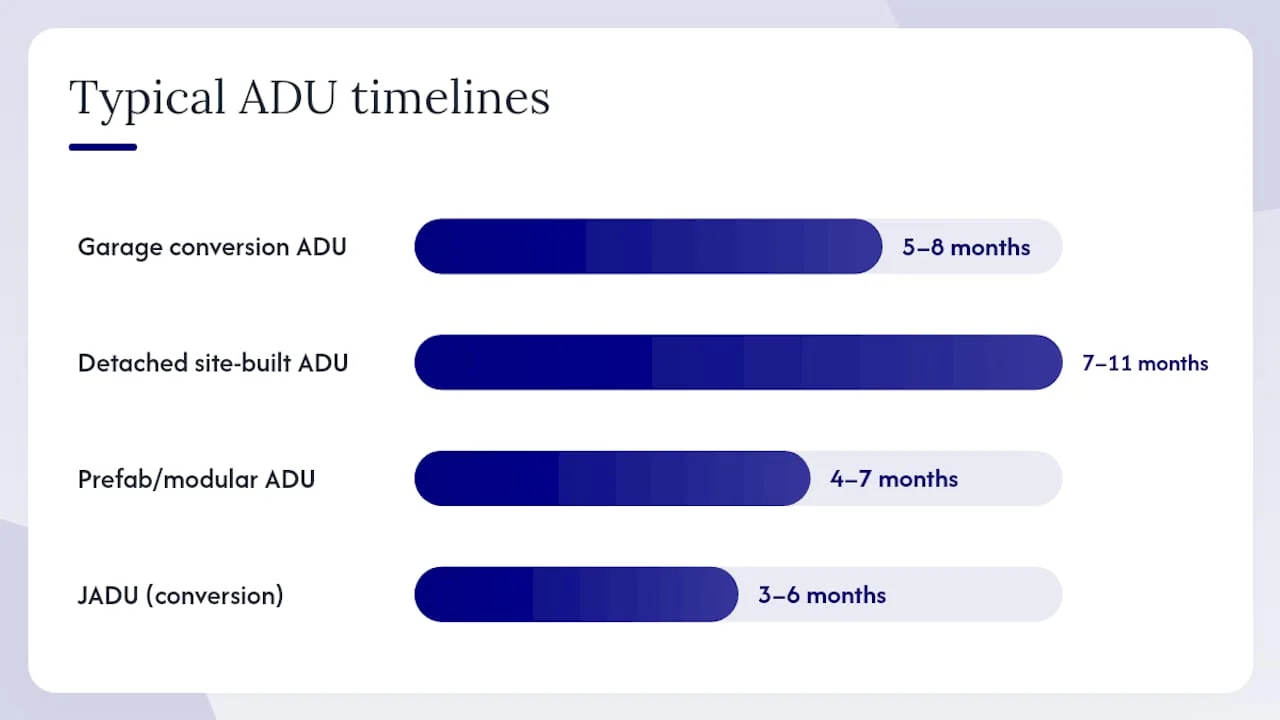
| Garage conversion | $130,000–$185,000 | 6–16 weeks | 8–16 weeks | 5–8 months typical |
| Detached site-built ADU | $200,000–$280,000 | 8–18 weeks | 12–24 weeks | 7–11 months typical |
| Prefab/modular ADU | $170,000–$250,000 | 6–16 weeks | 6–10 weeks on-site | 4–7 months typical |
| JADU (garage or interior conversion) | $80,000–$140,000 | 4–12 weeks | 6–12 weeks | 3–6 months typical |
Ranges reflect typical California market conditions and do not include land cost or financing fees. Site-specific conditions can push costs above these ranges.
Ranges reflect typical California market conditions and do not include land cost or financing fees. Site-specific conditions can push costs above these ranges.
The biggest cost drivers
Site preparation and utilities. Utility capacity upgrades, long sewer runs, and hillside grading are the most common sources of budget overruns. These costs are frequently excluded from advertised package pricing. A firm that does not scope utility capacity in the first 30 days of a project is setting you up for a change order. Ask specifically: “What utility work is included in your base price, and what triggers an upgrade cost?”
Structural complexity. Soft-story garages, hillside foundations, and older structures with non-standard framing all add engineering hours and construction cost. Prefab units avoid some of this, but the foundation and site work still applies.
Finishes and fixtures. A standard finish package on a 500-square-foot ADU might run $15,000–$25,000. Upgrading to premium finishes can add $20,000 or more. For investors, standardizing on a mid-tier finish package across all units is one of the simplest ways to control per-unit cost.
Permit fees and school fees. California cities charge impact fees on new ADUs. These vary by jurisdiction and unit size. Budget for them explicitly; they are not optional and are not included in most construction contracts.
How Uni Construction runs a scalable ADU program: an operational look
Uni Construction operates as a full-service design-build firm in Los Angeles covering architectural design, permit-ready drawings, structural engineering, Title 24 energy compliance, and construction project management. The firm’s model is built around the turnkey approach described above: one team handles the project from site feasibility through certificate of occupancy.
Here is how that process runs in practice:
Site feasibility (weeks 1–2). Uni Construction’s team reviews zoning, setbacks, utility capacity, and structural conditions before any design work begins. This is where hidden site costs get identified, not discovered mid-construction. Investors running multi-site programs benefit from this phase being standardized: the same checklist applies to every site, which means the feasibility output is comparable across properties.
Repeatable plan adaptation (weeks 2–6). Rather than designing each ADU from scratch, Uni Construction adapts from a library of pre-engineered plan sets. For a garage conversion, the starting point is a proven layout that has already cleared plan check in the target jurisdiction. Adaptations for site-specific conditions (ceiling height, setback variance, utility location) are documented and priced before design is finalized.
Permit management (weeks 4–16). Uni Construction handles permit submissions, plan-check responses, and coordination with the building department in-house. For investors with multiple sites, the firm can manage concurrent permit applications, which is the operational lever that makes a rollout program faster than sequential permitting. The portfolio of completed projects reflects this throughput across different ADU types and jurisdictions within Southern California.
Construction sequencing (weeks 12–30+). Trades are sequenced to minimize rework: rough framing and MEP (mechanical, electrical, plumbing) are inspected before drywall, and final finishes are staged to avoid damage from subsequent trades. This sequencing discipline is what keeps punch lists short at handover.
Handover and warranty. Uni Construction provides written warranty documentation at project close. Investors receive a complete permit and inspection record for each unit, which is the documentation lenders and future buyers want to see.
Pro Tip: Ask any ADU firm you are evaluating to walk you through a specific project from feasibility to certificate of occupancy, naming the permit timeline and any plan-check corrections they received. A firm with genuine experience answers this in detail. A firm without it gives you a generic process description.
For California homeowners and investors ready to start a feasibility review, Uni Construction’s ADU services page covers the full scope of what the firm offers across design, engineering, and construction.
What changes about permitting when you scale to multiple ADU sites?
A single ADU permit is manageable. Three concurrent permits in two different jurisdictions require a different level of operational discipline.
Permit strategy for multi-site rollouts
- Standardize plan sets across sites where jurisdictions allow. A plan set that has already cleared plan check in a given city can often be reused with minor modifications, cutting weeks off the design phase.
- Submit permits for the next site before the current site breaks ground. Parallel permitting is the most effective way to compress total program duration.
- Conduct utility capacity checks (electrical panel, sewer lateral, water service) before permit submission, not after. Utility upgrades triggered by plan check add months to the timeline.
- Track plan-check correction history by jurisdiction. A firm that logs what corrections each city typically requests can preemptively address them in the initial submission.
Pro Tip: Engage your structural engineer and Title 24 consultant at the design phase, not after design is complete. Retrofitting energy compliance or structural changes into a finished design set adds two to four weeks and often triggers a full plan-check resubmission.
For multi-jurisdiction rollouts, organizations like NAHB publish industry guidance on residential construction best practices that can inform your permit strategy and help you benchmark what a reasonable plan-check timeline looks like in your market. For Washington State projects or Pacific Northwest jurisdictions, BIAW offers region-specific permitting resources and contractor advocacy that can accelerate local approvals.
How do investors finance scalable ADU programs, and what returns can they expect?
Financing a single ADU is straightforward. Financing a multi-unit rollout requires a different conversation with lenders.
Common financing options
Cash. The simplest path. No lender requirements, no interest cost, maximum flexibility. The constraint is capital deployment speed: most investors cannot fund multiple concurrent builds from cash reserves.
Construction loans. Short-term loans that fund the build and convert to a permanent mortgage at completion. Lenders want to see an experienced GC, a fixed-price contract, and a permit in hand before funding. For investors, having a firm with documented permit history and a fixed-price contract structure makes this conversation much easier.
Home equity lines of credit (HELOCs). For homeowners with significant equity, a HELOC is often the lowest-cost financing path for a single ADU. The draw-down flexibility matches the phased payment structure of most construction contracts.
Portfolio lenders. Investors running multi-unit programs often work with portfolio lenders who understand ADU economics and can structure loans against projected rental income rather than just current property value. These lenders typically want to see consistent cost per unit, a track record of completed permits, and a GC with verifiable project history.
What lenders want to see for rollout programs
- A fixed-price contract from a licensed GC with ADU experience
- Permit history: how many permits has the GC pulled and received approval on?
- Consistent cost estimates across units (variance above 15% raises questions)
- A warranty document from the contractor
Financing tips for scale
- Batch permit applications to reduce the gap between permit approval and construction start across multiple sites
- Use master service agreements with your GC to lock in unit pricing across a multi-site program
- Request lender-friendly warranty and inspection documentation from your contractor before you start the financing conversation
- For garage conversions, check whether your lender treats the converted unit as a separate income-producing asset or as part of the primary residence. The answer affects your loan structure.
Key Takeaways
Turnkey design-build with in-house permitting and repeatable plan libraries is the most reliable model for scaling ADU programs, whether you are adding one unit or running a multi-site investor rollout.
| Point | Details |
|---|---|
| Turnkey model leads for scale | A single firm handling design, permitting, and construction reduces change orders and compresses permit timelines. |
| Permitting throughput is the bottleneck | Parallel permit applications across sites are only possible with a firm that has genuine in-house permitting capacity. |
| Fixed-price contracts protect investors | Cost-plus contracts expose rollout programs to per-unit variance that breaks pro formas; always negotiate fixed-price terms. |
| Site prep costs are the top budget risk | Utility upgrades, grading, and structural surprises are frequently excluded from advertised pricing; scope them in week one. |
| Uni Construction for California projects | Uni Construction offers turnkey ADU services in Los Angeles with in-house permitting, repeatable plan libraries, and full design-build delivery. |
The case for repeatable systems over heroic project management
Most ADU programs fail at scale not because the construction is hard, but because the coordination is. The firms that deliver reliably across multiple sites are not the ones with the most talented project managers. They are the ones with the most boring, repeatable systems: the same plan set adapted to each site, the same permit checklist run in the same order, the same subcontractor relationships activated in the same sequence.
The conventional wisdom in residential construction is that every project is unique and requires a custom approach. That framing serves contractors who want to justify high fees and resist accountability. For investors and homeowners who need predictable outcomes, it is the wrong mental model entirely.
What actually works is treating ADU delivery the way a good manufacturer treats production: standardize everything that can be standardized, document every deviation, and use that documentation to improve the next run. A firm that has pulled 50 permits in Los Angeles County knows exactly which plan-check corrections each city typically requests. That knowledge is worth more than any individual project manager’s talent, because it survives turnover and scales across sites.
The other thing most articles understate: the cost of a bad vendor compounds. A single-site homeowner who picks the wrong contractor loses time and money on one project. An investor who picks the wrong contractor for a rollout program loses time and money on every site, simultaneously, while their permit queue stalls and their pro forma deteriorates. The evaluation checklist in this article is not a nice-to-have. It is the difference between a program that delivers and one that teaches expensive lessons.
Uni Construction brings turnkey ADU delivery to Los Angeles homeowners and investors
If the evaluation criteria above describe what you are looking for, Uni Construction delivers exactly that model in Los Angeles and across Southern California. The firm covers the full project scope: architectural design, permit-ready drawings, structural engineering, Title 24 energy compliance, and construction management, all under one contract.
What that means practically: you are not coordinating between an architect who does not talk to your engineer and a GC who blames the drawings for every delay. Uni Construction’s in-house team runs the project from feasibility through certificate of occupancy, with a repeatable plan library that has already cleared plan check in Los Angeles jurisdictions. Investors get fixed-price contracts, parallel permitting capacity, and the project documentation lenders want to see. Homeowners get a single point of contact and a warranty that is in writing before construction starts.
The starting point is a feasibility review. Request a consultation with Uni Construction’s Los Angeles team to get a site-specific assessment of your ADU options, cost range, and permit timeline before you commit to any design or contract.
Sources and further reading
Authoritative resources for ADU permitting, industry standards, and Uni Construction project pages: