


Adding accessory dwelling units to properties you already own is one of the most capital-efficient ways to grow a rental portfolio right now. You skip land acquisition, you leverage existing infrastructure, and you add a rentable door at a fraction of what a new property purchase costs. The strategy has a name in investor circles: the ADU scale strategy. It works by building on lots you already control rather than competing for new acquisitions in a tight market.
A few things have converged to make this moment particularly good for ADU property portfolio expansion. Financing has matured: DSCR loans now underwrite ADU rental income directly, and the Freddie Mac CHOICERenovation mortgage gives investors a conventional path to fund renovation-based ADU builds. Regulatory barriers have dropped: California removed most owner-occupancy requirements for ADUs as of January 1, 2025, and similar reforms are spreading through Oregon, Washington, and Sun Belt states. And the economics are hard to argue with.
Key reasons investors are adding ADUs to existing properties:
- No land purchase required, so capital goes directly into construction
- Existing utilities and infrastructure reduce per-door setup costs
- ADU rental income counts toward DSCR loan qualification for refinancing
- Property values increase 20–35% per ADU added
- Regulatory reforms have widened feasibility across most major U.S. markets
- A pilot-first approach lets investors refine the process before scaling
How ADUs expand your rental portfolio’s income and value
The financial case for building ADUs on existing investment properties is straightforward once you run the numbers. Building 8 ADUs on properties you already own can double your door count and add $900–$1,200 per month in rental income per unit without any land acquisition cost. Compare that to buying 8 new properties: you’d need down payments, separate tax lots, and entirely new management relationships.

Property value is the other side of the equation. Each ADU typically lifts the host property’s value by 20–35%, which improves your refinancing position and overall portfolio equity. In high-rent markets like Los Angeles, ADUs can generate $1,500–$2,500 per month, pushing gross yield-on-cost well above typical acquisition-based returns.

Portfolio diversification matters too. Multiple income streams on a single lot mean one vacancy doesn’t wipe out the property’s cash flow. The main unit still produces rent while the ADU turns over, and vice versa. That buffer is something a single-unit rental simply can’t offer.
Other concrete benefits worth noting:
- Lower per-door capital investment than buying comparable rental properties
- One property manager handles both units on the same lot
- ADU-friendly legislation is expanding in most states, reducing permitting friction
- Stabilized ADU income supports cash-out refinances to fund the next build
- Interior conversions and garage conversions carry the lowest construction costs and fastest timelines
What are your best ADU financing options in 2026?
Financing has historically been the biggest barrier to ADU construction, but the product landscape has shifted significantly. Investors now have purpose-built options that underwrite on property income rather than personal pay stubs.
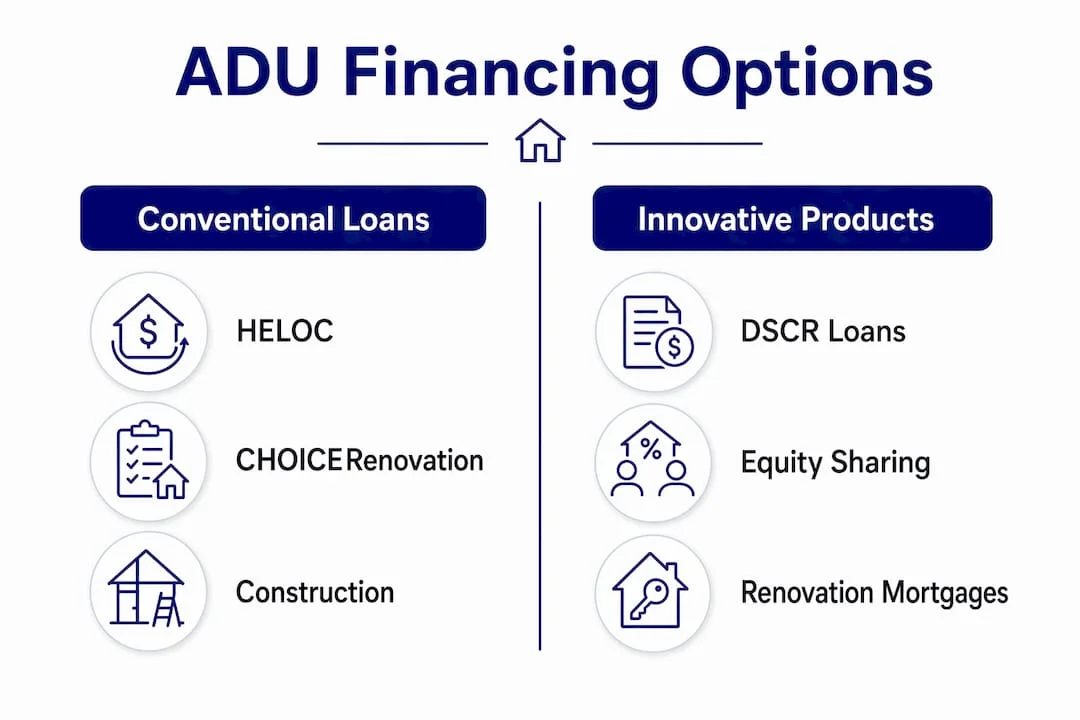
| Loan Type | Best For | Key Feature |
|---|---|---|
| HELOC | ADUs under $180K with existing equity | Flexible draws, interest only on what you use |
| Cash-out refinance | Investors with significant equity | Fixed rate, lump sum, resets primary mortgage |
| Construction-to-permanent loan | Detached new builds, hold-to-rent | One closing, converts to DSCR at stabilization |
| DSCR loan | Refinancing after ADU is leased | Qualifies on property rents, not personal income |
| Freddie Mac CHOICERenovation | Renovation-based ADU conversions | Conventional loan wrapping renovation costs into purchase or refi |
The Freddie Mac CHOICERenovation mortgage deserves specific attention for investors doing garage conversions or interior ADU builds. It wraps renovation costs into a single conventional loan, either at purchase or refinance, with the completed value used for underwriting. That means you can borrow against what the property will be worth after the ADU is finished, not what it’s worth today. For investors converting existing structures, it’s often the cleanest path.
DSCR loans increasingly underwrite ADU projects using combined property income, meaning the ADU’s rent stacks with the main unit’s rent to support the coverage ratio. That same income can support a cash-out refinance to fund your next build, turning one ADU into a repeatable system. Freddie Mac also allows ADU rental income under its standard lending guidelines, which matters when you’re refinancing a stabilized property.
Key financing considerations before you apply:
- Document projected ADU rents with comparable market data, not just estimates
- Ask lenders explicitly whether they factor ADU income into debt-to-income calculations
- Construction loans require plans, permits, and contractor bids upfront
- HELOC approval timelines run 2–4 weeks; construction loans can take 6–8 weeks
- Build a 10–15% cost contingency into the number you underwrite
Pro Tip: Match your financing structure to your exit. If you plan to hold and refinance, a construction-to-permanent loan avoids a second closing. If you want flexibility to sell or restructure, a standalone construction loan keeps your options open.
What zoning and regulatory rules affect ADU feasibility?
Zoning is where many ADU projects stall, but the regulatory environment has improved substantially. Most jurisdictions require a minimum lot size of around 5,000 square feet and specify maximum ADU sizes, setback distances, and parking requirements. Those rules vary by city and county, so confirming local code before you commit capital is non-negotiable.
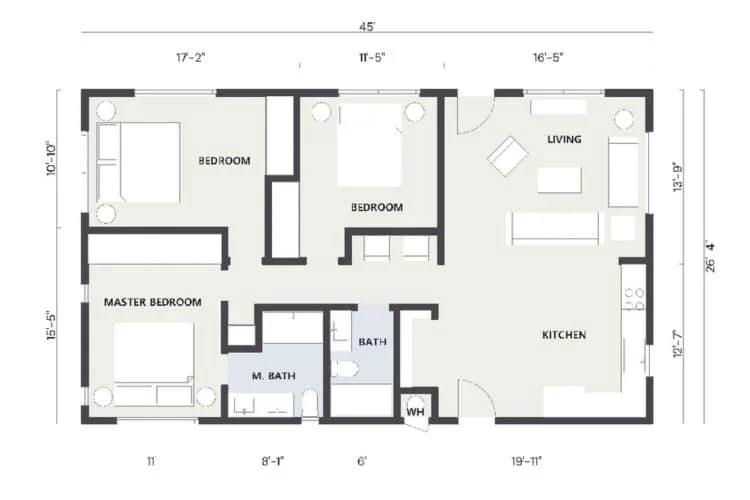
California’s 2026 ADU Ordinance Amendment clarified that a single-family lot with one primary dwelling can potentially add up to four accessory units: a Junior ADU (JADU) up to 500 square feet, a state-exempt interior ADU, a state-exempt detached ADU up to 800 square feet, and one local ADU up to 1,200 square feet. That’s a meaningful expansion of density potential on a single lot.
Key legal and regulatory factors to verify before building:
- Minimum lot size requirements (typically 5,000–6,000 sq ft in most jurisdictions)
- Setback rules: state-exempt detached ADUs in California require 4-foot side and rear setbacks
- Owner-occupancy requirements: California removed most of these effective January 1, 2025
- Parking requirements: many ADU-friendly states have eliminated or reduced these
- HOA restrictions, which can prohibit ADU construction even where local code allows it
- Permit processing timelines, which range from weeks to 12 months depending on jurisdiction
For California ADU market conditions specifically, the combination of state preemption and local ordinance updates has made permitting more predictable than it was five years ago. Other states are following: Oregon, Washington, and a growing list of Sun Belt municipalities have moved to reduce approval friction and eliminate parking mandates.
How do ADU type and construction costs affect your budget?
The three main ADU types carry very different cost profiles, and choosing the right one for each property determines whether the project pencils.
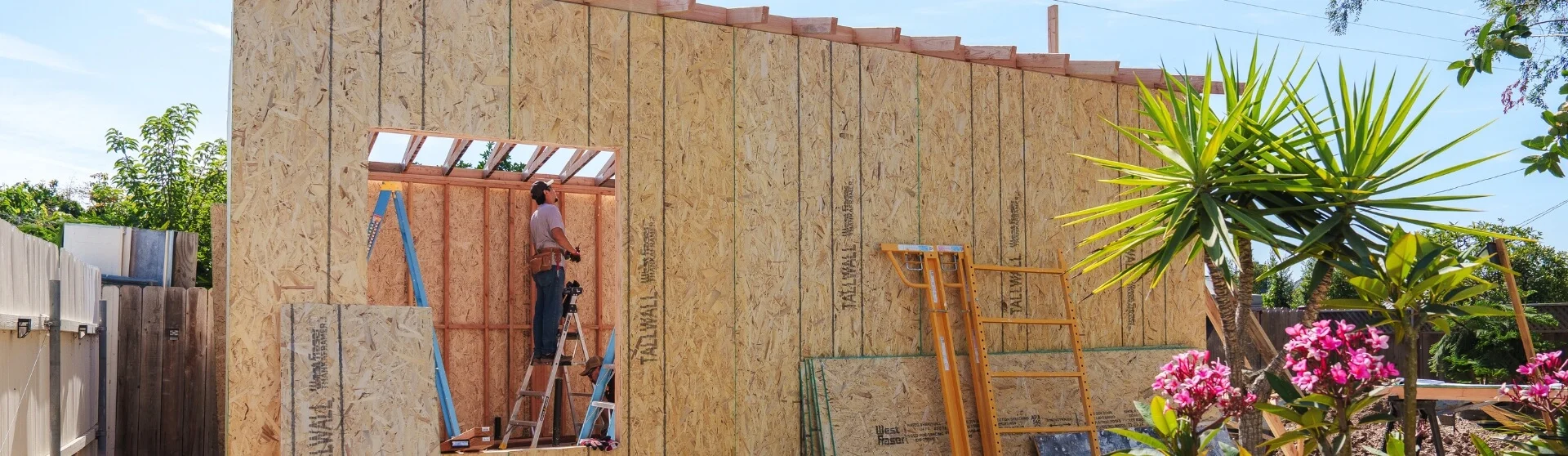
Garage conversions are the cheapest entry point at $60,000–$90,000, with timelines of 3–4 months. You’re working with existing walls, a roof, and often partial utility connections, which cuts both cost and complexity. Interior or basement conversions run $40,000–$70,000 and take 2–4 months. Detached new builds are the most expensive option at $100,000–$180,000 and take 5–8 months, but they also deliver the most rental appeal and the strongest value lift.
Utility upgrades can add $10,000–$25,000 to any ADU project. Existing water, sewer, and electrical service may not support a second unit, and discovering that mid-build is expensive. Verify utility capacity before you commit.
Factors that move costs significantly:
- Site conditions: slope, soil type, and access all affect foundation and grading costs
- Local permit fees, which range from modest to substantial depending on jurisdiction
- Utility connection requirements and distance from existing service points
- Design choices: open floor plans and standard finishes rent well and cost less than custom layouts
- Prefabricated ADUs offer speed advantages but may face additional zoning scrutiny
Pro Tip: For design layouts that maximize rental income, prioritize natural light, separate entrances, and in-unit laundry. Tenants pay a premium for those features, and they’re far cheaper to build in than to retrofit.
The payback period on a well-executed ADU runs 5–8 years from rental income alone, before accounting for the property value increase. In high-cost markets, that math improves considerably.
How to integrate ADUs into a growing investment portfolio
The investors who scale ADU portfolios successfully share one habit: they start with one unit and treat it as a learning project before rolling out across their portfolio. That pilot-first approach lets you refine your contractor selection, permitting process, and design template before you’re managing multiple simultaneous builds.
After the pilot, a pace of 2–3 ADUs per year keeps operations manageable. At that rate, you can add 8 doors to a portfolio of 8 properties over roughly four years without buying a single new property. The capital efficiency of this approach is real: you’re leveraging land you already own, infrastructure already in place, and management relationships already established.
Criteria for identifying which properties in your portfolio are good ADU candidates:
- Lot size of at least 5,000–6,000 sq ft, with room for required setbacks
- Detached garage or underutilized structure that can be converted
- Alley or side-yard access for a separate ADU entrance
- Strong local rental demand and favorable rent-to-construction-cost ratios
- No HOA restrictions prohibiting ADU construction
- Utility capacity sufficient to support a second unit without major upgrades
The long-term wealth play is a stacking strategy: build, stabilize rents, refinance using DSCR underwriting on the combined income, and redeploy the pulled equity into the next build. Each cycle compounds the portfolio’s door count and equity base without requiring new land purchases.
Focus on land value versus structure value when selecting properties. A lot where the land represents a high share of total value, typically an undervalued home on a large lot, gives you the most room to add density and capture the resulting value increase.
How to choose the right design and construction partner
The quality of your contractor determines whether an ADU project comes in on time and on budget. Contractor risk is common in ADU builds because smaller, less complex projects tend to attract less experienced general contractors. Vetting is not optional.
What to look for when evaluating candidates:
- Verified license and insurance, confirmed through your state contractor licensing board
- Demonstrated experience with ADU projects specifically, not just general residential construction
- Knowledge of local permitting requirements and relationships with the relevant building departments
- Capacity to manage small-scale projects without delegating to unvetted subcontractors
- Fixed-price bids with clearly defined scope, not time-and-materials estimates
- References from completed ADU projects you can actually visit or verify
Pro Tip: Ask every contractor candidate to walk you through a recent ADU permit set. If they can’t explain the drawings or don’t know the local setback rules off the top of their head, that’s your answer.
Transparent communication matters as much as technical skill. A partner who flags a problem early, whether it’s a utility conflict or a permit delay, saves you far more than one who stays quiet and lets costs compound. Get a 20% contingency built into your contract, not just your mental budget. ADU budgets are notoriously sensitive to site conditions, and the contractors who tell you otherwise are the ones who will call you with change orders.
Partners who offer integrated design, structural engineering, and construction consulting under one roof reduce coordination risk significantly. When the designer, engineer, and builder are aligned from day one, permit submissions go in cleaner and revisions cost less.
Long-term maintenance and management strategies for ADUs
Managing an ADU within a larger portfolio requires a slightly different approach than managing a standalone rental. Because the ADU shares a lot with the primary unit, maintenance issues on one can affect the other. Establish clear written agreements with tenants on shared spaces, utility responsibilities, and noise expectations before anyone moves in.
Preventive maintenance schedules pay off more on ADUs than on larger units because smaller systems, particularly HVAC, water heaters, and electrical panels, have less redundancy. A failed water heater in a 400-square-foot ADU is a bigger proportional disruption than in a 1,500-square-foot house. Budget 1–2% of construction cost annually for maintenance reserves.
Property management software that handles multiple units per address simplifies rent collection, maintenance tracking, and lease management across a portfolio with ADUs. Many platforms now support multi-unit properties with shared lot addresses. For investors managing more than a handful of ADU-equipped properties, a dedicated property manager familiar with ADU-specific tenant dynamics is worth the fee.
How to analyze rental income potential from an ADU
Rental income analysis for an ADU starts with local Fair Market Rents as a floor, not a ceiling. A well-built ADU with in-unit laundry, a private entrance, and modern finishes typically commands above-market rents relative to comparable apartments, because tenants are paying for privacy and quality rather than just square footage.
Run the yield-on-cost calculation before you commit: divide projected net operating income by all-in construction cost. A $180,000 detached ADU renting for $1,800 per month produces a gross yield-on-cost of around 12% before expenses. That clears the cost of investor debt in most current lending environments and leaves room for vacancy, maintenance, and management fees.
Tenant selection for ADUs benefits from clear screening criteria applied consistently. Because ADU tenants share a lot with the primary unit’s occupants, compatibility matters beyond just creditworthiness. Many investors find that longer-term tenants, particularly those in stable employment or with family connections to the area, reduce turnover and the friction that comes with close-proximity living arrangements.
What are the real risks of ADU investment, and how do you manage them?
ADU investment carries specific risks that don’t show up in standard rental property analysis. Construction cost overruns are the most common: ADU budgets frequently exceed initial estimates by 15–25%. Getting three fixed-price bids and holding a 20% contingency is the standard mitigation.
Permitting timelines are unpredictable. Depending on jurisdiction, permit processing can take anywhere from a few weeks to 12 months. A project that stalls in permitting ties up capital and delays income. Starting the permit process before finalizing contractor selection, and working with a partner who has established relationships with local building departments, reduces that exposure.
Over-improvement is a risk that’s easy to underestimate. Building a $180,000 ADU on a property in a market where ADU rents top out at $900 per month doesn’t work financially. Match the construction investment to the local rent ceiling, and run the yield-on-cost calculation with conservative rent assumptions before you break ground. For a deeper look at common ADU investment pitfalls, California-specific risks are well-documented and instructive even for investors in other markets.
Other risks to plan for:
- HOA restrictions that surface after purchase, blocking permitted builds
- Neighbor resistance that slows permitting even where ADUs are legally allowed
- Utility upgrade costs that weren’t identified in the pre-construction assessment
- Tenant density friction when multiple households share a small lot
What does a successful ADU portfolio expansion actually look like?
The REI Prime example of a Portland investor illustrates the strategy concretely. An investor with 5 single-family rentals on lots ranging from 6,500 to 8,200 square feet builds her first detached ADU for $115,000, financed with a HELOC. The unit rents for $1,350 per month. Net income after additional expenses: $950 per month, producing a cash-on-cash return of 9.9%. She completes one ADU per year over the next three years. By year four, she holds 9 doors on 5 properties, generating $3,800 per month in additional net income from the ADUs alone. Total ADU investment: $440,000. Total additional annual income: $45,600. Estimated portfolio value increase: $600,000.
That trajectory is what the pilot-first, 2–3-per-year pacing strategy produces in practice. The first ADU proves the economics and refines the process. Each subsequent build gets faster and cheaper as the investor develops contractor relationships, permitting familiarity, and design templates that work in their specific market.
The investors who stumble are typically the ones who try to build too many units simultaneously before they’ve worked out the operational details. Managing three concurrent ADU builds with three different contractors, across three different permit jurisdictions, before you’ve completed even one is a reliable path to cost overruns and delays.
Uni Construction brings your ADU portfolio plans from design to permit
Investors adding ADUs to their portfolios face a specific problem: most architectural and construction firms are set up for large projects, not the fast, permit-focused work that ADU builds require. Uni Construction is built for exactly this. Based in Los Angeles with deep experience across Southern California, Uni Construction handles custom ADU design, permit-ready drawings, structural engineering, and construction consulting as an integrated package, so you’re not coordinating between a designer, an engineer, and a contractor who’ve never worked together.
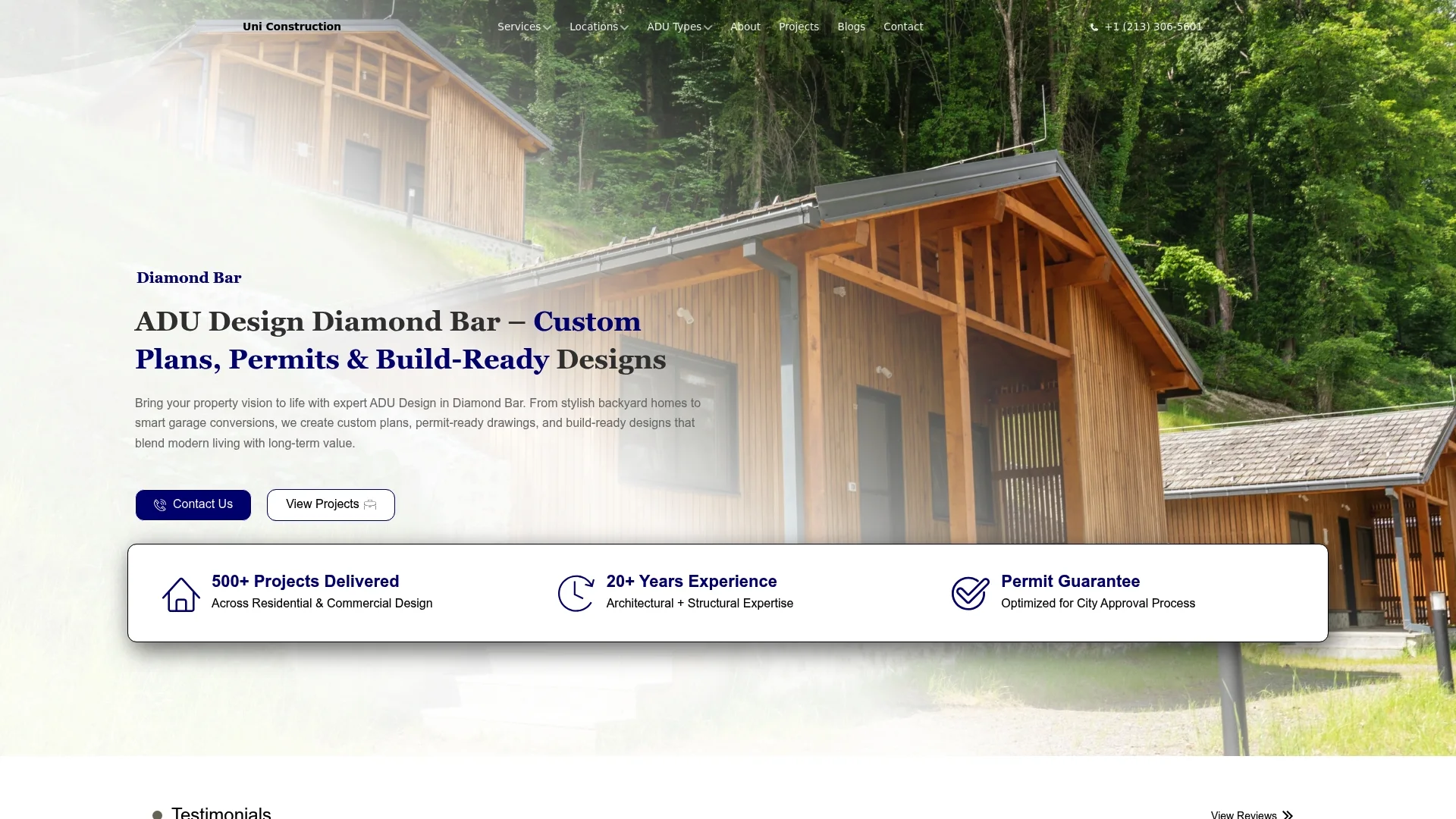
For investors targeting ADU projects in Los Angeles and the surrounding region, Uni Construction’s permit expertise and local regulatory knowledge cut the timeline between design and approved permit significantly. The team works across garage conversions, detached new builds, and interior conversions, with completed projects you can review before committing. If you’re ready to add doors to your portfolio without the coordination overhead of assembling your own project team, contact Uni Construction to discuss your property and get a project assessment.
Key Takeaways
ADU property portfolio expansion is the most capital-efficient way to grow rental door count in markets with supportive zoning, using existing land, infrastructure, and management relationships to add income without new acquisitions.
| Point | Details |
|---|---|
| Capital efficiency | Building ADUs on existing lots avoids land acquisition costs and leverages infrastructure already in place. |
| Value and income lift | Each ADU typically increases property value by 20–35% and can add $900–$1,200 per month in rental income per unit. |
| Financing options | DSCR loans, HELOCs, construction-to-permanent loans, and the Freddie Mac CHOICERenovation mortgage all support ADU builds. |
| Scale with discipline | A pilot-first approach followed by 2–3 ADUs per year prevents operational overload and refines the build process. |
| Uni Construction for Los Angeles investors | Uni Construction provides integrated design, permitting, and construction consulting for ADU portfolio expansion in Southern California. |