

Choosing the company that will build your ADU is one of the biggest decisions you will make during the project.
A good builder does more than put up walls. They need to understand your property, coordinate design and permits, identify utility problems early, price the work clearly, manage trades, and guide construction through inspections.
That is why homeowners trying to choose an ADU builder in Los Angeles should compare much more than the final price.
Quick Answer: What Should You Look for in an ADU Builder?
A good Los Angeles ADU builder should have an appropriate active California contractor license, relevant ADU experience, clear insurance information, local permitting knowledge, a detailed written scope, realistic project stages, and a transparent process for changes and payments.
They should also evaluate the property before making firm promises. Access, electrical capacity, sewer connections, existing structures, and other site conditions can affect both design and construction.
Project-Guided by the Uni Construction Team
Trusted ADU and construction guidance can turn confusing design, permitting, utility, and building requirements into clearer next steps.
The goal is to help homeowners, property investors, and business owners identify project risks early, avoid expensive planning mistakes, and make informed decisions before starting an ADU, remodel, addition, or construction project.
What to Check Before You Choose an ADU Builder in Los Angeles
At a glance, check these nine things:
- California contractor license and insurance.
- Real ADU experience in the Los Angeles area.
- Property-specific feasibility review.
- Responsibility for design, engineering, and permits.
- Electrical and utility planning.
- Detailed and comparable construction proposals.
- Clear contract and payment terms.
- Communication and project-management process.
- Warning signs such as pressure, vague pricing, or missing documentation.
A polished website can be useful, but it should never replace this due diligence.
1. Verify the Builder’s California License and Insurance
Start with facts you can verify.
Ask the contractor for their license number and check the current status through the California Contractors State License Board. You should understand who is actually contracting for the construction and whether the license information matches the company you are dealing with.
Also ask about applicable insurance coverage and who will be performing the work.
California CSLB guidance recommends checking contractor licensing and obtaining local references before entering a home-improvement contract.
Do this yourself rather than relying only on a license number printed on a proposal.
2. Look for Real Los Angeles ADU Experience
General construction experience matters, but ADUs create their own coordination issues.
A builder may be excellent at kitchens or bathrooms and still have limited experience managing an accessory dwelling unit from early planning through permits, utilities, construction, inspections, and closeout.
Ask for comparable completed ADUs
Ask:
- How many ADUs have you worked on?
- Can I see projects similar to mine?
- Have you completed detached ADUs?
- What about garage conversions?
- Have you worked with lots similar to my property?
- Can you provide recent references?
The goal is not simply to find the company with the biggest project count. You want evidence that its experience resembles the work you plan to build.
Confirm local permitting experience
Los Angeles-area addresses may fall under different permitting jurisdictions. That matters because review procedures and local requirements can vary.
A builder should identify the correct jurisdiction before presenting the permit process as certain.
When homeowners are still planning the layout and project scope, professional ADU design in Los Angeles should connect the design to property conditions, construction realities, and the applicable approval path.
3. Make Sure the Builder Reviews Your Property Before Pricing It
Be careful with a builder who gives you a confident construction number after hearing only the proposed square footage.
Two ADUs of the same size can involve very different work.
Site access and lot conditions
A useful early review may consider:
- Where the ADU can sit.
- Access to the backyard.
- Slope.
- Existing hardscape.
- Fences or gates.
- Trees.
- Demolition.
- Construction staging.
- Drainage.
- Existing structures.
Limited access, for example, can change how materials and equipment reach the work area.
Garage conditions and utility routes
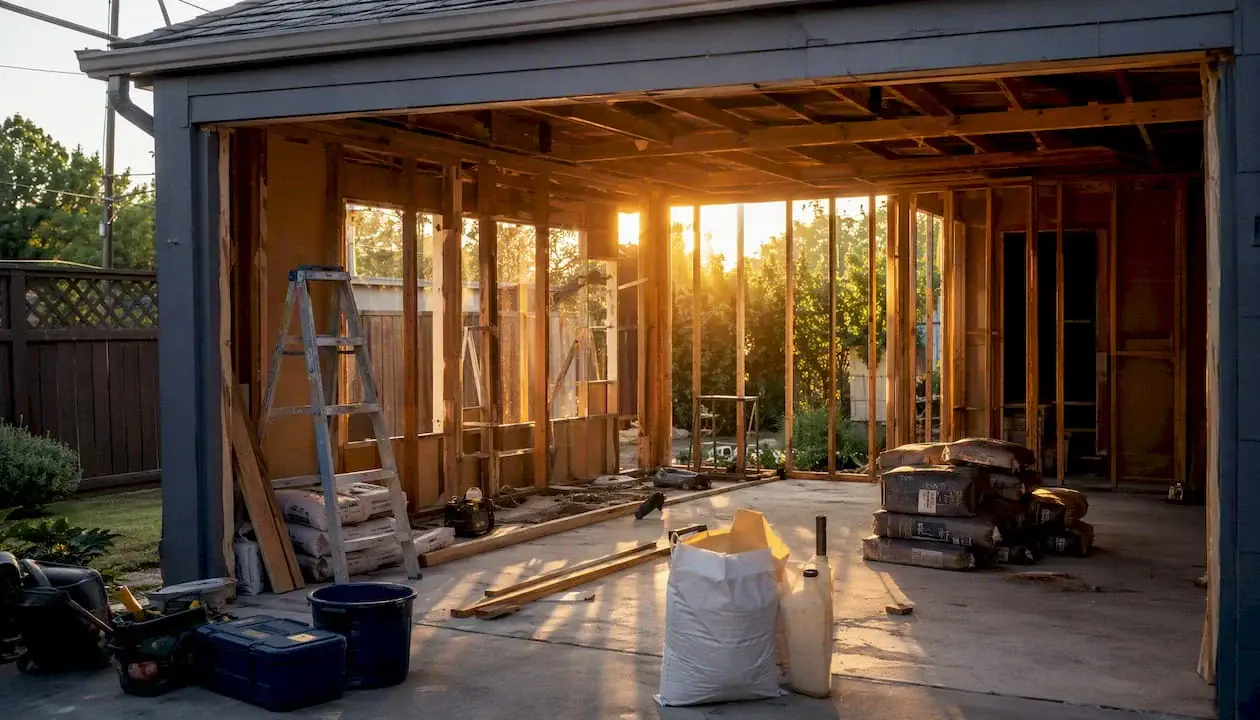
For a garage conversion, existing conditions deserve extra attention.
The builder may need to understand the existing slab, framing, roof, moisture conditions, ceiling height, utilities, and available records before assuming that conversion will be simple.
The same principle applies to a new detached ADU. Sewer, water, electrical, drainage, and other utility routes can affect cost and construction planning.
Strong competitor pages increasingly bring this feasibility work forward instead of treating it as something to discover after the plans are finished.
4. Understand Who Handles ADU Design and Permits
One of the most important questions is simple:
Who is responsible for getting the project from your idea to buildable plans?
The answer may involve a designer, architect, engineer, energy consultant, contractor, permit coordinator, or several of them.
Design-build versus separate teams
Neither model is automatically right for every homeowner.
A separate design team can work well when responsibilities and budget coordination are clear. A design-build arrangement may simplify communication because design and construction decisions can be reviewed together.
The important issue is accountability.
Before signing, identify:
- Who prepares the plans?
- Who coordinates structural engineering?
- Who handles required supporting documents?
- Who submits for permits?
- Who communicates with the reviewing jurisdiction?
- Who updates drawings if corrections are required?
- Who confirms that the approved design matches the construction proposal?
If your project needs more detailed architectural planning, an ADU architect in Los Angeles can help develop property-specific plans and coordinate the documents required before construction.
Who handles plan-check corrections?
Permit submission is not always the end of the design process.
A reviewing agency may return comments that require responses or plan revisions. Therefore, ask whether responding to plan-check corrections is part of the agreed design scope.
Do not assume it is included.
5. Ask About Electrical Capacity Before Design Is Finalized
Electrical planning deserves attention early, particularly when the existing house already has electrical problems.
An ADU can add loads from:
- Lighting.
- Receptacles.
- HVAC.
- Cooking equipment.
- Water heating.
- Laundry appliances.
- Other electrical equipment.
Depending on the existing system and the proposed ADU, the project team may need to evaluate the main panel, available capacity, circuits, routing, a possible subpanel, or potential service changes.
New Dawn’s Los Angeles ADU guidance is a good example of why electrical capacity should be considered during early feasibility rather than ignored until construction.
Existing electrical problems deserve extra attention
If your home already has breakers that trip frequently, an aging panel, known wiring problems, previous unpermitted electrical work, or another unresolved issue, mention it before the ADU design is finalized.
Do not assume the ADU contractor’s quoted price automatically includes correcting unrelated problems in the main house.
Instead, ask:
- What electrical work is included?
- What assumptions does the proposal make about the existing service?
- Who evaluates required electrical capacity?
- Is a panel or service upgrade included?
- What happens if additional work is discovered?
Clear answers now can prevent arguments later.
6. Compare ADU Quotes by Scope, Not Just Price
Three proposals with three different totals may not actually be pricing the same project.
One company may include engineering, utility trenching, fixtures, permit coordination, and site restoration. Another may exclude some or all of them.
That makes the cheapest number difficult to judge.
What should be included?
Ask each builder to identify the assumptions behind:
- Design.
- Engineering.
- Permit preparation.
- Permit fees.
- Site preparation.
- Foundation.
- Framing.
- Roofing.
- Windows and doors.
- Electrical.
- Plumbing.
- HVAC.
- Utility connections.
- Interior finishes.
- Appliances where applicable.
- Exterior finishes.
- Inspections.
- Cleanup.
- Site restoration.
The exact list will depend on your project.
The important thing is that you can see what you are buying.
Watch allowances and exclusions
An allowance is not necessarily a problem. However, you need to know which items remain allowances and what happens if your final selection costs more.
Exclusions matter just as much.
If sewer work, electrical upgrades, retaining work, landscaping restoration, permit fees, or another major item is excluded, the lower proposal may eventually cost more.
A detailed proposal from an experienced ADU builder in Los Angeles should make the construction scope, assumptions, and responsibilities easier to compare before work begins.
A simple way to compare builders
| What to Compare | Stronger Sign | Warning Sign |
|---|---|---|
| License | Easy to verify | Avoids giving details |
| ADU experience | Comparable completed projects | Mostly unrelated remodeling work |
| Property review | Site and utilities discussed | Quotes only by square footage |
| Permitting | Responsibilities are clear | “We will deal with it later” |
| Proposal | Detailed inclusions and exclusions | One vague total |
| Electrical | Capacity and routing discussed | Existing service ignored |
| Changes | Written process | Verbal agreements |
| Communication | Named contact and update process | Unclear responsibility |
| Timeline | Explained by phase | Unrealistic single completion promise |
7. Read the Construction Contract Carefully
Never treat the contract as paperwork you can review after deciding which builder you like.
It is part of the decision.
A clear contract should identify the parties, project scope, price, payment terms, responsibilities, important project dates, and how changes will be handled.
CSLB guidance says home-improvement contracts should include a written payment schedule, permit responsibility, project completion information, and written change orders when the price or scope changes.
Payment schedule
California currently places limits on down payments for residential ADU/home-improvement work. CSLB states that the down payment generally cannot exceed $1,000 or 10% of the contract price, whichever is less, while later payments cannot exceed the value of work performed or materials delivered. CSLB also describes a rare exception involving an approved blanket performance and payment bond.
Because laws and contract rules can change, confirm current requirements directly with CSLB before signing.
Change orders and additional work
Construction can reveal conditions that were not visible during initial planning.
That does not mean every surprise should lead to an unexplained invoice.
Ask how change orders are:
- Identified.
- Priced.
- Presented.
- Approved.
- Added to the project schedule.
CSLB advises that changes to price or scope should be documented through written change orders.
8. Evaluate Communication and Project Management
A technically capable builder can still create a difficult project if communication is poor.
Before you hire anyone, find out:
- Who is your main contact?
- Who is the project manager?
- How often are updates provided?
- How are decisions documented?
- How are schedule changes communicated?
- Who coordinates subcontractors?
- Who schedules inspections?
- Who handles questions from the designer or engineer?
Pay attention during the sales process.
If simple questions already require repeated follow-ups, that may tell you something about what communication will feel like during construction.
9. Watch for ADU Contractor Red Flags
One warning sign may simply require another question. Several warning signs together deserve more caution.
Be careful when a builder:
- Pushes you to sign immediately.
- Will not provide licensing information.
- Cannot show relevant ADU work.
- Refuses to provide references.
- Gives a firm price without understanding the property.
- Provides a vague scope.
- Leaves major utility work undefined.
- Ignores electrical capacity.
- Cannot explain who manages permits.
- Uses unrealistic permit or construction promises.
- Requests payments that appear inconsistent with California requirements.
- Depends heavily on verbal promises.
- Cannot explain the change-order process.
- Offers a dramatically cheaper price without explaining why.
The goal is not to find a builder who promises that nothing will ever go wrong.
Construction rarely works that way.
Look instead for a team that identifies risk early, explains what is known, separates assumptions from confirmed conditions, and documents how unexpected work will be handled.
Questions to Ask Every ADU Builder
Bring the same questions to every consultation.
- What California contractor license will cover my project?
- Can you show me recent ADUs similar to mine?
- Have you worked in my permitting jurisdiction?
- What property feasibility work happens before design is finalized?
- Who prepares the architectural and engineering documents?
- Who handles permit submission and corrections?
- What electrical and utility assumptions are included?
- What is excluded from the proposal?
- Which items are allowances?
- How are change orders approved?
- Who will manage my project day to day?
- How will progress be communicated?
- Can I speak with recent clients?
- What could realistically change the price or schedule?
- What happens between final inspection and project closeout?
Specific answers are usually more useful than polished sales answers.
How Many ADU Builders Should You Compare?
For many homeowners, comparing around three qualified builders gives enough information to spot major differences without turning the process into endless bidding.
However, compare them using the same project assumptions.
If one builder is pricing a basic structure while another includes engineering, extensive utility work, upgraded finishes, and site restoration, the numbers are not directly comparable.
Your goal is not to collect the greatest number of estimates.
Your goal is to understand what each estimate actually includes.
Frequently Asked Questions
Ask for the contractor’s license number and verify its current status through the California Contractors State License Board. CSLB also recommends checking references and reviewing contract terms before hiring a contractor.
Look at relevant experience rather than the job title alone. A qualified general contractor with substantial ADU experience may be a strong candidate. Ask for comparable completed projects and evidence that the team understands design, utilities, permitting, inspections, and ADU construction.
Some builders provide full design-build and permitting coordination, while other homeowners hire designers or permit professionals separately. What matters is that responsibility is clearly assigned before the project begins.
It should clearly define the priced scope and identify important assumptions, exclusions, allowances, utility work, finishes, permit responsibilities, and other project-specific costs. You should be able to compare competing proposals on the same basis.
Tell the project team before the ADU plans are finalized. Existing panel limitations, wiring problems, or other electrical conditions may affect the scope. Ask what will be evaluated and which upgrades, if any, are included in the proposal.
Not automatically.
First determine why the price is lower. A genuinely efficient builder may offer a competitive proposal, but a low price can also result from missing scope, lower allowances, excluded utility work, or different material assumptions.
Compare scope before total price.
Get Clear About Your ADU Before You Sign
The best time to uncover an ADU problem is before construction begins.
Check licensing. Review comparable work. Understand the property. Ask about electrical and utility capacity. Confirm who is responsible for design and permits. Compare written scopes. Read the contract carefully.
Most importantly, choose a builder who is willing to explain the project rather than simply sell it.
If your property has unusual access, an existing garage, electrical concerns, utility questions, unfinished plans, or a scope that is difficult to price, a professional project review can help turn those unknowns into clearer decisions before you commit to construction.