

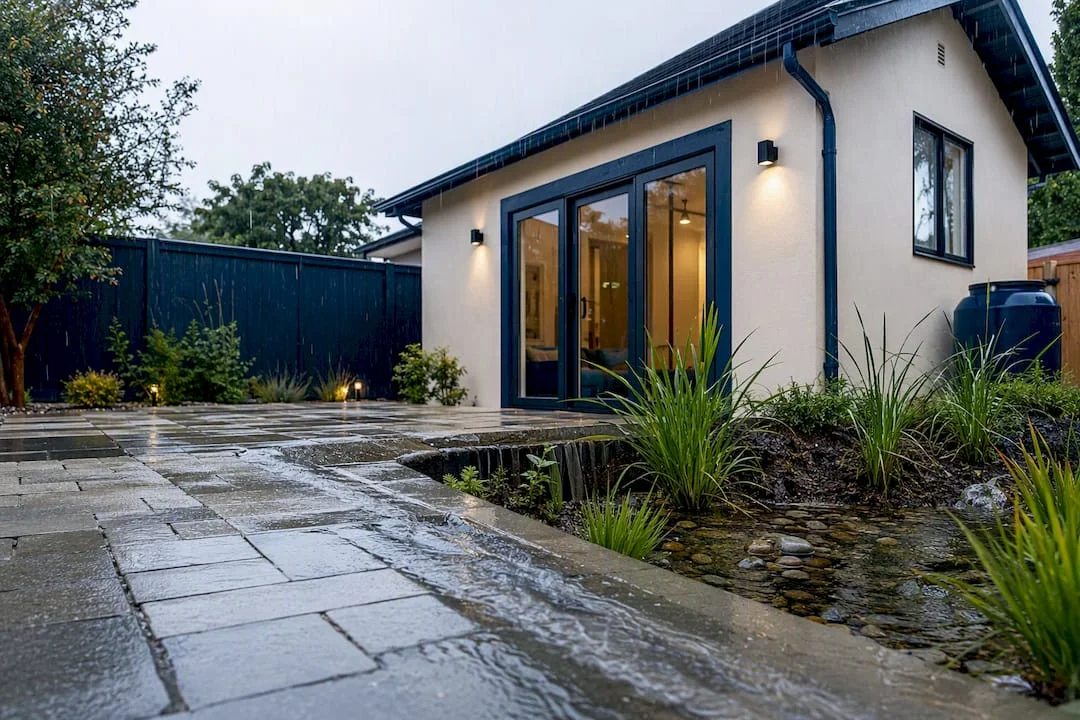
Yes, most Los Angeles ADU projects trigger a Low Impact Development review, and it runs on a separate track from your building permit. Start by opening a Customer Service Request through LASAN’s LID Plan Check portal or confirming applicability directly with the Watershed Protection Division. LADBS will flag the LID requirement on your Clearance Summary Worksheet, but LASAN issues the actual clearance, and Uni Construction routinely coordinates that handoff for clients so it doesn’t stall the final inspection.
TL;DR:
- More ADU projects in Los Angeles trigger LID review than many homeowners realize, especially if impervious surface increases even slightly.
- LID clearance depends on stormwater capacity and site features, requiring specific mitigation measures like permeable paving or rain gardens, not engineering solutions.
- LASAN must issue final clearance via the LID Certificate of Occupancy before LADBS signs off on your final permit and Certificate of Occupancy.
- Submitting accurate impervious surface calculations early and in detail can prevent delays of two to three weeks in the permitting process.
- Uni Construction manages the coordination between LADBS and LASAN to streamline LID clearance and permit approval, minimizing project delays.
What LID Means for a Los Angeles ADU
Low Impact Development is the city’s stormwater standard for keeping runoff and pollutants out of the storm drain system, and Los Angeles has tightened it through ordinances in 2011, 2015, and again in 2024. LADBS and LASAN treat it as its own review lane, separate from structural and electrical plan checks, because it deals with drainage and site grading rather than the building itself.
That distinction matters for design. Adding a detached ADU usually means new roof area, new hardscape, or a new driveway extension, and each of those increases the impervious surface on your lot. LASAN wants to know where that extra water goes before it approves the project.
Homeowners typically get asked to include one or more of these:
- A permeable paving section instead of solid concrete for a new patio or parking pad
- A small bioretention area or rain garden tied to a downspout
- Roof drainage routed to a landscaped area instead of straight to the street
When LID Plan Check and Clearance Actually Apply
Not every ADU triggers a full LID submittal, but more projects qualify than homeowners expect. The county’s own guidance on impervious surface calculations makes clear that even modest additions to hardscape can cross a review threshold.
Common triggers include:
- Any net increase in impervious area from a new detached ADU, driveway, or patio
- Redevelopment of a lot that disturbs a set percentage of existing surface
- Garage conversions that add new pavement or relocate parking elsewhere on the lot
Here’s the part that surprises people: a “no new roof” garage conversion can still get flagged if it shifts parking onto a new concrete pad. The only reliable way to know is to check with LADBS at plan check or call LASAN directly before you finalize your site plan. Guessing wrong here costs weeks, not days.
How LID Fits Into the LADBS Permit and C of O Process
LID clearance shows up in two different places in your paperwork, and mixing them up is the single biggest source of delay Uni Construction sees on ADU jobs.
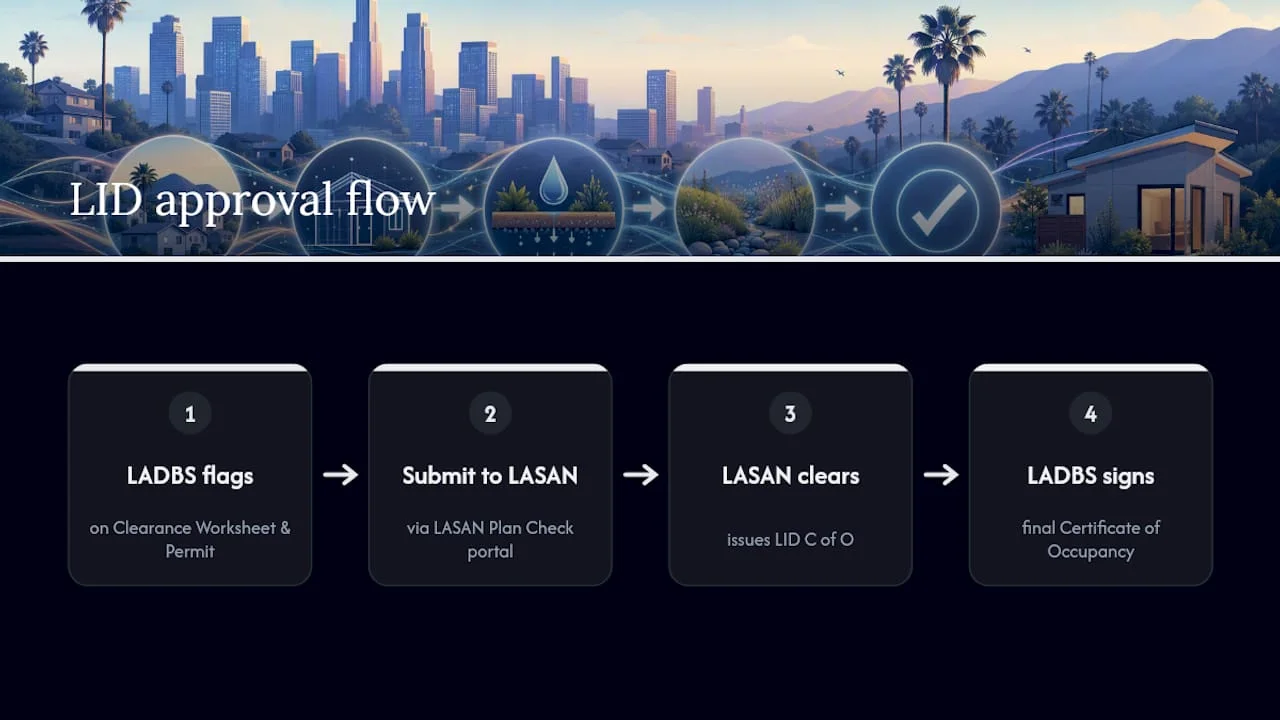
At plan check, LADBS lists LID as a required clearance on the Clearance Summary Worksheet and later on the Permit & Inspection Report. That’s simply LADBS flagging that the item exists. It does not mean LADBS has cleared it.
The actual clearance comes from LASAN, not LADBS. LADBS will not sign off on your final Certificate of Occupancy until LASAN has issued its own LID C of O clearance, confirmed through the LID Plan Check Submittal portal. Homeowners who submit their LASAN request late, after framing is already up, are the ones who end up sitting on a finished ADU with no C of O. Submit early, and this becomes a formality rather than a bottleneck.
Step-By-Step: Getting LID Plan Check and C of O Clearance
Follow this order and you’ll avoid most of the back-and-forth that stretches ADU timelines:
- Get your LADBS plan check started first. If LID applies, it appears on your Clearance Summary Worksheet almost immediately.
- Open a LASAN Customer Service Request specifying “LID Plan Check” as the service, and attach your site plan and an impervious area calculation table.
- Include mitigation details up front, spot elevations, and note whether your project qualifies as small scale or large scale, since that distinction affects how much analysis LASAN wants to see.
- Book your LASAN appointment through appointments.lacity.org, selecting LASAN and then the LID service. The older LID portal stopped accepting new applications after April 6, 2026, so the CSR workflow is now the only path in.
- After plan check clearance, build to the approved mitigation, then file a second LASAN CSR requesting the LID C of O clearance once construction is complete, tying it to your final LADBS inspection.
Pro Tip: Submit your impervious area table with exact square footage, not rounded estimates. LASAN reviewers send back vague submissions almost every time, and that round trip alone can add two to three weeks.
Our ADU feasibility checklist for Los Angeles walks through the same site triggers before you ever get to plan check.
Mitigation Options That Actually Pass Review
Most small ADU projects don’t need an engineered stormwater system. They need one or two of the standard measures LASAN reviewers see constantly:
- Permeable pavers for driveways or patios, which let water pass through instead of running off
- Rain gardens or bioretention beds planted in a low spot that catches roof runoff
- Downspout dispersion, simply directing gutters onto landscaped soil instead of pavement
- Infiltration beds, gravel-filled trenches under a lawn area that hold and slowly release water
- Vegetated swales, shallow planted channels that carry water toward a permeable area
A full hydrologic analysis or engineered solution generally only comes into play on steep slopes, poor-draining clay soils, or lots close to the public right of way. For a typical flat lot behind a single-family home, the five measures above usually cover it. Full detached ADU builds tend to need more of them combined; a simple garage conversion often gets by with just downspout dispersion and a permeable pad.
Standard ADU Plans Still Face Site-Specific LID Review
LA County’s Standard ADU Plans Program exists to cut architectural review time by offering pre-approved floor plans. It’s a real time-saver on the design side, but it does not touch drainage.
Your lot’s slope, soil, and existing impervious area are unique to your property, so LID review, structural verification, and utility connections still happen on a site-specific basis even with a pre-approved plan. Homeowners going this route should submit their impervious area documentation and confirm utility hookups just as they would with a custom design. If your lot has any drainage complications, slope, a low spot, proximity to a storm drain, a custom plan built around your site from the start often creates less LID friction than retrofitting mitigation onto a generic layout.
Watch These Regulatory Interactions Before You Break Ground
A few overlapping rules can change what your ADU is allowed to look like or how it’s classified once it’s built.
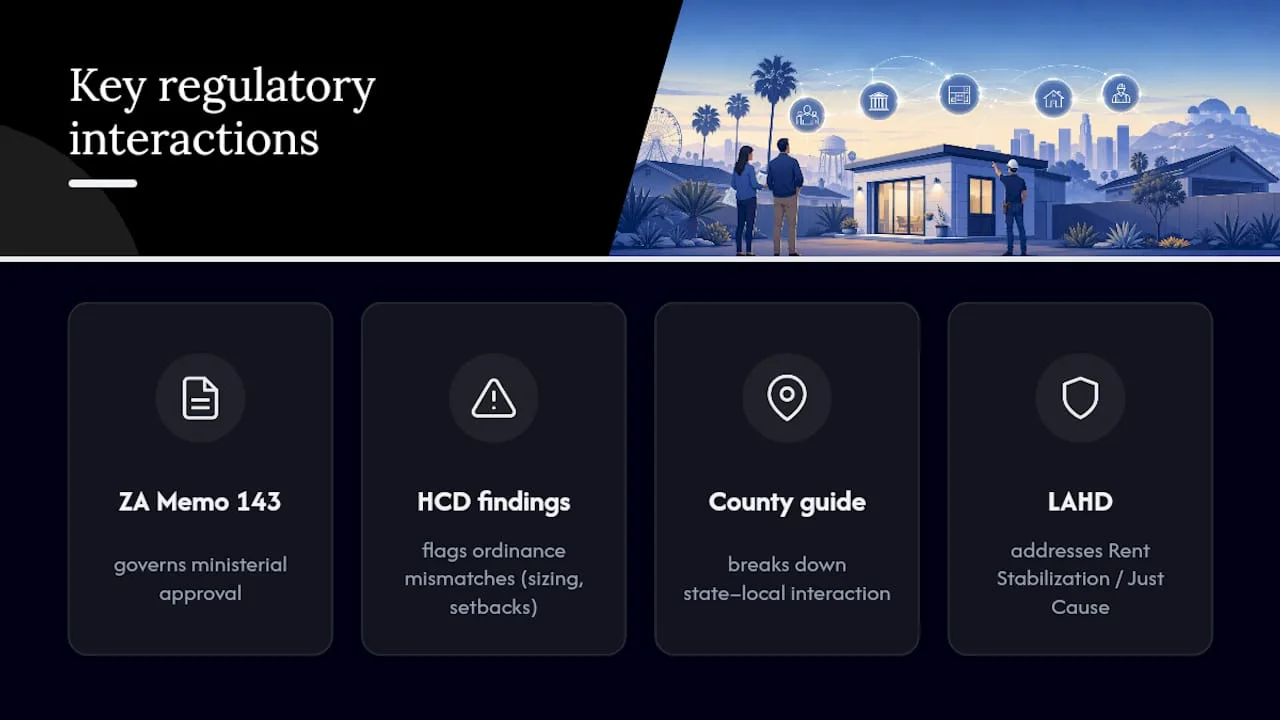
ZA Memo 143 walks through how state ADU law updates get folded into local development standards, and it’s the document that governs which projects qualify for ministerial (no-hearing) approval. Layered on top of that, HCD’s findings letter points out places where the city’s ordinance doesn’t fully match state law, including sizing and setback allowances under Government Code § 66323. Our guide to LA County ADU development regulations breaks down how those state and local layers interact in practice.
Adding an ADU can also shift a property’s status under the Rent Stabilization Ordinance or Just Cause Ordinance, something LAHD addresses directly. If you rent out any unit on the parcel now or plan to, check with LAHD before you finalize your permit application, not after.
Uni Construction’s Practical Advice on Permitting ADUs in LA
Most LID-related delays trace back to one thing: an incomplete impervious calculation submitted too late in the process. Uni Construction resolves this by running the LASAN CSR in parallel with LADBS plan check rather than waiting for LADBS to flag it first.
Every permit-ready package we prepare includes a full impervious calculation table, detailed mitigation notes matched to the site’s soil and slope, and direct coordination with LASAN reviewers. If you’re not sure whether your lot triggers LID review, a feasibility check before you draw anything up saves real time later.
, Uni Construction
How Uni Construction Handles LID and ADU Permits for You
Coordinating LADBS plan check, a LASAN CSR, and a Certificate of Occupancy across two agencies is exactly the kind of paperwork gap where ADU projects lose months. Uni Construction handles that coordination as part of its design and permit service, not as an add-on you have to chase down yourself.
Our packages include custom ADU design, permit-ready drawings, structural engineering, and direct liaison with both LADBS and LASAN on your behalf, so the impervious calculations and mitigation notes are built into your plans from day one instead of getting bounced back mid-review. If you’re weighing a detached unit, a garage conversion, or a junior ADU, start with a feasibility review through our Los Angeles ADU page to see exactly what your lot will need before you commit to a design.
Where to Go for Official Guidance
Bookmark the LASAN LID Plan Check portal for CSR submissions, LADBS’s ADU page for the Clearance Summary Worksheet, and the county’s Standard ADU Plans Program if you’re considering a pre-approved layout. For zoning questions that intersect with site drainage, our Los Angeles ADU zoning guide and Upright Construction’s permit processing resource are both worth a look.